The Canadian leader also said the US-Israeli attacks on Iran appear to be “inconsistent with international law.”

Published March 5, 2026
Canadian Prime Minister Mark Carney said he could not rule out his country’s military involvement in the escalating war in the Middle East, having previously said the US and Israeli attacks on Iran were “inconsistent with international law”.
Speaking alongside Australian Prime Minister Anthony Albanese in Canberra on Thursday, Carney was asked if there was a situation in which Canada would become involved.
Recommended stories
list of 4 itemsend of list
“You can never categorically rule out participation,” Carney said, noting that the question was “hypothetical.”
“We will stand with our allies,” he said, adding that “we will always stand up for Canadians.”
Carney previously said he supported the attacks on Iran “with some regret” as they represented an extreme example of the breakdown of world order.
The Canadian prime minister also stressed that his country was not informed in advance of the US-Israeli attack on Iran, in his first remarks since the war began on Saturday.
“We were not informed in advance, we were not asked to participate,” Carney told reporters traveling with him to Australia on Wednesday.
“First facie, it appears that these actions are incompatible with international law,” he said.
“The United States and Israel have acted without engaging with the United Nations or consulting with their allies, including Canada,” he added, according to Australian newspaper SBS News, while condemning attacks on civilians in Iran and calling for “all parties… to respect the rules of international engagement.”
Whether the US and Israeli attacks on Iran had violated international law was “a judgment for others to make,” he added.
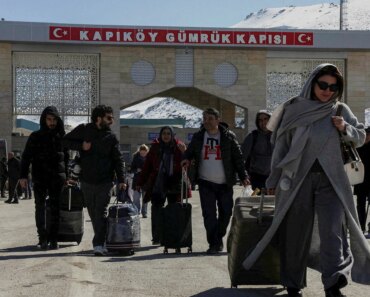
Canadian Foreign Affairs Minister Anita Anand said Wednesday that efforts were underway to help more than 2,000 Canadians who have requested government assistance leave the Middle East region since war broke out on Saturday.
Anand said about half of all requests for help came from Canadians in the United Arab Emirates, more than 230 from Qatar, at least 160 from Lebanon, more than 90 from Israel and 74 from Iran.
Canada’s Foreign Affairs Ministry has been instructed to arrange charter flights from the United Arab Emirates in the coming days, pending approval from the UAE government to use its airspace, the minister said.
Commercial air traffic remains largely absent in much of the region, and major Gulf hubs – including Dubai, the world’s busiest airport for international passengers – are largely closed amid the conflict, in the biggest disruption to travel since the COVID pandemic.
Repatriation flights chartered by foreign governments, including Britain and France, were due to depart on Wednesday and Thursday, while the United Arab Emirates opened safe air corridors to allow some citizens to return home.
Under normal circumstances, thousands of commercial flights would leave the region each day.