Blockstream Research says it has deployed post-quantum signature verification in Liquid and describes what it sees as the first time real transactions on a Bitcoin production chain have been signed with a post-quantum scheme. For the Bitcoin infrastructure, it is less about the immediate emergency than about proving that quantum-resistant devices can be tested in live conditions before a crisis forces the issue.
The announcement focuses on Simplicity, Blockstream’s smart contract language for Liquid. Instead of waiting for consensus to be developed across the network, the team used Simplicity to create a custom spending condition that allows users to lock assets into a contract that requires a post-quantum signature for redemption. In practice, this means that Liquid users can choose to hedge LBTC and other issued assets, including stablecoins and securities, without changing Liquid’s core consensus rules.
How Blockstream is dealing with Bitcoin’s quantum threat
Blockstream touted it as a key breakthrough. “The traditional approach to adding post-quantum signatures requires consensus changes across the entire network – a slow and careful process involving all stakeholders,” the research note says. “But Simplicity, Blockstream’s smart contract language on Liquid, offers another way.”
The validator is based on SHRINCS, a compact hash-based design that Blockstream Research says it developed specifically for the blockchain environment. The system includes a state mode designed for normal use that generates smaller signatures, and a stateless mode designed for recovery scenarios so users can access funds even if they lose state. This two-pronged design speaks to the practical challenges of post-quantum cryptography: theoretical security is not enough if the system is difficult to handle in real-world wallets.
Just as important, Blockstream says, this is not a lab simulation. The team broadcast two live transactions on the Liquid mainnet, one using stateless mode and the other using stateless fallback. These transactions provided real value, and Blockstream said this approach works not only for Bitcoin in Liquid, but for all assets issued on the network.
A symbolic detail is also highlighted in the note. Since Liquid requires the transaction size to scale with the computing budget, the team needs to fill the excess space in post-quantum transactions. “Instead of filling these transactions with zeros, Blockstream has filled the extra space with Bitcoin’s white paper — a nod to the cypherpunk roots of this work.”
However, the company was careful not to oversell what it shipped. “This checker is completely quantum impervious to liquid,” the post reads. “Several important components remain classically secure,” including bitcoin, the commitment of secret assets, and the Liquid blockchain consensus protocol. In other words, it is a first building block, not a complete answer to the threat of the quantum future.
This distinction is important for how the evolution should be read. The research note repeatedly points out that cryptographically compatible quantum computers do not exist today and may not arrive for years or decades. But it argues that it is a mistake to wait until such machines are near, especially for systems like Bitcoin, where security assumptions are strongly tied to classic ECDSA and Schnorr signatures.
“What we’ve done at Liquid – building, testing and implementing post-quantum solutions in production systems – is that we’re preparing Bitcoin’s infrastructure for the future,” Blockstream said. This may be the clearest path here: not that Bitcoin has solved the quantum problem, but that it begins a reliable path from theory to production experiments.
At press time, BTC was trading at $71,130.
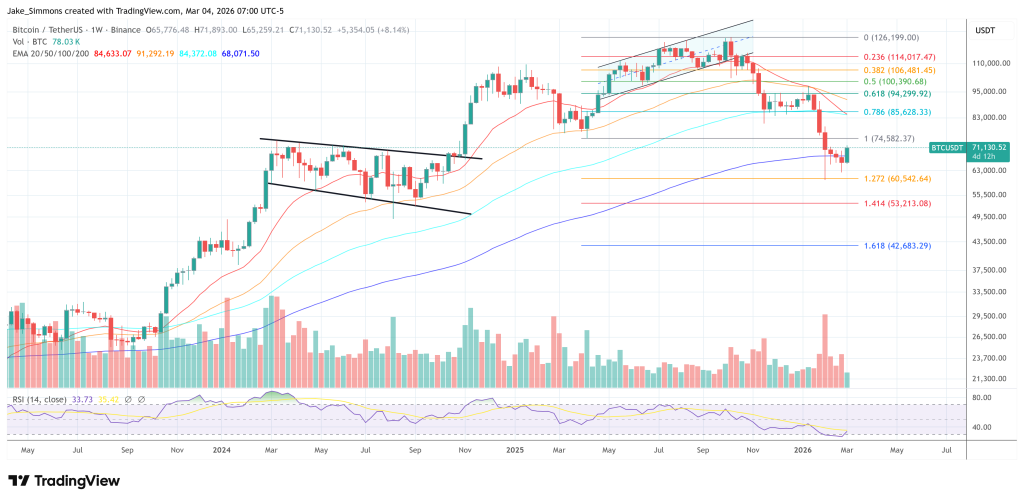
Featured image created with DALL.E, chart from TradingView.com
Editing process because bitcoinist is committed to delivering thoroughly researched, accurate and unbiased content. We adhere to strict sourcing standards and every page is rigorously reviewed by a team of top technology experts and experienced editors. This process ensures the integrity, relevance and value of our content to our readers.