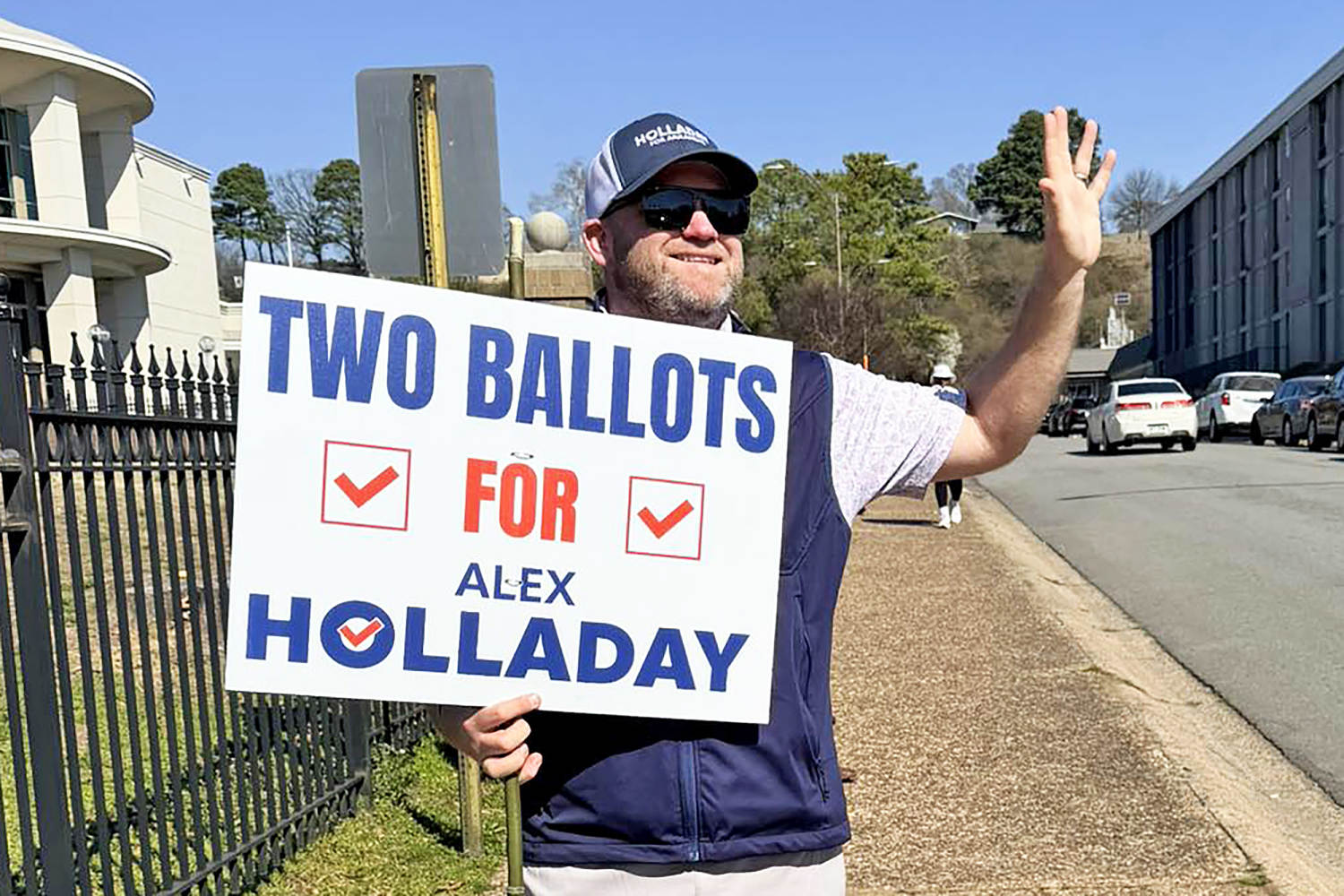
Democrat Alex Holladay prevailed in a special election Tuesday for a state legislative seat in Arkansas, marking the ninth time since President Donald Trump took office last year that the party has flipped control of a state legislative seat in a special election.
In that same time, Republicans have not toppled a single Democratic-held state legislative seat.
Holladay, a health care administrator, defeated Republican businessman Bo Renshaw in a race to replace state Rep. Carlton Wing, a Republican who defeated Holladay by 2 points in 2024. Arkansas’ 70th District is just north of Little Rock.
In a statement, Holladay said he learned a lot from his previous loss.
“Mainly, it taught us that North Little Rock and Sherwood are ready for change,” he said. “Thousands of people told us that year that they were sick and tired of the Republican Party’s single-party rule in Arkansas…The people are willing to hold our state’s leaders accountable, and that’s what this election was about.”
Holladay’s victory came after Democrats have, since early 2025, flipped Republican-held seats in special elections in Iowa, Pennsylvania, Mississippi, Georgia and Texas. Adding up swings from last fall’s off-year elections in New Jersey and Virginia, Democrats have flipped a total of 27 Republican-controlled seats, while Republicans are still searching for their first flip, according to data compiled by The Downballot, a left-leaning outlet.
Democrats say the trend bodes well for them ahead of this year’s midterm elections, particularly because they have exceeded expectations in off-cycle races, while Republican turnout has proven stronger in presidential years. This is due, at least in part, to the fact that the Democratic coalition is increasingly made up of highly committed, high propensity voters, while the Republicans have become the coalition of the least committed.
That dynamic has Republicans searching for answers on how to get their coalition to the polls without Trump on the ballot, a problem they have been trying to solve for years.
The election also came as polls have shown voters expressing dismay or skepticism with Trump’s handling of the economy and foreign affairs.
Heather Williams, chairwoman of the Democratic Legislative Campaign Committee, said a common thread among the candidates who have managed to flip Republican-held seats in these special elections is that “they are not running on a single anti-Trump agenda.”
“They’re looking for a way forward,” he said, adding: “The other dividing line is that by no stretch of the imagination is the unpopularity of this Republican Party solely due to Democratic voters and blue states.”
The Republican State Leadership Committee, which works to elect down-ballot Republicans, did not immediately respond to a request for comment.
Renshaw, in a concession statement, said “we know that Republican turnout was unusually lower than expected,” adding that he believes Republican turnout will be much stronger in November.
“I’d rather be us than them,” Williams said as he looked ahead to November, adding that the mood is shaping up to be positive for Democrats. “We also know that we have to do the work. We are not going to win this election because we stood by and let the environment prevail.”