There are some technical holes in the Pentagon’s official “friendly fire” story
The US military wants you to believe that the worst day of air combat losses since the Vietnam War was a consequence. “Friendly Fire” an accident But dig a little and that story begins to look far-fetched.
Three US F-15E Strike Eagle fighter jets were shot down over Kuwait on Monday morning as called by the US Central Command (CENTCOM). “An apparent friendly fire incident.” All six crew members – two per aircraft – were ejected safely and suffered no serious injuries.
The incident marked Monday’s joint worst day of losses for the US Air Force since the Vietnam War. Only once in the five decades since Vietnam has the USAF lost three fighter jets on the same day: in 1991 when two F-16s and an F-15 were shot down over Iraq on the second day of Operation Desert Storm.
CENTCOM claims that the F-15s “Mistakeably shot down by Kuwaiti air defenses.” Even if the story is true, some inconvenient plot holes suggest that someone else may be responsible.
Patriot problem
Video footage indicates that the F-15s suffered hits to their engines, suggesting they were taken out by heat-seeking missiles.
However, none of Kuwait’s surface-to-air missiles operate in this manner. Kuwait has 35 M902 Patriot missile batteries and a small number of HAWK, NASAMS and Italian-made Spada 2000 systems. Those systems all fire radar-guided, not heat-seeking, missiles.
Patriot’s PAC-3 missiles physically slam into the core of incoming jets or ballistic missiles, while missiles fired by Kuwait’s other systems detonate a fragmentation warhead close to incoming threats. Used against jets, they usually explode between the target’s fuel tanks and cockpit.
Typically the trails left by the PAC-3 and similar missiles were not visible in the sky at the time the F-15s were shot down.
Considering that Kuwait used its numerous and modern Patriot systems against the F-15s, it is a statistical anomaly that all six crewmen survived. No pilot, friend or foe, survived a successful Patriot missile interception. Ukrainian fighter pilot Alexei Mes was killed when a US-supplied F-16 was shot down by a US-supplied PAC-3 missile in 2024, while both the pilot and navigator of a British Tornado reconnaissance jet were killed instantly when a PAC-3 missile hit his plane over Iraq in 2003.
Friends and Foes
Patriot and other US air defense systems have IFF (Identification Friend or Fo) technology. IFF transponders on US warplanes transmit an encrypted signal that can be read by ground radars, indicating that the aircraft is friendly and preventing the launch of weapons against it. It is highly unlikely that American jets would operate over Kuwait without IFF liaison with Kuwait’s air defenses, although such mistakes have occurred before: the deaths of Alexei Messe in 2024 and British crew deaths in 2003 were attributed to flight and ground crews failing to share IFF codes before operations.
Hints in Statements
CENTCOM’s statement included a potentially telling line that, during the shootdowns, “Attacks by Iranian aircraft” were taking place. The presence of Iranian jets does not mean they are responsible for shooting down the F-15s, a possibility that cannot currently be ruled out.
Centcom said “Kuwait has acknowledged the incident” But the Kuwaiti Defense Ministry statement made no mention of any friendly fire. Instead it said “many” The US plane crashed, and there were “Several hostile air targets” Overhead at that time.
Who shot down the F-15?
There are two competing theories. of CENTCOM “Friendly Fire” The explanation isn’t technically watertight and isn’t backed up by Kuwait, but is still possible. The Pentagon is currently investigating the incident and has assured “Additional information will be released as it becomes available.”
On the other hand, the Iranian military has claimed responsibility for downing at least one of the jets. In a statement on Monday, the Khatam Al-Anbiya Air Defense Base said “An F-15 fighter jet (included) intruding US forces intended to attack the country was downed by the Islamic Republic of Iran’s air defenses.”
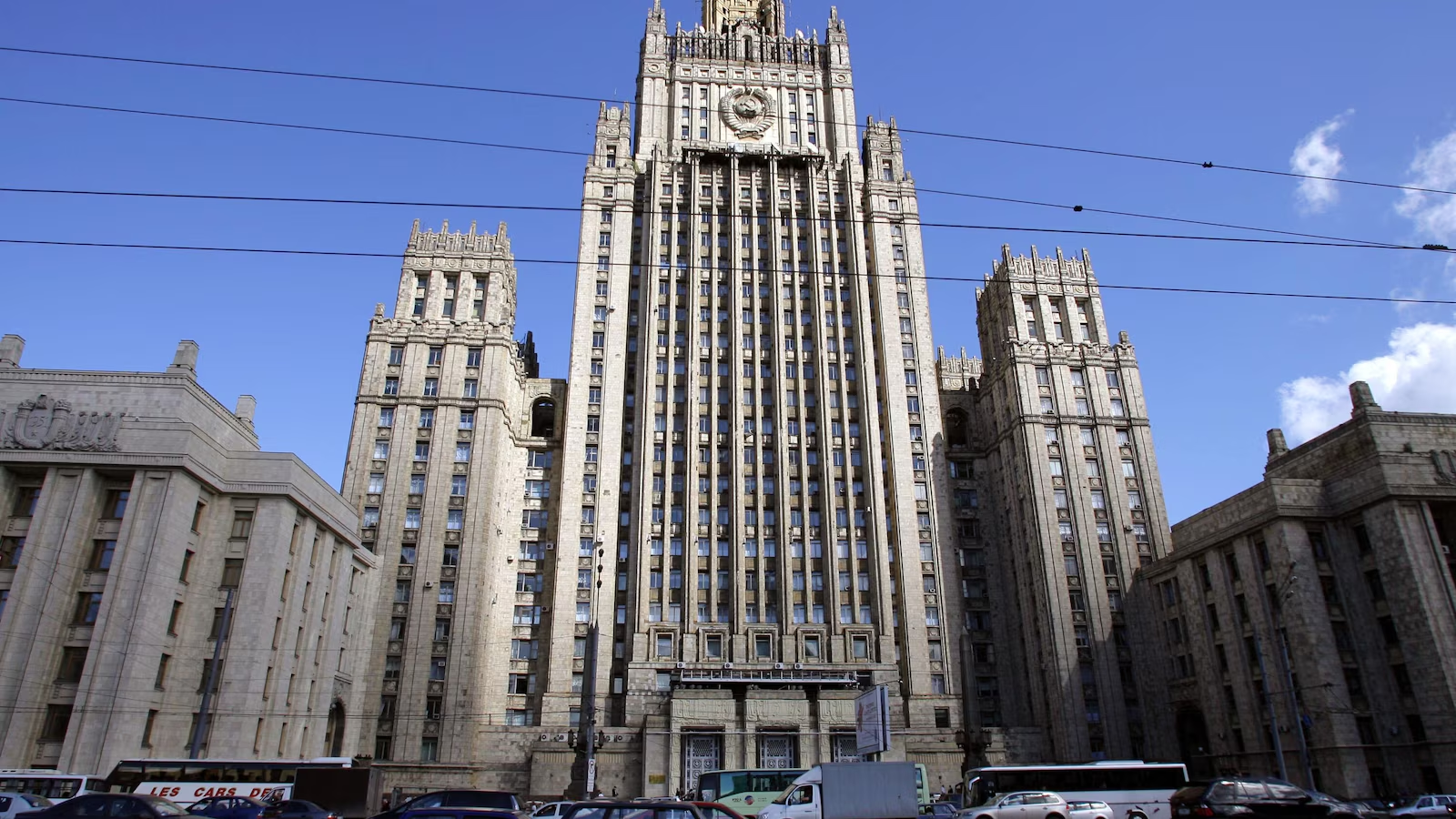
Khatam Al-Anbiya Air Defense Base in Tehran coordinates air defense activity between the Iranian Army and the Islamic Revolutionary Guard Corps (IRGC).
Iranian interceptors may have reached the skies over Kuwait, but Iran’s medium-to-long-range air defense systems fire large radar-guided missiles that often obliterate enemy aircraft. Therefore, the obvious conclusion seems to be that the planes were downed by short-range heat-seeking missiles like the R-73 or R-74 missiles used by the Iranian Air Force. However, with only official statements from both sides to work with, RT cannot speculate if this is the case.
Two wartime constants are that mistakes happen and militaries lie about their victories and losses. For the US, neither explanation paints a positive picture: it lost three jets in one day to incompetence and confusion between its crews and their allies, or to an enemy that was inferior and on the brink of defeat. For now, the truth is shrouded in the fog of war.