Posted on December 8, 2024
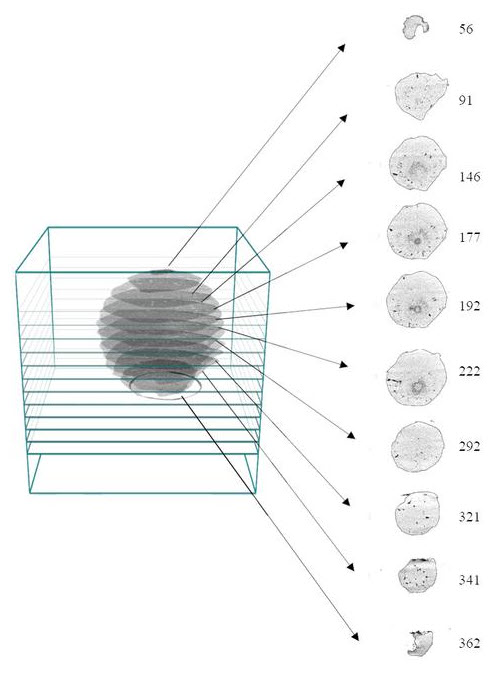
Researchers in Catalonia have used computed tomography (CT) to examine giant hailstones that fell during an unusually powerful thunderstorm in the summer of 2022. This method enabled the researchers to examine the large hailstones without breaking them.
The study revealed that even hailstones that appear spherical can have irregular internal axes and planes. The scans also provide data on the density levels and stratification of hail as it forms and grows during a severe thunderstorm. Researchers were able to observe 512 images (CT slices) showing the location of the nucleus and different layers.
Lead author Carme Farnell Barqué said in a statement, “It is the first time we have a direct observation of the entire internal structure of hailstones, which can provide clues to improve forecasts of hail formation.”
Barqué also says: “Until now, it was believed that very large hailstones could only have irregular shapes. However, we observed that the outer and inner shapes can vary. In one case, we have shown that the sample showed heterogeneous growth but had a regular outer shape. Conversely, stones with irregular outer shapes showed homogeneous growth.
Co-author Dr. Tomeu Rigo Ribas says: “We show that the embryo can be located far from the center. This fact implies that the stones can grow heterogeneously in three directions.”
A research paper on hail CT scans was published in the journal, Frontiers in Environmental Science.
Image: Farnell Barqué et al., 2024.