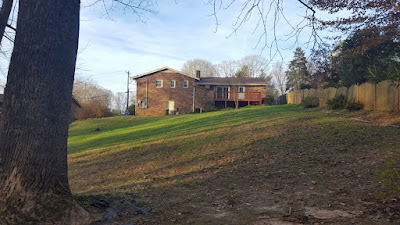
“Nostalgia is a feeling of loss and displacement, but it is also a romance with one’s own imagination. Nostalgic love can only survive in a long-distance relationship. A cinematic image of nostalgia is a double exposure, or a superimposition of two images – of home and abroad, of past and present, of dream and everyday life. The moment we try to break into a single image or force it into the surface.”
-Svetlana Boym, Nostalgia and its discontents
Nostalgia means different things to different groups of scholars. For historians, nostalgia is bad, “…essentially history without guilt…an abdication of personal responsibility, a guiltless homecoming, an ethical and aesthetic failure” (Boym, 2007). For social psychologists, nostalgia is good, “a meaningful resource (that) can serve an existential function” by helping us avoid thoughts of death (Routledge et al., 2008).
For cognitive neuroscience types, nostalgia is encapsulated in an fMRI experiment that compares brain responses to images of “nostalgic” objects (from childhood) vs. concurrent objects (Yang et al., 2021).1

In this post, my authority on cultural nostalgia is Svetlana Boym, who was the Curt Hugo Reisinger Professor of Slavic and Comparative Literature at Harvard, a Russian emigrant, and an extraordinary thinker, writer, cultural theorist and photographer. Her 2007 essay was adapted from her influential book, The future of nostalgia (2001). She saw nostalgia as a manifestation of collective memory and longing, with two contrasting types. Reflective nostalgia is exemplified by the displacement of immigrants, who may long for a home that no longer exists (or perhaps never existed). Restorative nostalgia, on the other hand, is a dangerous impulse to return to a “pure” (or nationalistic) state of the distant past. Is it fair for psychologists to regard nostalgia as a private recollection devoid of a larger context?
A blast from the past
Reconciling these different views of nostalgia was earlier terror management theory (TMT). In this theory, reminders of death (mortality) increase in-group favoritism and defense of one’s own worldview as a way of allaying existential fears. Thus, restorative nostalgia can be seen in the light (or darkness) of TMT. Instructing participants to write about a nostalgic event actually reduced mortality (Routledge et al., 2008). However, TMT has failed to replicate in several large studies, so there goes that idea (ie the link between social psychology experiments and restorative nostalgia, not the concept of restorative nostalgia itself).
Escape from the pandemic
The COVID memory vortex changed our perception of time and space and warped the horizons of past and future. A limited sense of the present (and the lack of new cultural production) caused TV nostalgia and musical nostalgia:
Nostalgia became a default listening mode—and to me, the cumulative oldness felt unsettlingly new. The old problem with nostalgia was that it made it harder to imagine the future. The new problem with nostalgia was that it made it harder to experience the present.
But wasn’t this also a way to avoid ubiquitous thoughts of death and constant media coverage (and lived experience) of overwhelmed essential workers, illness, hospitalization and relatives dying alone? Was there something special about nostalgia, or would an absorbing distraction suffice? Nostalgia intervention studies during COVID-19 showed improvements in well-being (Wildschut & Sedikides, 2022), but control conditions did not include sourdough bread baking, home improvement projects, or Zoom Peloton sessions.
Pleasantly numb
A fleeting feeling of nostalgia can apparently reduce the perception of physical pain (Zhang et al., 2022) – although the effect looks quite modest to me.
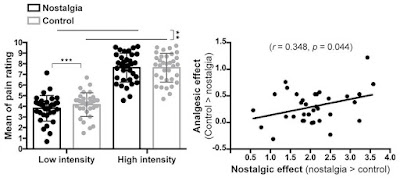
In this study, visual cues were presented for 8 sec (eg, childhood or modern gums), followed by 3 sec of thermal stimulation (low vs. high), a 7 sec wait, and then a rating of perceived pain intensity on that sample. The next image-pain cycle will occur 10 seconds later. Very small downward modulations of cortical activity were observed with nostalgia, but the impressive associations were in the thalamus.
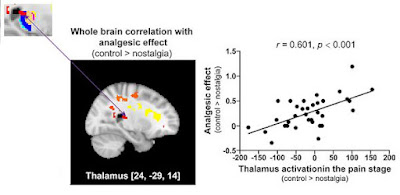
modified from fig. 4 (Zhang et al., 2022). During pain coding, the thalamus showed a positive correlation between the BOLD response and the analgesic effect.
While acknowledging that nostalgia is a complicated emotion, the authors stated that…
These findings suggest that the thalamus may play a key role in the encoding process of nostalgia and pain information in the possible brain circuit for nostalgia-induced analgesia.
But nostalgia can also induce feelings of emotional pain and sadness. On the very last day I spent in my childhood home, I walked around the backyard and was struck by a dizzying sense of loss. My memories of running around playing wiffle ball – badminton – croquet – nerf football – frisbee – and building a minimalist tree house and burying dead animals under a cross – were faint and lonely. I just sold the house and my best friend (who used to live next door) was dead and my mom was dead. I mourned in a way I never did while inside the house, emptying it of all my mother’s possessions.
“Nostalgia is a feeling of loss and displacement…”
Footnote
1 This study found that presentation of nostalgic images was associated with improved mortality salience, along with increased activation in the right amygdala (Yang et al., 2021). Which is the opposite of previous studies…
References
Boym S. (2007). Nostalgia and its discontents. The Hedgehog Review. 9(2):7-19.
Routledge C, Arndt J, Sedikides C, Wildschut T. (2008). A blast from the past: The terror management function of nostalgia. Journal of Experimental Social Psychology 44(1):132-40.
Wildschut T, Sedikides C. (2022). Benefits of nostalgia in vulnerable populations. European Review of Social Psychology 27:1-48.
Yang Z, Sedikides C, Izuma K, Wildschut T, Kashima ES, Luo YL, Chen J, Cai H. (2021). Nostalgia enhances the detection of death threat: neural and behavioral evidence. Scientific reports 11(1):1-8.
Zhang M, Yang Z, Zhong J, Zhang Y, Lin X, Cai H, Kong Y. (2022). Thalamocortical mechanisms of nostalgia-induced analgesia. Journal of Neuroscience 42(14):2963-72.