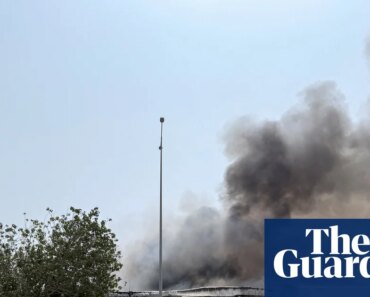
Iranian drones struck the US embassy in Riyadh as Tehran continued to launch waves of retaliatory attacks against the Gulf and Israel, while Israeli soldiers began operating in southern Lebanon on the fourth day of an increasingly regional war in the Middle East.
The drone attack on the US embassy in Riyadh caused a minor fire, prompting the diplomatic mission to ask Americans to distance themselves from the premises. The attack followed an earlier Iranian drone attack on the US embassy in Kuwait, as Iran continued to attack US bases, facilities and personnel in the Arab Gulf states.
The pro-Iran group Hezbollah also continued to target Israel, saying it launched two volleys of missiles overnight at military bases in northern Israel. In response, Israel continued to carry out attacks and issue evacuation orders on villages in southern Lebanon, virtually emptying the country south of the Litani River and turning Beirut’s southern suburbs into a ghost city.
On Tuesday morning, Israeli Defense Minister Israel Katz said he had ordered Israeli soldiers to “hold and advance” toward areas of southern Lebanon to prevent further Hezbollah firing into northern Israel. It was the first recognition that Israel’s campaign against Hezbollah would not only be aerial but would involve troops on the ground.
Meanwhile, the United States and Israel continued their attacks on Iran, with the United States claiming that it had destroyed the command and control facilities of the Islamic Revolutionary Guard Corps.
What began as a war between Iran, on the one hand, and the United States and Israel, on the other, has become a regional conflict at breakneck speed, with new fronts opening up every day.
The U.S.-Israeli air war against Iran began with strikes on Tehran on Saturday, killing Supreme Leader Ali Khamenei and prompting Iranian retaliation against Israel and missile attacks on Arab nations with U.S. bases across the region. The fighting quickly expanded to include at least nine countries and several pro-Iran groups.
On Tuesday, Israeli Prime Minister Benjamin Netanyahu said the war against Iran could take “some time” and that, while it would not “take years,” it could drag on. “It’s not an endless war,” he told Fox News.
US President Donald Trump, who has issued a series of contradictory statements about the length of the war, also said Monday that it could last “much longer” than the month initially planned.
U.S. officials such as Defense Secretary Pete Hegseth also publicly flirted with the idea of American troops in Iran, anathema to analysts who pointed to Iran’s vast, mountainous geography as an obstacle to any troop presence.
Secretary of State Marco Rubio said “the hardest blows are yet to come,” while administration officials said their plan for the Iran campaign had so far gone better than expected.
U.S. officials offered various justifications for why they launched war in Iran, with Rubio claiming that Israel forced the United States. “We knew there was going to be an Israeli action. We knew that would precipitate an attack on American forces, and we knew that if we didn’t preemptively pursue them before they launched those attacks, we would suffer greater casualties,” Rubio said.
Trump, for his part, has at times said the goal was regime change in Iran, and at other times said he was just trying to prevent Iran from obtaining a nuclear weapon and curb its ballistic missile program. Iran has consistently denied that it is developing nuclear weapons.
Netanyahu was clearer in his goals, saying the United States and Israel were “creating the conditions” for the Iranian people to overthrow his government. Israeli analysts suggested Iran’s campaign came at a good time for Netanyahu and would boost his poll numbers ahead of legislative elections.
In Iran, explosions were heard overnight across the country and particularly in the capital as the US-Israeli campaign continued. Estimates of people killed in the attacks ranged from 555 to 1,500 people, including 165 people in an attack on a girls’ primary school in southern Iran.
Iran continued to fire volleys of ballistic missiles at Israel, most of which were intercepted. A few missiles penetrated the country’s sophisticated missile defense system and killed 11 people in Israel.
The United States acknowledged the deaths of six soldiers, apparently killed while stationed in Kuwait.
Iran’s attacks on energy infrastructure in the Gulf have crippled oil-rich Gulf states, with Qatar announcing the cessation of its largest liquefied natural gas production facility, while Saudi Arabia ceased operations at its Ras Tanura oil refinery.
Global energy prices rose further after Iran closed the Strait of Hormuz, a global bottleneck for hydrocarbons, hitting several ships attempting to cross.
“The Strait of Hormuz is closed,” said Brigadier General Ebrahim Jabbari, an adviser to the paramilitary Revolutionary Guard, threatening to bomb ships attempting to cross. “Don’t come to this region.”
In Lebanon, Israel signaled that its campaign against Hezbollah could also be long. Similar to the war in Lebanon 18 months earlier, Israel steadily emptied the south of the country through evacuation warnings and then filled the areas near the border with Israeli troops.
However, it was unclear what resistance Hezbollah could offer this time, as Israel has severely degraded the group’s capabilities over two years of daily airstrikes. In the past two days, Israel has announced the assassination of senior leaders of the group, including Hussein Makled, Hezbollah’s intelligence chief.
It also targeted the Lebanese armed group’s logistical parts, including the Hezbollah-run al-Qard al-Hassan bank, and members of its political bureau, and attacked a building belonging to its al-Manar media channel on Tuesday morning. Human rights groups have said it is illegal to attack non-military targets, even if they are affiliated with the group.
Israeli airstrikes have so far killed 52 people and displaced at least 29,000 in Lebanon.
Hezbollah has continued to attack Israel, announcing that it had attacked the Ramat David and Meron air bases in northern Israel with one-way drones, and that it had targeted a base in the Golan Heights with rockets.
Domestically, Hezbollah has been criticized for dragging Lebanon into a war with Israel, in violation of the government’s declared neutrality. On Monday, Lebanon’s government took the unprecedented step of banning Hezbollah’s military and security activities. The government ordered the judiciary to arrest those responsible for firing rockets into Israel.