For decades, planetary scientists have debated a fundamental question about the Moon’s early history: Did it once generate a strong or weak magnetic field? A new study suggests that both options are true.
Today, the moon has no magnetic field at all. But some stones – especially many samples came back from NASA’s Apollo missions – have strong signals of magnetism, indicating that the Moon once had a magnetic field comparable to or even stronger than Earth’s. This interpretation suggested that the young moon once hosted a powerful internal dynamo—a molten, convective core capable of generating a global magnetic field much like Earth’s today.
But some scientists argued that because the Moon is relatively small, it would have struggled to maintain such a powerful field for hundreds of millions of years. An alternative theory proposed that the Moon’s core generated only a weak magnetic field, suggesting that only massive asteroid impacts could have temporarily reinforced it.
Now researchers from the University of Oxford offer a solution to the debate, and report moon could have experienced bursts of extremely strong magnetism long ago, but that these episodes would have been fleeting. For most of its early history — between 3.5 and 4 billion years ago — the study says the lunar magnetic field would have been weak.
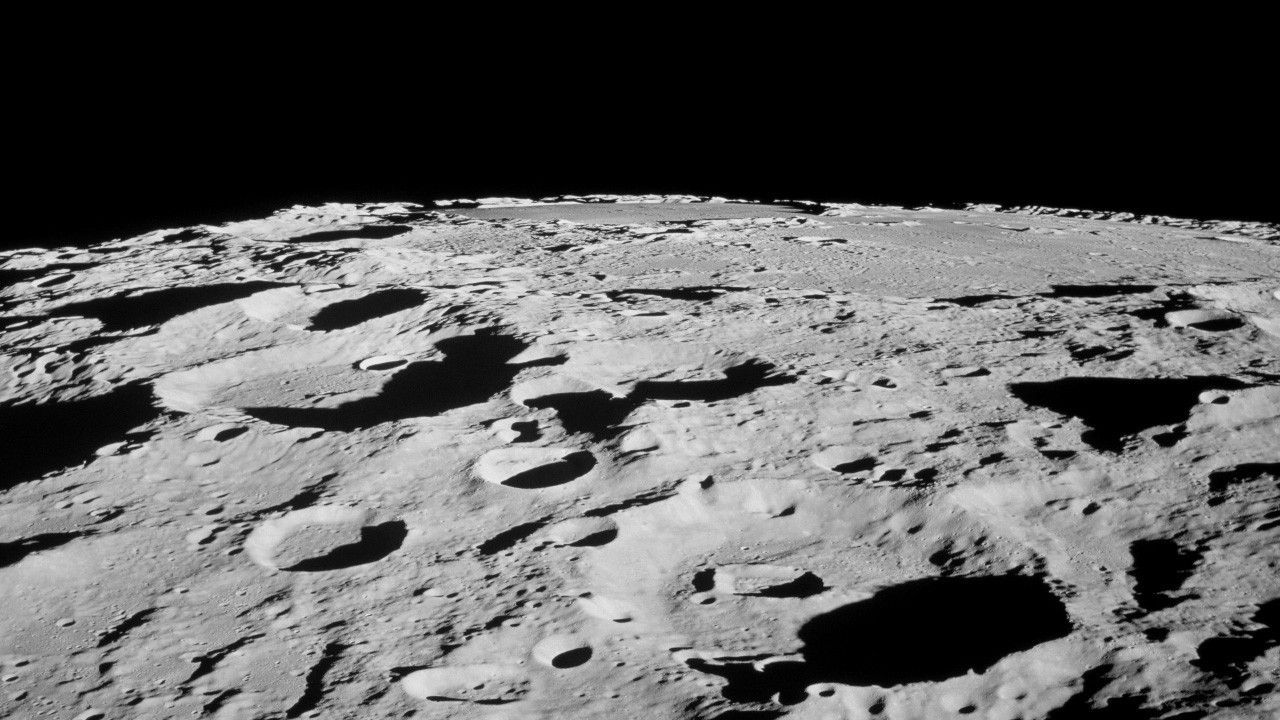
To reach this conclusion, the team revisited rock samples collected during NASA’s Apollo program and discovered that the long-standing disagreement stemmed from a sampling bias. The six Apollo missions landed on relatively flat, dark plains known as mare regions, which happen to be rich in a specific type of volcanic rock that recorded these magnetic events.
“Our new study suggests that the Apollo samples are biased towards extremely rare events lasting a few thousand years – but until now these have been interpreted as representing 0.5 billion years of lunar history,” study leader Claire Nichols, an associate professor at Oxford, said in a statement. “It now appears that a sampling bias prevented us from realizing how brief and rare these strong magnetism events were.”
By analyzing the chemistry of mare basalts, the researchers identified a link between the formation of titanium-rich rocks and lunar magnetism. Samples that registered strong magnetic fields contained high levels of titanium, while samples that registered weak magnetic fields had low levels of titanium.
“We now believe that for the vast majority of the Moon’s history, its magnetic field has been weak, which is consistent with our understanding of dynamo theory,” says Nichols. “But that for very short periods of time—no more than 5,000 years, but possibly as short as a few decades—melting of titanium-rich rocks at the Moon’s core-mantle boundary resulted in the generation of a very strong field.”
Computer models confirm that if scientists had sampled the Moon’s surface at random, rather than just from the jump regions, they would be unlikely to catch evidence of these rare magnetic peaks. It lends support to the idea that strong magnetic episodes were rare exceptions, not the rule.
Understanding the Moon’s magnetic past is important because magnetic fields shield planetary surfaces from solar wind and help scientists investigate the evolution of planetary interiors. Pinning down when—and how—the moon’s dynamo operated provides clues about how its core cooled, how its mantle evolved, and why its geological activity faded.
It also provides an important point of comparison for understanding why Earth’s dynamo persists while the Moon is shut down. Some scientists have even suggested that the Moon’s ancient magnetic field may have interacted with Earth’s early magnetosphere, potentially influencing how our planet retained its atmosphere.
With NASA’s upcoming The Artemis program set to explore new areas of the moon, scientists hope to test their predictions and further uncover the history of the moon’s vanished magnetic field.
A study on these results was published on 26 February in the journal Nature Geoscience.