The long-running confrontation between the United States and Iran entered a new phase on Saturday when joint US-Israeli airstrikes targeted Iran, marking a moment of open military hostilities.
As US President Donald Trump signals that operations could last four to five weeks, we look at whether Washington can sustain a new war in the Middle East and how much it could ultimately cost.
What is Operation Epic Fury?
On February 28, Trump confirmed in an eight-minute video posted on Truth Social that the United States had engaged in what he described as a “major combat operation” inside Iran.
The Pentagon later said the mission was called Operation Epic Fury.
Trump said the goal was to “ensure that Iran does not obtain a nuclear weapon.”
“We are going to destroy their missiles and destroy their missile industry. It will be completely annihilated,” he added.
The US military said it had struck more than 1,250 targets in Iran since operations began on Saturday. In a separate statement, the US military’s Central Command (CENTCOM) said it had attacked and destroyed 11 Iranian ships.
The operation reportedly involved airstrikes, sea-launched cruise missiles, and coordinated attacks against nuclear-related facilities as well as high-level figures linked to Iran’s defense establishment.
Iranian Supreme Leader Ayatollah Ali Khamenei, who had led the country since 1989, was killed when his compound in Tehran was leveled during the first wave of attacks.
On Monday, Trump vowed to continue the war for as long as necessary, suggesting it could drag on for several weeks. As of Monday, the Iranian Red Crescent said 555 people had been killed in 130 locations in Iran.
How much has the United States already spent on Israel and the Middle East since 2023?
According to Brown University’s Costs of War 2025 report, since October 7, 2023, the United States has provided Israel with about $21.7 billion in military aid.
On top of that, the American taxpayer has funded American operations supporting Israel in Yemen, Iran and throughout the Middle East at a cost of between $9.65 billion and $12.07 billion.
That brings total U.S. spending related to the conflict to between $31.35 billion and $33.77 billion, and rising.
What weapons systems are being used in the Iran war?
According to CENTCOM, Operation Epic Fury has involved more than 20 weapons systems across air, sea, land and missile defense forces.
CENTCOM says more than 1,000 targets inside Iran have been struck, using more than 20 different systems in the air, sea and land, as well as the missile defense force.
“The goal of the United States and the Israelis now is to mitigate or degrade – as quickly as they can – the offensive capabilities of the Iranians to continue wreaking havoc. What they want is to stop these attacks, or at least slow them down as much as possible,” Kevin Donegan, former director of operations at CENTCOM, told Al Jazeera.
Some of the weapon systems include:
Air power:
The campaign has relied heavily on US air assets, including:
- B-1 bombers
- B-2 stealth bombers – used to attack key nuclear and military infrastructure
- F-35 Lightning II and F-22 Raptor: advanced stealth fighters
- F-15 fighter jets: widely used; three were lost in an incident over Kuwait on March 1
- F-16 Fighting Falcon, F/A-18 Super Hornet and A-10 attack aircraft: all confirmed for attack and support roles
- EA-18G Growler – used for electronic attacks and suppression of enemy air defenses.
- Airborne early warning and control aircraft (AWACS): which provide command, control and management of the battlespace.
Drones and long-range attack systems
Also part of the operation are unmanned systems and rocket artillery:
- LUCAS Drones: This operation marks the first combat use of these unidirectional “low-cost unmanned combat strike system” drones, which were reverse-engineered from Iranian designs.
- MQ-9 Reaper drones: active in surveillance and precision attack functions
- M-142 High Mobility Artillery Rocket Systems (HIMARS) – ground rocket artillery
- Tomahawk cruise missiles: launched from naval assets.
Missile defense systems
- Patriot and THAAD (Terminal High Altitude Area Defense) interceptor missile systems: used to intercept Iranian ballistic missiles and drones.
- Anti-drone systems.
Naval power projection
- Two aircraft carrier strike groups, led by USS Gerald R. Ford and USS Abraham Lincoln: providing massive maritime power
- P-8 Poseidon: conducting maritime patrol and reconnaissance
- Cargo and tankers: C-17 Globemaster, C-130 Hercules and several refueling tankers maintain the logistics flow.
How much could the Iran war cost the United States?
It is difficult to predict the total cost of an ongoing military campaign. It’s too early to say how much the new war could end up costing the United States, experts say.
“The Pentagon hasn’t released that information, so we can only speculate… but there are a lot of moving pieces, and we can speculate on the cost of individual weapons; we can speculate on the cost of operations, naval operations,” Christopher Peble, senior researcher at the Stimson Center, told Al Jazeera.
Reports from the Anadolou news agency estimate that the United States may have spent approximately $779 million during the first 24 hours of Operation Epic Fury.
Military preparation prior to the attack, including repositioning aircraft, deploying more than a dozen warships and mobilizing regional assets, is estimated to have cost an additional $630 million.
According to the Center for a New American Security, it costs approximately $6.5 million per day to operate an aircraft carrier strike group, such as the USS Gerald R Ford.
There are also costs associated with equipment losses.
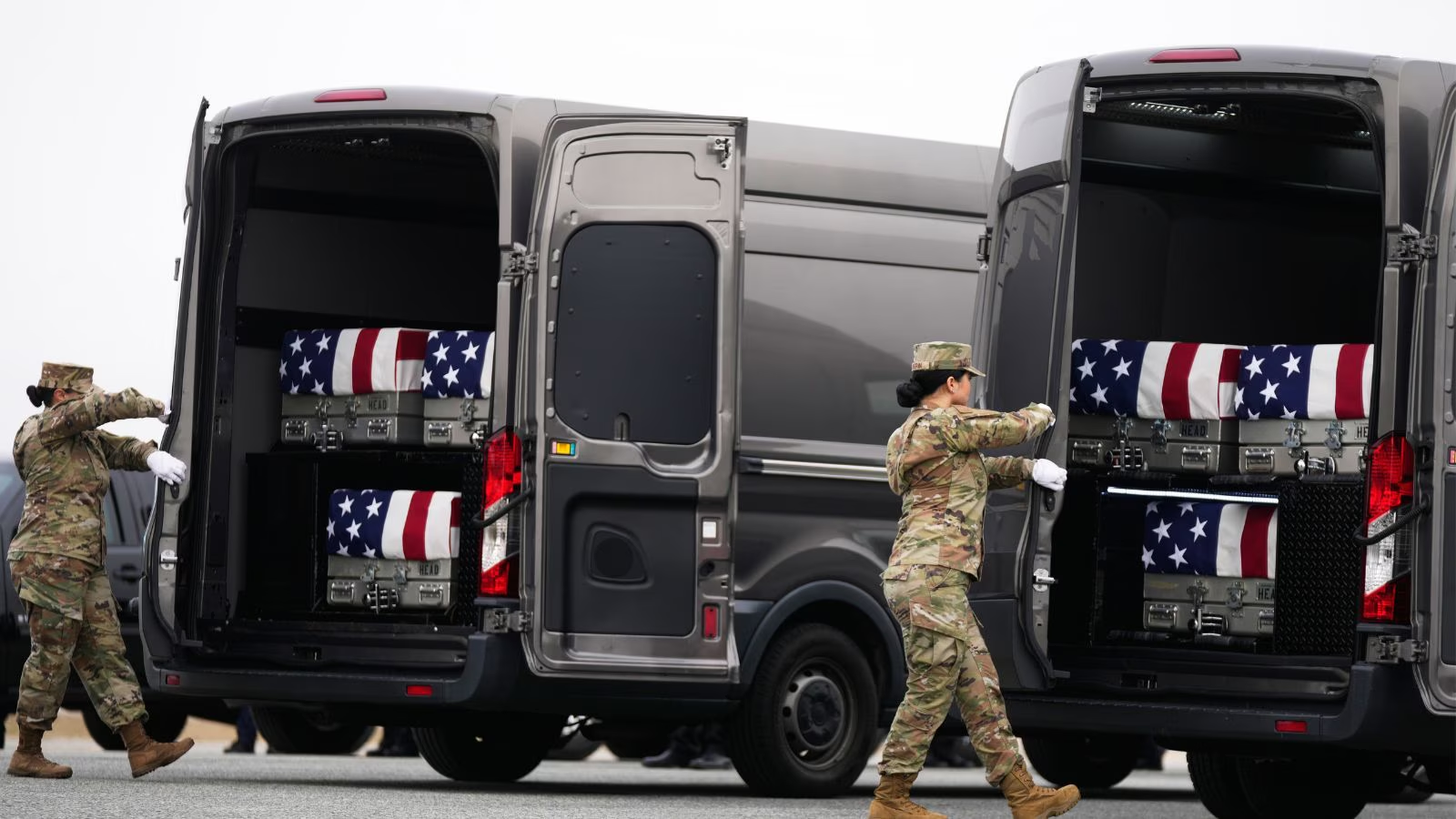
At least three U.S. fighter jets were shot down over Kuwait in what U.S. officials described as a friendly fire incident.
But experts suggest the biggest concern may not be financial sustainability, but inventory.
“It’s sustainable with respect to the cost. I mean, we have a $1 trillion defense budget in the United States and a request to get to $1.5 trillion, which I think is appalling, but that the president is committed to,” Preble said.
“So a trillion dollars is enough. The question is about the actual inventory of weapons in the American arsenal, especially interceptors, such as Patriot missiles or SM-6, standard missiles that are used as interceptors of ballistic missiles.”
Preble warned that high interception rates cannot continue indefinitely.
“It is reasonable to speculate that the pace of operations at this time, in terms of number of interceptions, could not continue indefinitely, certainly, and perhaps could not continue for more than several weeks,” he said.
He noted that similar concerns arose during the 12-day conflict with Iran in June, when there was speculation that both US and Israeli forces were running out of stockpiles of interceptors. While some supplies may have since been replenished, the interceptors are also destined for other theaters.
“Some of these interceptors were intended to be sent to Ukraine to counter Russian attacks. Some are used in Asia, in the Indo-Pacific. They would be important in case of a contingency there,” he said. “Therefore, there would be some concern about removing those weapons from that theater.”
Manufacturing replacements are not instantaneous.
“A Patriot missile or an SM-6… it’s a very complicated piece of equipment,” Preble added.
“It’s not like they’re producing them, hundreds or thousands a day. That’s not the pace of manufacturing.”