Guadalajara, Mexico — The leader of the Jalisco New Generation cartel was buried Monday in a glittering gold casket with enormous floral wreaths and a large military presence in the state that gave its name to one of Mexico’s most powerful cartels.
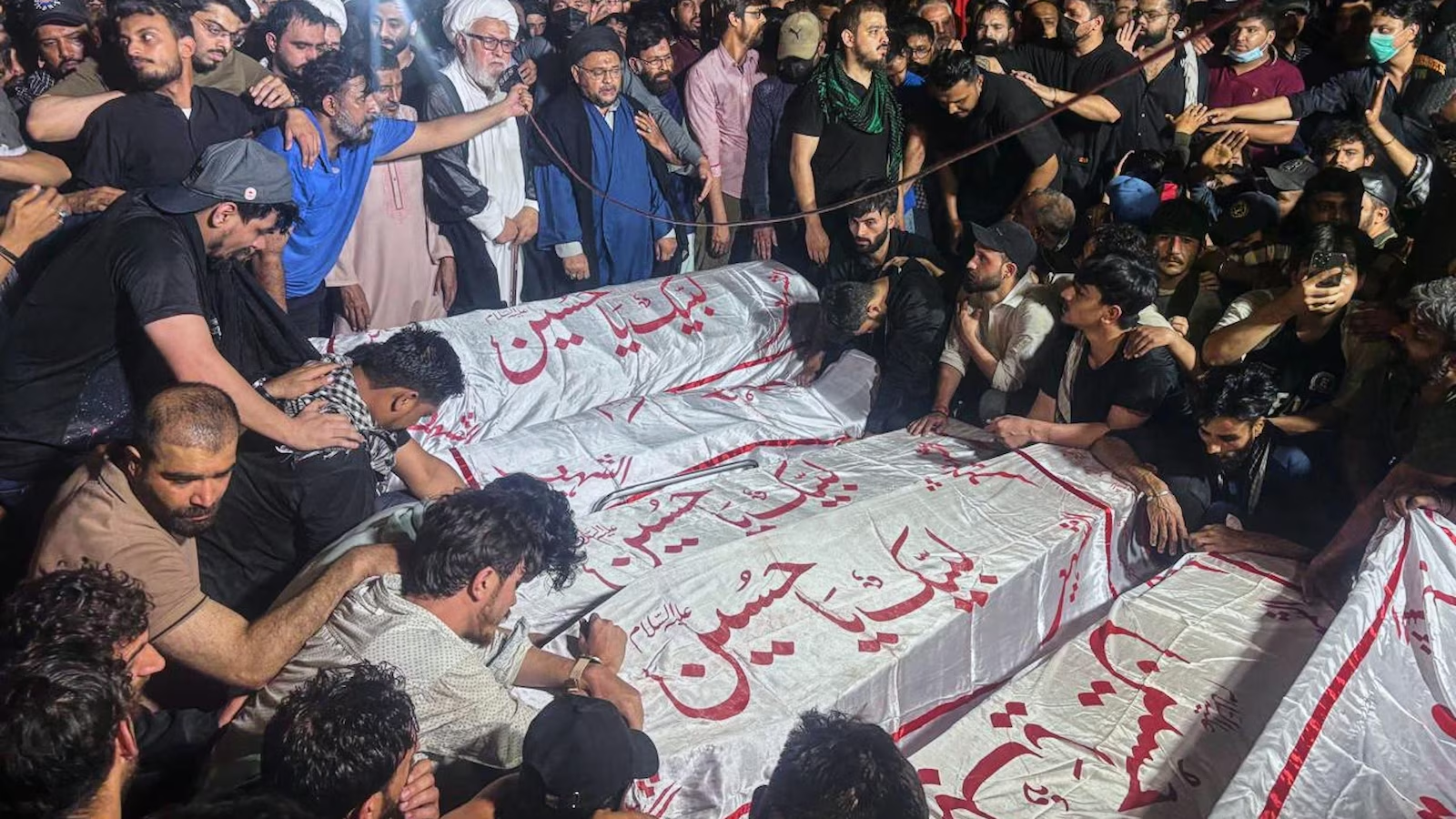
Nemesio Oseguera Cervantes, alias “El Mencho,” is buried in a cemetery in Zapopan, a suburb of Guadalajara, Mexico’s second-largest city, a federal official confirmed. Tens of thousands accompanied the funeral procession, many carrying black umbrellas on a sunny day and accompanied by a band playing Mexican regional music known as banda.
An official who spoke to the scene requested anonymity because he was not authorized to discuss the case. The attorney general’s office declined to confirm El Mencho’s burial site for “security reasons.”
Since Sunday, security has been beefed up around the funeral home where huge wreaths of flowers have been arriving anonymously. Some have included the image of a rooster in the flowers, and Oseguera Cervantes is sometimes called the “Lord of the Roosters.”
The Mexican army killed Oseguera Cervantes a week earlier while trying to capture him. He died of multiple gunshot wounds, according to a death certificate obtained by The Associated Press.
The killing sparked violence in nearly 20 states. The death certificate fits the description of the operation to capture Oseguera Cervantes given by Defense Secretary Ricardo Trevilla, who said the cartel leader and two bodyguards were critically wounded in a shootout with soldiers outside a home in Tapalpa, Jalisco. Three died on the way to the hospital.
The certificate specified that Oseguera Cervantes had bullet wounds to his chest, abdomen and legs.
His body was taken to Mexico City where an autopsy was performed and later released to his family on Saturday, the attorney general’s office said in a brief statement.
The death certificate notes that Oseguera Cervantes was buried, as is standard practice in cases of violent death to allow additional forensic evidence to be collected if needed in the future. The record does not say where the burial will take place.
The authorities’ security concerns around the burial site are well founded. The killing of Oseguera Cervantes set off reprisals by the cartel in several states. More than 70 people were killed between the military operation and the subsequent violence. The government said security operations against other high-ranking members of the cartel were continuing.
An air of mystery surrounds the tombs of drug lords in Mexico, whose supporters try to elevate them to legend. Within hours of El Mencho’s death, ballads known as narcocorridos were written about his assassination.
In neighboring Sinaloa state Culiacán, home to the cartel of the same name, is a cemetery known for its luxurious crypts and tombs of one-time royals such as Ignacio Coronel – an old associate of El Mencho – and Arturo Beltran Leyva.
There was a drug lord who was famously killed twice, Nazario Moreno, the leader of the violent and pseudo-religious Knights Templar cartel, who was killed in 2010 to kill him in 2014, authorities said.
Sometimes bodies disappear, including that of Heriberto Lazcano, leader of the dreaded Zetas, whose body was stolen in 2012. Or they die in strange circumstances, like Amado Carrillo Fuentes, “Lord of the Skies”, who died in plastic surgery.
___
Sanchez reports from Mexico City. AP writer Maria Varza in Mexico City contributed to this report.
(Tags to be translated)Murder(T)Music(T)Funerals and Memorial Services(T)General News(T)War and Unrest(T)Drug Cartels(T)World News(T)Article(T)130699347