March 3 brings a rare, striking and rather ominous spectacle to the night sky in the form of a blood moona total lunar eclipse that occurs when Earth goes directly between Sun and that Moon. For many cultures throughout history, blood moons have served as an omen, often an ominous one.
For fans of The Legend of Zelda, they can also represent a grim omen, but also an opportunity. The real Blood Moon and its video game counterparts share striking visuals and emotional power. But scientifically and existentially they are worlds apart.
The Science of the Blood Moon

When the Earth passes between the Sun and the Moon during totality, it completely blocks direct sunlight from reaching the Moon’s surface. Instead of disappearing from view, the natural satellite changes a dramatic, rusty red hue. This blood moon phenomenon occurs as a result of the light-filtering properties of Earth’s atmosphere.
Shorter blue wavelengths of sunlight are scattered away—much in the same way that Rayleigh scattering turns the sky red at sunset—while longer orange and red wavelengths pass more easily, only to bend or refract on the moon’s disk, turning it a muted, bloody crimson.
It corresponds to every sunrise and sunset on Earth projected onto the Moon, but the resulting shadow depends on atmospheric conditions. Dust, volcanic ash or other particles in the atmosphere can result in a deeper red color, while clear skies give a lighter yellow color.
Total lunar eclipses happen about once every two years, and despite the myths that have gathered around them, they are remarkably predictable (astronomers can predict them centuries in advance). And the good news is that unlike solar eclipsesthey can be seen with the naked eye without risk.
The real mythology of the blood moon

Not surprisingly, given a blood moon’s ominous hue, a vast codex of mythology and legend has gathered around them from various cultures throughout history. Ancient civilizations across Mesopotamia, China, Mesoamerica and Europe often interpreted eclipses as cosmic warnings. In some traditions, it was believed that a celestial animal swallowed the moon.
In ancient China, the eclipse was interpreted as a cosmic dragon or dog trying to swallow the moon whole. During an eclipse, people would beat drums, shoot arrows, or make loud noises to scare the dragon away, as a red moon was seen as a sign of impending misfortune or celestial imbalance.
For others, a red moon signaled impending war, famine, or the death of a ruler. Ancient Sumerians, for example, believed that an eclipse was the result of demons attacking or eating the moon, and feared that it foretold the death or fall of a king. To protect their sovereign, priests would install a substitute king or perform ceremonies to ward off the curse.

The Christian Bible and biblical texts also refer to red or blood moons in ominous tones. For example, the book of Joel in the Old Testament/Hebrew Bible includes the following passage (from Joel 2:30–31):
“The sun shall be turned to darkness and the moon to blood before the coming of the great and terrible day of the Lord.”
Joel returns in the New Testament with further bloody moon imagery, as quoted by Peter in Acts 2:19–20:
“The sun will be turned into darkness and the moon into blood, before the great and glorious day of the Lord comes.” As you would expect, Revelation also takes a major turn, probably the most dramatic in the Bible itself, in 6:12:
“The sun became black as sackcloth, the full moon became like blood.”
Psychologically, this reaction is understandable. The moon is one of the most stable features of the night sky. When it changes dramatically, especially when it shifts to mimic the color of blood, it disrupts the sense of permanence. Before scientific explanations, these kinds of radical changes required interpretation.
The Blood Moon in Hyrule
Look at
Nintendo takes the ancient sense of ante and weaponry for gaming.
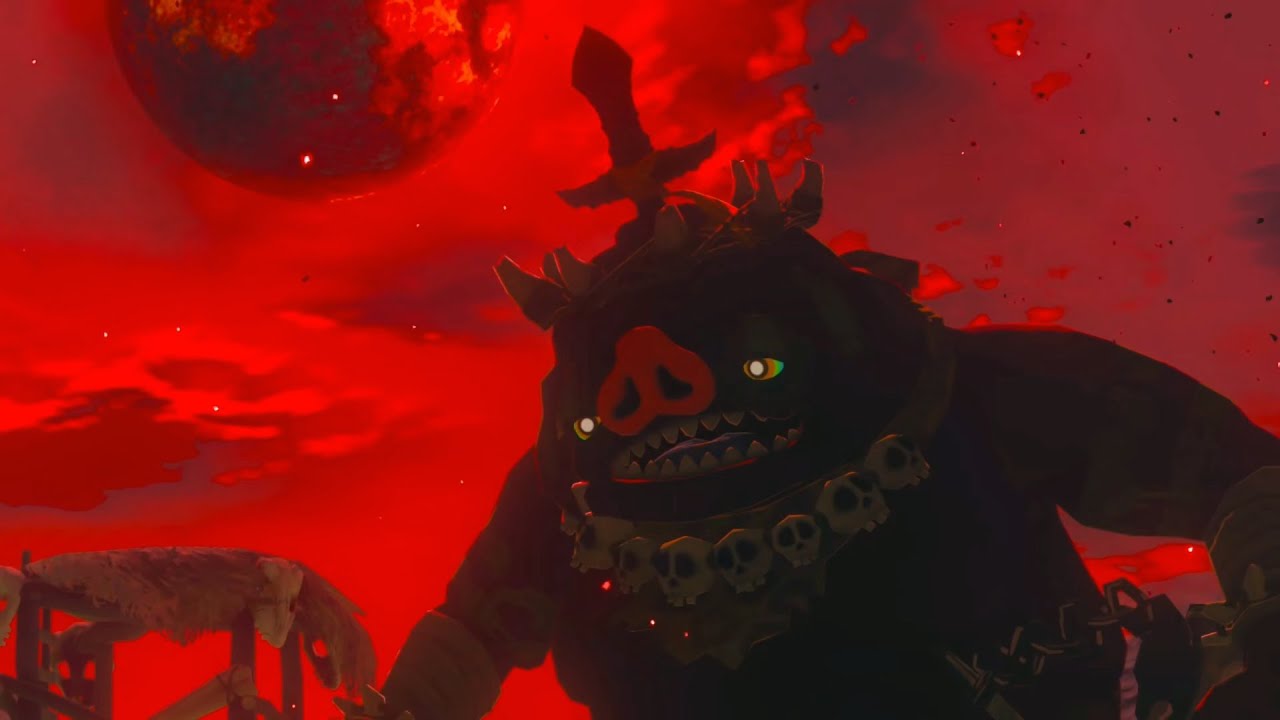
The Blood Moon appears in both The Legend of Zelda games on Nintendo Switch: Breath of the Wild and its sequel, Tears of the Kingdom. On the surface, it is a reflection of the ominous tone of the real mythology surrounding a total lunar eclipse; the sky turns an ominous red, an unnatural light covers the terrain, giving the feeling that something is terribly wrong.
As the blood moon rises, so do fallen enemies. The event respawns all slain enemies in Hyrule, and it also regenerates all the weapons and items (at least those outside of chests) that have been destroyed or picked up by the player.
Blood Moons also provide a useful boon for enterprising players: between 11:30 PM and 12:15 AM on the night of a Blood Moon, any cooking you do is guaranteed a “Critical Chef.” Dishes will get a useful upgrade, like extra healing power or a boost to the duration of their stat buff.

Related: Could the floating islands in “The Legend of Zelda: Tears of the Kingdom” exist?
Behind the scenes, blood moons are a useful tool for developers to prevent memory overload. Resetting the world ensures that the environment doesn’t become too cluttered and complicated to fit into the Switch’s relatively limited system memory, and prevents crashes.
Blood Moons will normally occur on a regular schedule, once every 168 minutes and 15 seconds of real-world gameplay, although certain player actions can delay them slightly. However, if the game detects a memory overload, it will trigger a “panic blood moon”, which can happen at any time of the day or night (not just at midnight, like standard blood moons). They will often be triggered if a player kills a huge number of enemies in a short amount of time, or overloads the screen with complex physics such as hundreds of objects or explosions.
In Tears of the Kingdom, you can force a Panic Blood Moon by using a multi-shot bow to shoot lots of Opal or Topaz arrows at a breakable rock wall in bullet time. The resulting explosion of particle effects will overwhelm the game engine and immediately trigger a blood moon.
The Falling Moon of Majora’s Mask

While not a blood moon, Majora’s Mask also taps into a rich vein of lunar paranoia by way of the grinning apocalypse moon. Everything the player does is on a timer, as the orbit of this grotesque moon decays and it comes hurtling toward the planet’s surface. Every three days it collides with the planet, destroying it and resetting the timeline.
There is no astronomical realism here. The moon’s orbit would never decay so neatly, nor would tidal forces wait for the impact to cause massive destruction. In reality, a moon approaching that size would trigger catastrophic gravitational effects long before the collision.
But realism is beside the point. The falling moon in Majora’s mask represents inevitability and horror. It is a visual countdown timer, a cosmic guillotine suspended in the sky. Where real eclipses inspired ancient anxiety because they disrupted normality, this fictional moon weaponizes disruption as the game’s central emotional driver.
Shared themes: why a crimson moon unsettles us

Despite obvious differences between the fictional moons that hang over Hyrule and the real world’s red moons, there are a number of telling parallels.
Both phenomena act on humanity’s instinctive reaction to celestial phenomena. We often do not recognize how connected to, and dependent on, the spheres that hang in the sky we are until something with them changes, or goes wrong. Across cultures and eras, the moon has symbolized constancy, the comforting cycle of tides, months, fertility and agriculture. When it turns red, that constancy seems threatened.
Whether consciously or intuitively, the developers at Nintendo understand this instinct. When the sky turns red, and the moon changes, there’s an immediate sense of danger and unease, even though the associated game mechanics aren’t actually that dangerous to the characters (unless you happen to be standing next to a Hinox you’ve just killed). As with a true lunar eclipse, which really only results in some shifting shadows or some mild disturbances in animals, feeling of a blood moon is often more intense in Hyrule than the consequences.
Looking to the sky without fear

The March 3 blood moon provides an opportunity to appreciate both astronomy and storytelling.
In the real sky, you witness the Earth’s atmosphere acting as a lens, bending sunlight across space. It is a living spectacle of orbital mechanics in motion. In games, red moons serve different purposes: systemic reset, narrative tension, and emotional horror. They borrow from ancient fears and amplify them for dramatic effect.
One reminds us of the reliability of celestial physics. The second reminds us how easily this reliability can be undermined in fiction. When the moon turns red on Tuesday, March 3, marvel at the science, and perhaps feel a flicker of the same awe that inspired myths, prophecies, and some of gaming’s most unforgettable skies.
Just don’t expect monsters to respawn.