Launched in 2021 and in active service since 2022, the James Webb Space Telescope has been getting its feet wet seeing already known exoplanets, but can now take credit for its first direct image of a previously unknown one.
Exoplanets have been discovered since 1992 when two, named Poltergeist and Phobetor, were found orbiting the pulsar PSR B1257+12.
Since then, they have become key targets in astronomy, in the hope that capturing snapshots in time can help us understand how planetary systems form. Thousands have been detected indirectly, but because they are less bright due to being ‘drowned’ by light from their star, direct observation is a challenge. So the two most common methods of detection look for the effect rather than direct display. Transit photometry uses a tiny drop of brightness from the star when the planet, seen from here, is in front of it, while radial velocity detects a star’s velocity variations caused by the planet’s gravitational influence.
To help, the Center national de la recherche scientifique in France developed a coronagraph attachment for JWST’s MIRI instrument that can recreate the effect observed during an eclipse. Such masking makes objects around a star easier to observe.
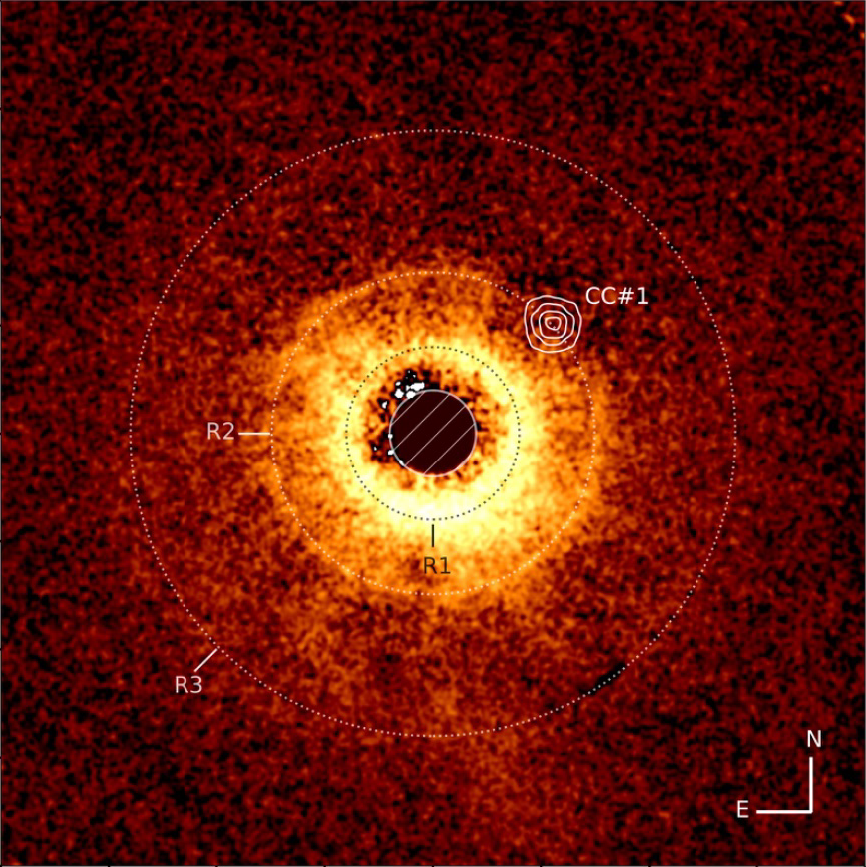 TWA 7 from the Very Large Telescope’s SPHERE instrument overlaid with an image from JWST’s MIRI reveals the empty region around TWA 7 B in the R2 ring (CC #1). ©A.-M. Lagrange et al. / ESO / JWST
With infinite stars, it is necessary to find measures of possibility, so astronomers focus on younger stars where the planets are still warm and the system disks can be seen by us “from above” – on the pole.
TWA 7 has three distinct rings, one very narrow and surrounded by two empty regions with almost no matter. JWST was able to find a source at the heart of this narrow ring – an exoplanet.
The new planet is comparable in size to Saturn, but 10 times lighter than those captured in previous images, and has been named TWA 7 b.