At least 200 civilians have been killed since the start of the US-Israel war against Iran last weekend, according to human rights groups, while people inside Iran told The Guardian they feared a rise in the death toll.
The Iranian Red Crescent Society said at least 555 people had been killed across Iran. However, in its latest update, Norway-based human rights group Hengaw said the death toll on the third day had reached at least 1,500, including 200 civilians and 1,300 members of Iranian forces.
Hengaw said he was concerned about the rising number of civilian deaths, with the highest number of civilian deaths recorded in Iran’s southern Hormozgan province after a missile attack on a girls’ primary school in Minab at the weekend, which reportedly killed more than 150 people, including children.
Amid a barrage of joint US-Israeli attacks on several cities in Iran, residents who spoke to The Guardian said they had received a wave of alerts and messages from authorities on their mobile phones.
According to Hengaw, residents of the city of Sanandaj, the capital of Iranian Kurdistan in northwestern Iran, received messages from the Islamic Revolutionary Guard Corps (IRGC) intelligence organization warning that any public movement or presence on the streets would be considered “direct cooperation with the enemy.”
The message said this was aimed at preventing “terrorist actions and street riots”, described as the next steps of the “enemy’s plan”.
Some residents interviewed by The Guardian said people in other cities had also received text messages from authorities. IranWire, an Iranian exile media outlet, also reported on similar texts warning their recipients against “any movement.”
A student based in Tehran said: “The regime has shut down the Internet again and now we are all trying to connect with each other and see what we can do to help weaken this regime and avenge our compatriots. Tehran is being bombed so intensely that it is impossible to know when, where and how we can protest and mobilize because the streets are quickly becoming dangerous. We don’t know where the IRGC hideouts are and that is a huge risk for us ordinary people.”
In a message transmitted to The Guardian through a relative based abroad, a Kurdish student said: “With the alerts and warnings coming in, even if we were planning to flee (the bombing), the regime’s agents will arrest us and charge us with terrorism. The goal of these alerts is to ensure that we are trapped so that they can blame Trump and company and weaponize the attacks in the neighborhoods adjacent to the IRGC bases. We know this regime very well and their tactics have not changed.”
Despite a near-total internet blackout, some people managed to call relatives abroad and send some text messages. Civilians who managed to connect with human rights groups also said that in the northwestern city of Mahabad, electricity was completely cut off on Monday after US-Israeli airstrikes.
In the northwestern city of Urmia, a prisoner called a relative to say that everything was under control in the prison and that no one had been executed in the room on Monday. The windows had been sealed with duct tape to reduce the sound of nearby explosions.
Hiwa Bahrami, head of the foreign affairs department of the Democratic Party of Iranian Kurdistan, said the regime had “deliberately established military bases and deployed its forces within populated regions, putting civilians at significant risk” in many areas, including Iranian Kurdistan.
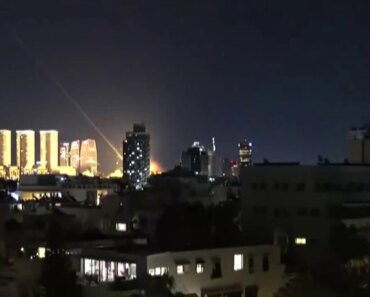
Meanwhile, civilians in Tehran said they were scrambling to flee to smaller cities as US-Israeli attacks intensify. Matin, a former journalist based in Tehran, said that although people hoped for help from the United States, clouds of smoke over the city’s skyline, continued loud explosions and videos showing debris in the heart of the capital had left him fearful.
“Look, we want freedom and we want the IRGC to pay for every drop of blood that our families have sacrificed for this fight. But since this morning, the videos I have been watching, which are already few because I can only log in from time to time, are breaking my heart… who will bring back those among us who die at the hands of the incoming bombs?
“I blame the regime for bringing us here, but that doesn’t mean I’m not afraid of American attacks killing innocents. Seeing my beloved city in this state too is not something I can celebrate. I’m really worried about the children of this country.”
Zhila, a Tehran-based filmmaker, said: “Our young people have no future in this country, the sanctions and any other restrictions that have crippled the economy are the work of the regime because they kept getting rich. Despite this, I still hoped that we would have been able to overthrow this regime.
“We tried everything, so even if I am against this war, I don’t think we have any choice but to seek help. How many die is something that is killing me inside, but it is also still fresh in our minds how many were killed by the regime. We have become so numb after what we saw in January that we are now in a strange state of mind.”