Ethereum’s long-term protocol roadmap may move faster than many expect as AI tools improve, according to Vitalik Buterin, who pointed to a recent experiment that used a coding agency to collect an ambitious reference client that covers much of Ethereum’s planned 2030-era architecture.
The comment came after developer Jiayao Qi, posted as YQ via X, unveiled ETH2030, an experimental Ethereum client built to target the network’s “2030+” road map project. The project consists of 702,000 lines of Go, covers 65 roadmaps in eight phases, passes 36,126 official Ethereum state tests, and can be synchronized with the mainnet by integrating with go-ethereum v1.17.0. Qi said the client was created in about six days using Claude Code at a cost of about $5,750 and 2.77 billion tokens.
AI can accelerate the Ethereum roadmap
Buterin called the effort “a very impressive experiment,” while stressing that a prototype built at this speed has obvious limitations. “Something like this built in two weeks without having an EIP has a lot of caveats,” he wrote. “Almost certainly a lot of critical bugs, and possibly in some cases ‘unstable’ versions of something that the AI hasn’t even tried to develop a perfect version of. But six months ago, even that was out of the realm of possibility, and what matters is where the trend is going.”
This distinction was more important to Buterin than the raw performance itself. In his view, AI is not just about compressing development time. It could change the way Ethereum engineers approach assurance. “Probably the right way to use it is to get half the benefit from AI in speed and half the benefit in security,” he said. “Generate more tests, test everything formally, do more things.”
He linked this directly to the ongoing work of official testing around Ethereum. Referring to Ethereum’s Lean efforts, Buterin said a colleague has already used AI to generate a machine-verifiable proof of STARK’s complex security theorem. “@leanethereum’s main rule is to verify everything formally, and AI will greatly speed up our ability to do this,” he wrote. “In addition to formal testing, the ability to create a large number of test cases is also important.”
ETH2030 itself was presented less as a candidate client than as a stress test for the roadmap. Qi has repeatedly pitched it as a rough draft rather than production software, arguing that its value lies in forcing hard engineering questions to be addressed now, not years later.
The roadmap, as implemented in the project, aims for a version of Ethereum with 10,000-plus TPS in L1, finalization in seconds instead of 15 minutes, single staking for 1 ETH, stateless nodes running on $7 Raspberry Pi, and more than 1 million TPS in L1 and L2. But the experiment also revealed a deep connection between innovation, from block access lists and gas repricing to PeerDAS, native aggregation and fast completion.
Qi was dull about the gaps. Pure-Go crypto hardware lags production code by about 10x to 100x, the consensus logic is untested on a live chain, and the jump from about 5 million gas per second today to the target of 1 billion gas per second remains highly speculative under real-world MEV and contract dependencies.
Buterin did not claim that AI will eliminate this problem. In fact, he warned against expecting a secure protocol from an instant. “There will be a lot of struggle with bugs and inconsistencies between implementations,” he said. “But even this wrestling can be done 5 times faster and 10 times more accurately.”
This, more than the headline numbers, is now in front of Ethereum researchers and customer groups. If AI can accelerate both implementation and verification, the roadmap can be more than just a distant architectural sketch. As Buterin said, people should at least be open to the “possibility” that Ethereum’s roadmap could be completed “much faster than people expect, with a much higher standard of security than people expect.”
At press time, ETH was trading at $1,956.
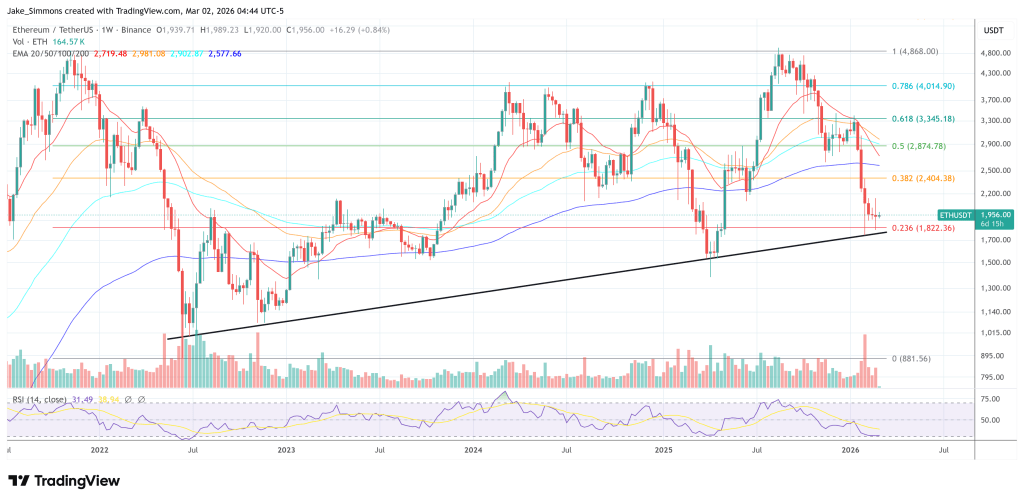
Featured image created with DALL.E, chart from TradingView.com
Editing process because bitcoinist is committed to delivering thoroughly researched, accurate and unbiased content. We adhere to strict sourcing standards and every page is rigorously reviewed by a team of top technology experts and experienced editors. This process ensures the integrity, relevance and value of our content to our readers.