Scientists have taken on the role of “cosmic archaeologists” to discover a rare, iron-deficient second-generation star – essentially a fossil record of the universe’s chemical evolution. Just as uncovering artifacts here on Earth teaches us about lost generations of humans, this observation provides hard evidence of how the first generation of stars died to chemically enrich their successors.
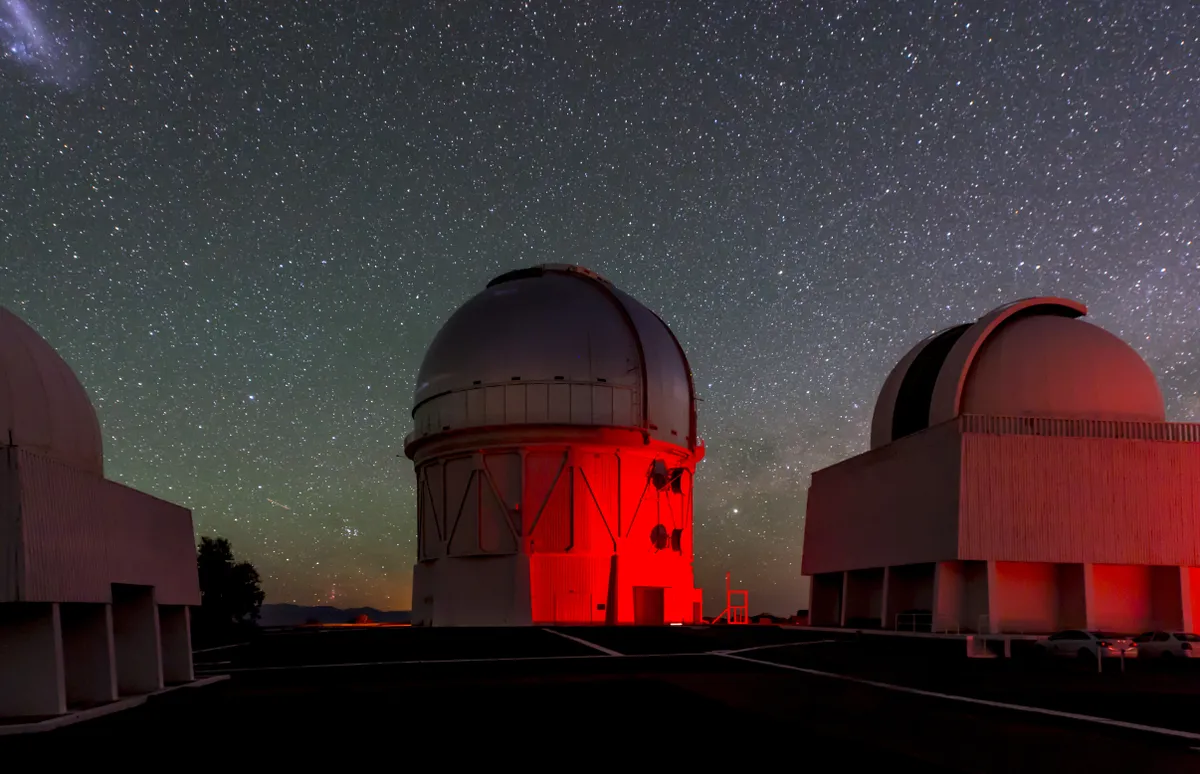
The second generation, or POP II, star was discovered in the dwarf galaxy Pictor II, located about 150,000 light-years from Earth in the constellation Pictor, using Dark energy camera (DECam) mounted on top of the Víctor M. Blanco 4-meter telescope. Designated PicII-503, the star has only 1/40,000 the iron of the Sun, making it a third-generation, or (somewhat confusingly) POP I star. The fact that PicII-503 has the lowest concentration of iron ever seen outside The Milky Way making it one of the most primordial stars ever discovered.
The article continues below
“Discoveries like this are cosmic archaeology, uncovering rare stellar fossils that preserve the fingerprints of the universe’s first stars,” Chris Davis, National Science Foundation Program Director for NOIRLab said in a statement.
A kind of magic
The first stars in the universe, or POP III stars, were born when the chemical abundance of the cosmos did not extend beyond hydrogenhelium and a smattering of heavier elements, which astronomers collectively call “metals”. This meant that these POP III stars were also dominated by hydrogen with only a little helium and very little in the way of metals. These stars forged the first carbon and iron in their cores, material that was distributed into the interstellar medium as these stars passed supernova and exploded at the end of life.
Interstellar clouds of gas and dust enriched with these metals eventually cooled and collapsed, giving birth to the second generation of stars, stars that were more metal-rich thanks to the donation of heavy elements from their predecessors. That makes POP II akin to time capsules, recording an important stage in the chemical enrichment of the universe.
“Discovering a star that unambiguously preserves the heavy metals of the first stars was at the edge of what we thought possible, given the extreme rarity of these objects,” team leader Anirudh Chiti of Stanford University said in the statement. “With the lowest abundance of iron ever recorded in an ultrafaint dwarf galaxy, PicII-503 provides a window into initial element production in a primordial system that is unprecedented.”
The first confirmed example of a POP II star found in a faint dwarf galaxy, PicII-503, was highlighted as an extremely metal-poor star in data collected by DECam’s MAGIC (Mapping the Ancient Galaxy in CaHK) survey. This 54-night observation was developed with the explicit purpose of identifying the oldest and most chemically primitive stars in the Milky Way and its dwarf galaxy companions.
“Without data from MAGIC, it would have been impossible to isolate this star among hundreds of other stars in the vicinity of the ultra-faint dwarf galaxy Pictor II,” Chiti said.
Chiti and colleagues combined MAGIC data with observations from Very large telescope (VLT) in the Atacama Desert region of northern Chile and the Baade Magellan Telescope to detect the low abundance of iron and calcium of PicII-503, the lowest seen outside our home galaxy. In turn, this revealed that PicII-503 was the first record of chemical enrichment found in a dwarf galaxy.
One possible explanation for the shockingly low iron-to-carbon ratio of PicII-503 is that when POP III stars went supernova, these explosions were relatively low in energy. That would have meant that while lighter elements like carbon were blasted into the interstellar medium, heavy elements like iron fell back into the wreckage of the supernova.
The fact that PicII-503 is found in one of the smallest dwarf galaxies ever seen, with a correspondingly low gravitational influence, supports the idea that POP III stars die in low-energy supernovae.
“What excites me the most is that we have observed a result of the very first element production in a primordial galaxy, which is a fundamental observation!” Chiti said. “It also ties cleanly to the signature that we have seen in the lowest metallicity halo stars of the Milky Way, tying together their origins and the first-star-enriched nature of these objects.”
The team’s research was published Monday (March 16) in the journal Natural astronomy.