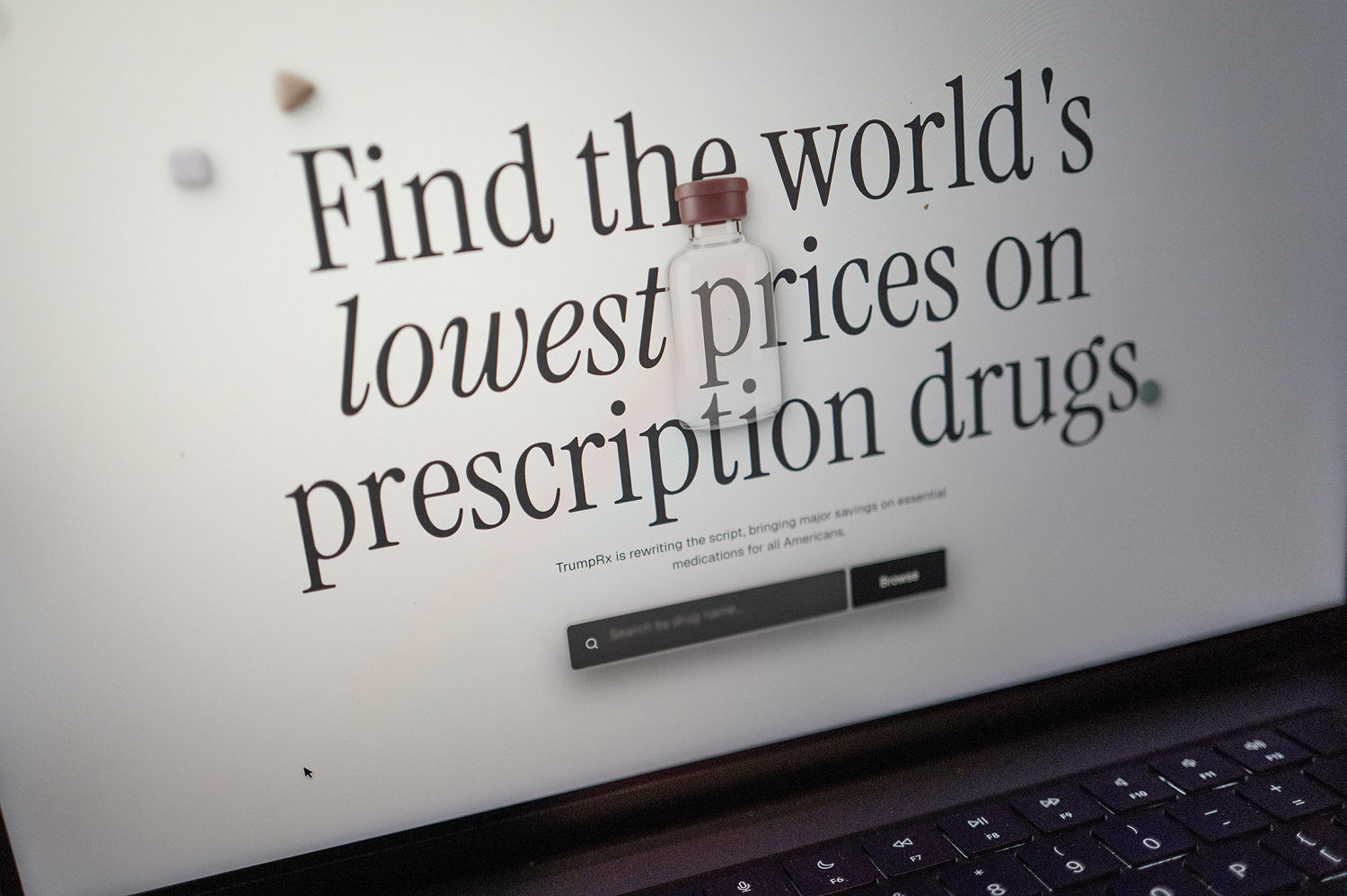
Americans are angry about drug prices. The Trump administration’s answer? New website.
But more than a month after launch, the site, TrumpRx.gov, is small — offering discounts on just 54 drugs. Many of those drugs already have cheaper generic versions or savings programs available elsewhere, and the discounts can’t be used with insurance or count toward deductibles. Awareness of the site is limited.
Whether TrumpRx actually lowers drug prices is important in ways that go beyond the website’s success. For President Donald Trump, it ties in with a broader push on health care spending as the midterms approach. But for many Americans, the problem touches on something deeper — years of frustration with a system they say feels stacked against them, where prices are hard to track and it’s not always clear if they’re getting a fair deal.
Health policy experts say what the administration does next will determine whether TrumpRx remains another option or helps make prescription drug costs easier to navigate.
“The idea isn’t exactly new, but it has Trump branding,” said Audrey Kearney, senior poll analyst at KFF, a nonpartisan health policy research group. “It’s another option for consumers, and we’ll have to tune in to see if it makes a real difference.”
Kearney, who co-authored a survey published last week by KFF, said nearly a third of people who take prescribed medications have heard at least something about TrumpRx. Only 7% said they had visited a site to compare prices, rising to nearly 16% of people taking GLP-1 drugs.
Even the White House acknowledged that the website is still in its early days. A White House official declined to say how many people have visited the site or how many drugs will be added this month.
IVF treatments and GLP-1 weight loss drugs are among the most searched drugs so far, the official said. The administration plans to add a “large batch” of drugs to the platform soon, and hopes to work with Congress to codify some drug pricing deals into law as part of a broader health care plan, the official said.
“We don’t see this as a final product,” the official said. “The goal here is to pass the president’s Great Healthcare Plan to codify these (most favored nation) deals, so if people use insurance to buy these drugs, they can also access the savings.”
There are no indications that Congress will take up the legislation.
What can TrumpRX do differently?
In practice, TrumpRx will be available at existing discount sites such as GoodRx or Mark Cuban Cost Plus Drug Co. The way it works, it lets people compare cash prices for drugs, but with fewer tools and less flexibility — and no way to buy directly through the site.
“What’s fascinating about TrumpRx is that it’s being touted as this new, innovative thing, when in fact, it’s kind of a combination of something that already exists,” said Antonio Ciaccia, CEO of 46Brooklyn, a nonprofit group that tracks prescription drug prices.
The site relies on GoodRx’s pricing data and technology to power many of its listings, Ciaccia said: Coupon cards are processed through GoodRx’s network, using the same BIN and PCN numbers — the codes pharmacies use to process drug discounts at the pharmacy counter.
What TrumpRX needs most is scale, said Jeffrey Joyce, director of health policy at the University of Southern California’s Schaefer Center for Health Policy and Economics.
Of the initial batch of drugs on the site, Joyce said, roughly half had generic versions that were often much cheaper. Those generics are widely available through other discount sites or at local pharmacies.
“In its current form, it is of limited use to uninsured consumers,” Joyce said. “If they get rid of everything that has a generic equivalent, you’re looking at a site with 22 drugs. And it’s basically a roundup of the usual suspects. It’s some IVF, some GLP-1s. It’s not a broad spectrum.”
“One thousand and fifty-four drugs, just proportionally speaking, is a small fraction of the population,” Ciaccia said.
Still, both Joyce and Ciaccia say TrumpRx has the potential — with the right investments — to go beyond existing discount sites.
Ciaccia said the platform could play a big role for people with private or employment-based insurance, where patients don’t always have access to low-cost medicine.
Pharmacy benefit managers, who decide which drugs go on insurers’ formularies, tend to get bigger discounts on higher-priced brand-name drugs, sometimes excluding lower-cost generics — a practice that drives up costs for patients.
In such cases, patients may turn to a platform like TrumpRx to find a lower-priced brand-name drug, even if their insurance supports the same drug at a higher cost.
“I don’t think TrumpRX is going to be a solution to the problems that exist today, but maybe it will replace the system we have,” Ciaccia said. “If rebates start to improve, there will be an option for employers who are already getting the short end of the stick in their benefit designs from PBMs.”
Joyce said the forum could be more useful by providing more transparency around drug prices, which are central to the Trump administration’s health care agenda.
He suggested Cost Plus Drug Co. as a starting point, where users can see a breakdown of drug costs, including ingredient costs, markup and shipping.
Currently, TrumpRx shows what people pay compared with the drugmaker’s list price. However, that comparison can be misleading, because insurance rarely pays that price, and even people without insurance often get discounts.
Improving transparency shows how prices vary by pharmacy or region, how discounts are negotiated, and how insurance compares with cash prices.
“It’s the uninsured who are the most screwed,” Joyce said. “There are lower prices, and from an educational and informational standpoint, I think it’s worth it.”