“By freeing up funds, we can all take some time off, giving me the opportunity to paint full-time.”
From northern roots to life in images
In the far north of Sweden, where long winters bring reflection and indoor living, Krister Flodin’s relationship with art began almost as soon as he could hold a pencil. Born in Luleå, he found solace in drawing from an early age, often choosing paper and color over the usual distractions of childhood. Visual expression became his first language, a way of viewing the world and interpreting its subtleties. As other children played sports, he studied their movements and translated them into lines and shapes. This early instinct was not a passing hobby but a deep-seated calling. Even then, he realized that art would remain central to his life, although the path forward would be more complex than his youthful ambitions suggested. His formative years established a sensitivity to the nuances of human gesture and emotion that still influences his practice today.
Despite his enthusiasm, outside expectations gradually changed his trajectory. Growing up in a culture shaped by Jante Law and a strong Lutheran work ethic meant that ambition was often tempered by humility and caution. Artistic aspirations do not easily fit into the definition of a stable or respectable career. His family questioned whether art could be considered “real work,” a doubt that fed into his own thinking. Social pressure and self-doubt caused him to shelve his dreams of becoming a fine artist. Rather than pursuing freelance painting, he chose a more traditional route in the creative industries, seeing it as a pragmatic compromise between imagination and financial security. The tension between inner desire and outer responsibility would stay with him for decades.
This compromise led to a long and successful career in advertising. Starting in 1987, Flodin built a career centered on visual communication as a graphic designer, illustrator, and later art director. He has developed marketing campaigns and images for high-profile clients such as Adobe, the Financial Times and Deutsche Bank. The industry honed his eye for composition and clarity, training him to remove unnecessary elements and convey information accurately. Yet amid the constant stream of deadlines and client briefs, the underlying desire to paint for myself never faded. The discipline and skills he acquired during these years would later become invaluable, but at the time they came at a personal cost that ultimately emerged in dramatic fashion.
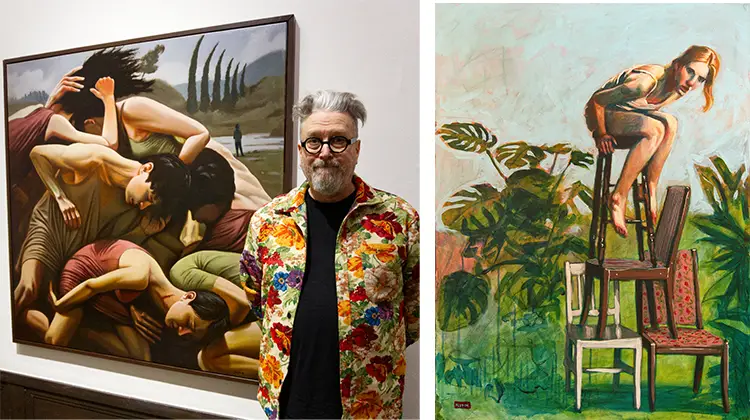
Christer Frodin: Burnout, Loss, and the Birth of the Freedom Project
2020 is a turning point that Frodin could not foresee and could not avoid. After working in a demanding industry for decades, he experienced severe burnout that eventually led to a breakdown, forcing him into rehab. This crisis is not limited to physical exhaustion; It became an existential reckoning. During this time, he realized that returning to the pace and pressure of freelance graphic design was no longer possible. His nervous system simply couldn’t handle it. Meanwhile, a profound personal tragedy struck when his partner’s son died. In his own fragile state, he felt the need to stay strong for her and postpone his own grief. A year later, the weight of accumulated trauma and fatigue has fully surfaced, leaving no room for denial. The life he had built was no longer sustainable.
In the midst of this upheaval came a radical decision. Together with his partners, Frodin launched what they called the “Freedom Project.” They sold their large apartment and car, intentionally downsizing to relieve financial pressure and create space for change. The move was both practical and symbolic, freeing up funds and allowing him to take a sabbatical and devote himself entirely to painting. A series of vivid dreams reinforced his sense of needing to step into uncertainty and abandon the safety net of his previous career. This leap into the unknown was born not of impulse but of necessity. By eliminating the superfluous and redefining their way of life, they built a framework in which art could finally take precedence over obligation.
During his first year of painting full-time, his canvases bear the marks of exhaustion and psychological stress. He sought to depict the fatigue that sleep cannot repair, as well as the mental fog and frayed nerves that accompany ennui. Over time, however, his thematic focus broadened. While isolation and exhaustion remain, they evolve into broader inquiries into identity, vulnerability, and social dynamics. He became increasingly interested in the fragile balance between strength and sensitivity and the experience of being human among other human beings. The crisis that once threatened to silence him instead became the catalyst, transforming a personal breakdown into an ongoing artistic investigation.
Echoes of history, music and the weight of social space
Frodin’s influence is rooted both in life experience and in a fascination with earlier centuries. The upheavals of recent years have shaped his emotional vocabulary, but he also has an unusual fondness for the eighteenth century. He often imagined himself strolling through Stockholm in 1763, wearing a powdered wig and three-cornered hat, immersed in the aesthetics and atmosphere of the era. This imaginative connection extends to the visual language of Baroque and Rococo art, as well as the classical music of the same period. Alongside these historical references are giants of modern art such as Andy Warhol, Salvador Dali, David Hockney, Gerhard Richter and Lucian Freud. Their mastery of light, symbolism and psychological intensity resonated with his own exploration of the meaning of figurative painting.
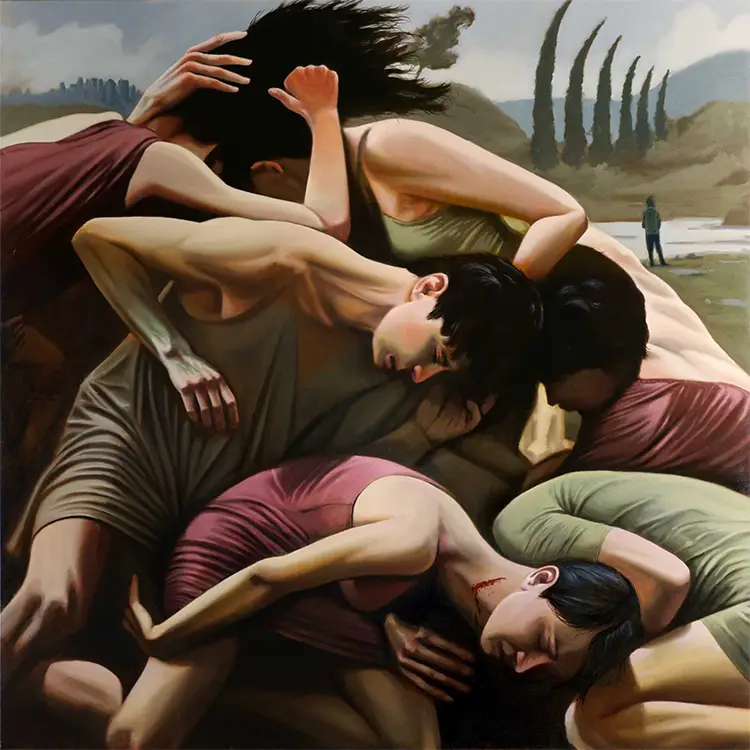
Music also plays a crucial role in shaping his studio environment. The vast soundscapes of Pink Floyd, the rhythmic intelligence of the Talking Heads, and the experimental textures of Brian Eno accompany his creative process, creating an atmosphere that oscillates between introspection and conceptual clarity. This fusion of historical imagination and contemporary influences is clearly visible in his painting “Socialite”, an oil painting on canvas with dimensions of 140 x 140 cm. The work depicts social interactions from an introvert’s perspective, rendering the invisible pressures of group dynamics into something almost tangible. The social positioning appears heavy and slightly threatening, capturing the psychological stress that public participation can bring. The painting’s inclusion in Stockholm’s Liljevalchs Konsthall’s prestigious Spring Salon confirms its resonance in the wider cultural conversation.
Whether a painting begins with a clear narrative or emerges from abstraction, storytelling remains at the heart of his creative approach. He often starts with a concept that needs to be expressed and lets the image evolve as layers accumulate. Other times, he would quickly cover the canvas to eliminate the intimidating whiteness, trusting that the meaning would emerge intuitively. Multiple works often occurred in parallel, allowing him to shift focus when one work stalled. This approach reflects his graphic design training and his commitment to mindfulness. Painting is a form of meditation, a disciplined yet open-ended dialogue between chaos and structure, intention and chance.
Krister Flodin: Daily Ritual and Renewed Vision
Life in the studio now unfolds at a pace designed to protect his health. He often wakes up to the sound of his companion making coffee instead of being woken up by the alarm clock. When the weather permits, he bikes to his studio in Stockholm’s WIP, a collective home with 90 studios and about 70 artists. His own space is approximately thirty square meters, large enough to accommodate canvases, sketches and a lounge chair, which is essential for his daily work. Each day starts with administrative tasks like answering emails and managing finances. He sets aside one day every other week for accounting. Before painting, he sits quietly, closes his eyes and focuses on his breathing, grounding himself before touching the canvas. Regular breaks are necessary as the after-effects of burnout still need to be respected.
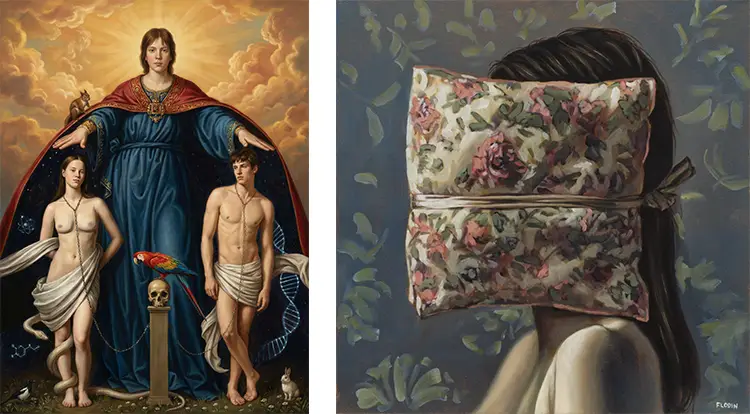
Among his current projects is a painting tentatively titled “Salvator Mundi.” The work responds to the contemporary global climate by proposing that redemption will not come through political leaders or traditional messianic figures. Instead, he envisions a restorative shift toward feminine energy to balance centuries of productivity-driven and profit-centered leadership. The work draws inspiration from the theme of Our Lady of Mercy, depicting a woman sheltering the manifest world under a cloak. A naked couple symbolizes humanity, chained to skulls, a reminder of death and the fear of death. Surrounding them are representations of DNA strands, atoms and stars, evoking the material basis of existence. A golden area extends above the cloak, suggesting pure potential, comparable to the wave function in quantum physics and the mythical Asgard. A squirrel, referencing Viking mythology, sits on the woman’s shoulder, acting as an intermediary between the tangible and the infinite, connecting visible reality and invisible possibilities.
The post Krister Flodin: Painting the Weight of Humanity appeared first on AATONAU.