Iranian and Russian naval units simulate rescuing a hijacked ship during a joint naval exercise at the Bandar Abbas port near the Strait of Hormuz in Hormozgan, Iran, on February 19, 2026.
Anadolu | Anadolu | Getty Images
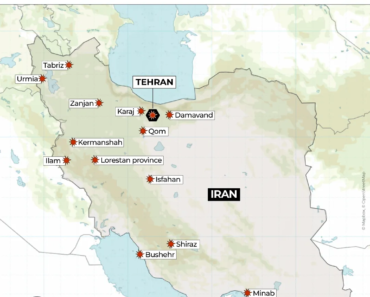
A new wave of attacks on the United Arab Emirates’ energy infrastructure has raised concerns about chronic supply disruptions amid the Iran war.
After the world’s largest ultra-sour gas developments were hit by a drone, a fire broke out in the UAE’s Fujairah oil industry zone and another tanker collided near the strategically important Strait of Hormuz.
The UAE reopened its airspace on Tuesday after a brief shutdown following a fire caused by an Iranian drone attack on a fuel tank.
Operations at the UAE’s massive Shah gas field were suspended on Tuesday after a drone strike caused a fire at the facility, according to Abu Dhabi officials. No injuries were reported from the incident.
The Shah gas field is located 180 kilometers southwest of Abu Dhabi and is operated by a joint venture between ADNOC and Occidental Petroleum Corporation. It has the capacity to produce 1.28 billion standard cubic feet of gas per day and 4.2 million tonnes of sulfur per year.
Separately, a drone strike sparked a fire in the Fujairah Oil Industry Zone, a critical hub for the UAE’s crude exports and bunkering operations. The Fujairah government media office said on Tuesday that there were no casualties.
Fujairah, one of the world’s major hubs for storing crude and fuels, is located on the eastern seaboard of the UAE and serves as a major shipping hub for the wider region.
It has faced repeated attacks in recent weeks, underscoring the vulnerability of the UAE’s only export route that bypasses the Strait of Hormuz.
Shipping through the Strait of Hormuz, one of the world’s major energy choke points, has come to a virtual standstill since the US and Israel launched strikes against Iran on February 28.
Iran has retaliated by targeting ships trying to pass through the maritime corridor, with several incidents reported in recent weeks.
Stretching about 248 miles from the onshore oil facilities at Habshan to Fujairah, the UAE’s Abu Dhabi Crude Oil Pipeline (ADCOP), or Habshan-Fujairah Oil Pipeline, is estimated to handle 1.5 million barrels per day, with a total capacity of 1.8 million barrels per day.
Oil prices
A tanker was also hit by an unidentified projectile while at anchor about 23 nautical miles east of Fujairah, UAE, in the Gulf of Oman, according to an update from the United Kingdom Maritime Trade Operations (UKMTO) Center on Monday.
UKMTO said the incident caused minor structural damage, no injuries to staff and no environmental impact reported.
The latest report comes after six ships were damaged in the Persian Gulf, the Strait of Hormuz and the Gulf of Oman last week, suggesting that Iranian oil prices could rise to $200 a barrel.
A plume of smoke rises from a fire near Dubai International Airport in Dubai on March 16, 2026. Flights are gradually resuming on March 16 at Dubai Airport, previously the world’s busiest for international flights, after a “drone-related incident” in which an Iranian Gulf attack sparked a fuel tank fire nearby, airport operators said.
– | Afp | Getty Images
Oil prices were higher on Tuesday morning as energy market participants closely monitored ongoing supply disruptions.
International Brent is raw Futures for May delivery advanced 3.2% to $103.40 a barrel, while U.S. West Texas Intermediate Futures for April delivery were up 3.4% at $96.69.
Prices have risen nearly 40% since the US-Iran war, reaching their highest level since 2022, as shipping through the strait has been severely disrupted. Brent closed above $100 for the first time in four years last week.
(tags to translate)Energy