LONDON – President Donald Trump has bullied and threatened America’s NATO allies. Now they want those same countries to help unblock the Strait of Hormuz — and their response isn’t exactly enthusiastic.
“This is not our war, we did not start it,” German Defense Minister Boris Pistorius told reporters on Monday.
It appeared to sum up the mood of US allies, with leaders from Berlin to London expressing reservations about Trump’s demands and suggesting there are no immediate plans to offer military support to reopen the critical waterway.
Iran has effectively closed the trade route in response to the US-Israeli offensive launched last month. This raised global oil prices and threatened an international economic shock, as economists had warned before the war began.
Follow live coverage here.

Trump called on the “countries of the world that receive oil through the Strait of Hormuz” to “take care of that route,” he said in a Sunday post on Truth Social. In an interview with the Financial Times that same day, he went further, warning that NATO would have a “very bad future” if its members did not help free up the strait.
Trump is “a little rich” asking for help from countries he has insulted in the past, former Estonian President Toomas Hendrik Ilves told NBC News in a phone interview Monday.
Earlier, Estonian Foreign Minister Margus Tsakna called Trump to provide more information. Europe needs to understand Trump’s “strategic goals. What will the plan be?” He asked.
Although often wary of risking the president’s wrath, many European governments have been reluctant to be dragged into war with Tehran.
Some, such as Spain’s leftist government, rejected the Hormuz demand outright.
Defense Minister Margarita Robles said “Spain will never accept any stopgap measures” to keep the strait open, “because the objective must be to end the war and end it now.”
Even in Italy, whose Prime Minister Giorgia Meloni has previously portrayed herself as a Trump whisperer, the government refused to engage.

“Diplomacy needs to prevail,” Foreign Minister Antonio Tajani told reporters.
In Britain, Trump criticized Prime Minister Keir Stormer for not participating in the initial attack on Iran.
Stormer told a news conference on Monday that he was “working with all our allies, including our European partners” to “restore freedom of navigation” as soon as possible.
“Finally, we need to reopen the Strait of Hormuz to ensure stability in the market,” he said. “That’s not an easy task.”

But Stormer made it clear that he would not be drawn into a “broad war” and that any Hormuz mission would have to be a broader effort – involving the US and Gulf states – rather than something for NATO.
Meanwhile, Japan and Australia have said they have no plans to send ships to aid Trump’s appeal.
Other proposals are on the table, such as a deal struck in 2022 that ensured Ukraine could export grain amid the Russian offensive, top European diplomat Kaja Kallas said Monday.
But member states rejected a proposal to expand the current European Union naval mandate in the Red Sea to include the Strait of Hormuz. “For the time being, there was no appetite to change the operational mandate,” Kallas said.
The spat over the strait marks the latest strain of tension between the Trump administration and Washington’s historic friends across the Atlantic.
Last year, the president refused to rule out using military force to seize Denmark’s semi-autonomous island of Greenland. He then falsely claimed that NATO allies were not fighting on the front lines in Afghanistan – causing dismay and anger across the continent.
“It’s a bit rich – after you threaten Denmark and insult the memory of almost 1,000 NATO troops who fought in Afghanistan – oh, you should all come and help us now,” said Ilves, who was president of Estonia between 2006 and 2016. They again?” he added.
“It was a political nonstarter from the beginning,” he said. “I’m not sure what they expected.”
Ultimately, much of the European skepticism over Trump’s Hormuz demand stems from his wariness of war.
“The European answer should be: the way to end the problem is to end the war, not to join it,” said Sven Biskop, director of the Belgian think tank Egmont Institute. “Don’t be intimidated by threats on NATO” from Trump, he said.

Asked for comment on the European response, the White House directed NBC News to comments made by Press Secretary Carolyn Leavitt, who told reporters that these countries should help because they “are benefiting greatly from the United States military taking away the Iranian threat.”
“The president is absolutely right to call on these countries to do more to help the United States reopen the Strait of Hormuz so that we can prevent this terrorist regime from restricting the free flow of energy,” he said.
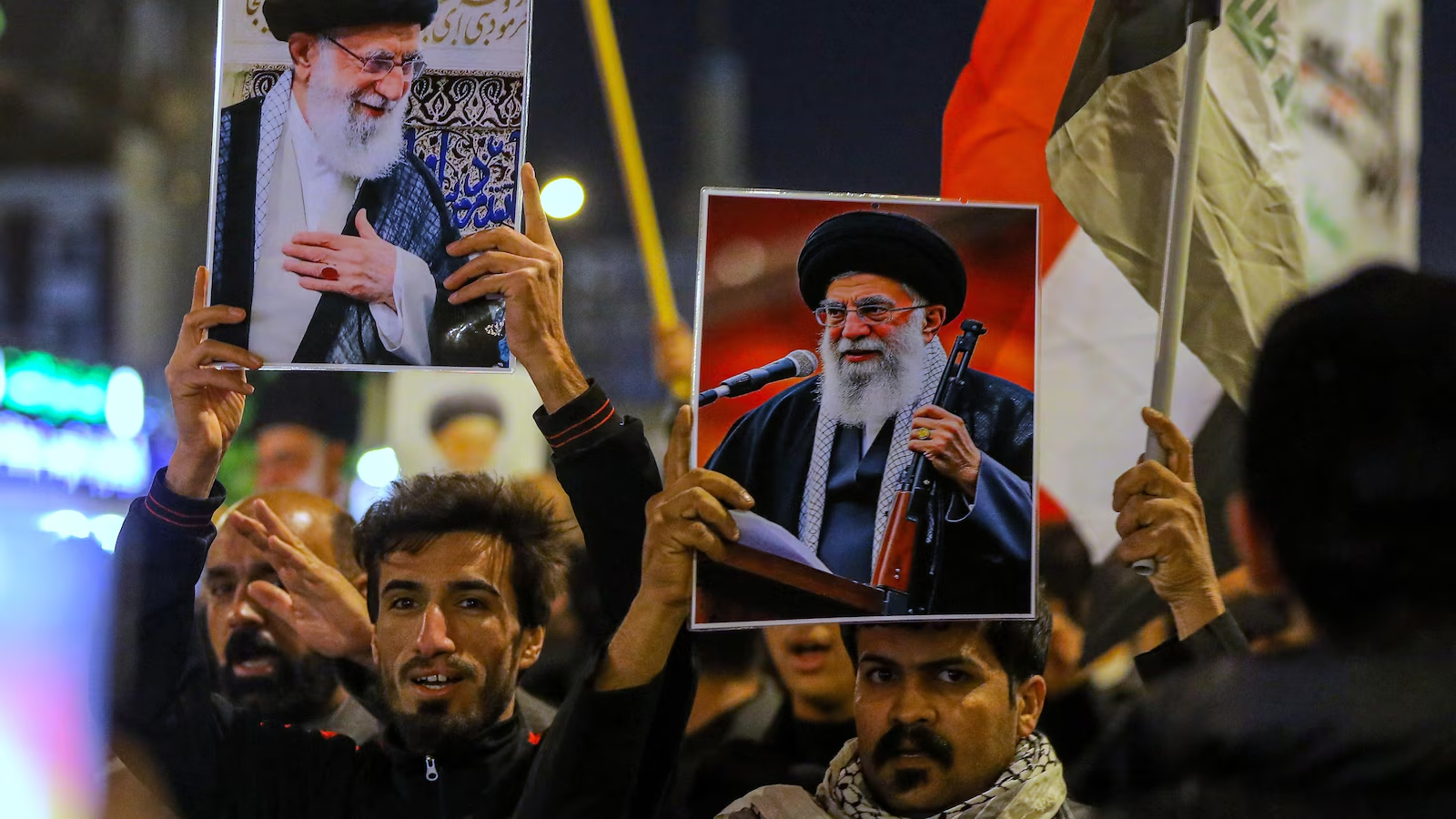
Although several ships have been bombed while trying to cross the strait, Iran denies that it has completely closed the narrow neck of water. After the US and Israel started a war, it said it would attack the ships of those countries or their allies.
“From our point of view the Strait of Hormuz is open and closed only to the enemy,” Iranian Foreign Minister Abbas Araghi wrote in a telegram.