Bitcoin was the first asset to rate the Iran war, as it was the only liquid market when the US and Israel first launched their attack on Saturday, a few weeks ago.
It fell 8.5% that day. Two weeks later, it outperformed gold, the S&P 500, Asian stocks and the Korean stock market. Only oil and the dollar have done better, both directly benefiting from the conflict itself.

Bitcoin’s safe-haven status — a concept that was debated amid last year’s price decline — appears to be returning to the minds of investors. In addition, it acts as the fastest shock absorber in global markets, as the upswing is faster while the downswings are less.
The pattern becomes clearer when you see that Bitcoin has found buyers after each sale.
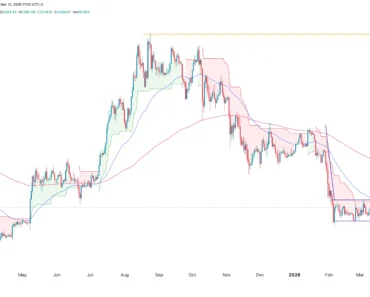
On February 28, the day of the first strike, it reached $64,000. On March 2, after Iran’s retaliatory missile strikes on the Gulf states, the base was $66,000. By March 7, after a week of ongoing conflicts, the lowest was $68,000. After the tanker attacks on March 12, it held $69,400. And after Harg Island on Saturday, the lowest was $70,596.

In simpler words, each seller finds buyers at a higher level than the last one.
The trend level of the lows in one event increased by about $1,000-$2,000, compressing the range from the bottom, while $73,000-$74,000 is kept as a ceiling, which has now rejected Bitcoin four times.
This tension should eventually be resolved. Either the floor will hit the ceiling and bitcoin will break above $74,000 in the next attempt, or the pattern will break and a bigger rally will finally overwhelm the buying.
Stay strong
The most interesting part is that Bitcoin has done better than other assets over the past two weeks.
Since the start of the war, oil has risen more than 40%, as the chart below shows. The S&P 500 fell. Gold was volatile in both directions. Asian stocks suffered their worst week since March 2020.

All of this doesn’t mean that bitcoin is suddenly a safe haven, but it’s still making headlines. But it recovers faster each time, and each recovery is maintained at a higher level.
The contrast with the beginning of this year is sharp. In early February, a sudden cascade of liquidations wiped out $2.5 billion in leveraged positions in one weekend as bitcoin fell to $77,000, wiping nearly $800 billion off its October peak in market value.
The episode looked like an event that could shatter market confidence for months. Instead, it appears to have cleaned up the weakest hands and repositioned itself, leaving a lean market that has absorbed every headline in the war without a repeat of such forced selling.
At the same time, the macro layer adds context. Trump said late Friday that he had protected the oil infrastructure of Iran’s oil-producing island “for reasons of decency” but would “immediately reconsider” if Iran continues to close the Strait of Hormuz. Iran responded that any attack on its energy infrastructure would lead to retaliatory attacks on US-related facilities.
This conditional threat is new, and if it materializes, it will significantly worsen the supply disruption, which the IEA has already called the largest in history.
But bitcoin’s adaptation to war tells traders something about what this market has become.
It’s not a safe haven, and it’s not a risk-only asset. It has become a 24/7 liquidity pool that absorbs shocks faster than anything else because it is the only thing that trades when shocks hit.