Ethereum is currently testing key resistance levels as the broader cryptocurrency market attempts to recover from a recent period of volatility and downward pressure. After weeks of corrective price action, ETH has begun to stabilize, with buyers slowly pushing the asset higher as traders reassess market conditions and liquidity flows in the digital asset.
While price action offers the possibility of a short-term rebound, derivatives market data suggests that more structural changes may be brewing below the surface. According to the latest analysis by CryptoQuant Arab Chain analyst, the indicator ETH Binance Futures Smart Money CVD (90D) reflects a significant change in demand dynamics in the Ethereum derivatives market on Binance.
The indicator tracks the cumulative difference between aggressive buy orders and aggressive sell orders executed by market orders in the futures market. Because these orders represent traders looking to execute trades immediately, the metric provides valuable insight into real-time demand pressure from more active market participants.
According to the latest data, aggressive buying volume in Ethereum futures on Binance recently reached about $4.583 billion, while aggressive selling volume was around $4.576 billion. As a result, Taker Delta recorded a positive daily value of around $7.15 million, indicating a slight advantage for buyers in this session as the market tried to regain momentum.
Smart Money CVD still reflects dominant selling pressure
Despite the recent session showing a slight advantage for buyers, the broader structure of the Ethereum derivatives market is prone to selling pressure. According to the analysis, the 90-day Smart Money CVD is still recording a negative reading of around -$5.71B, indicating that aggressive selling activity has outweighed aggressive buying over the past three months.

From a practical perspective, this means that market participants were more willing to sell Ethereum using market orders to collect during that period. Because CVD tracks the cumulative difference between buy and sell orders executed directly in the market, sustained negative values usually reflect a market environment dominated by sellers closing positions or initiating short trades.
However, analysts note that a negative CVD reading does not automatically translate into an immediate downward price movement. Market dynamics can sometimes produce a different result through a mechanism known as liquidity absorption.
In such cases, large buyers place limit orders in the order book, which allows them to increase the selling pressure without raising the price in the short term. This behavior can create a temporary equilibrium in which aggressive sellers continue to bid while patient buyers gradually accumulate supplies.
If this absorption process continues, it could eventually reduce selling pressure and set the stage for a possible reversal in market momentum.
Ethereum is testing a long-term support zone after a multi-month correction
The weekly chart shows that Ethereum is trying to stabilize after a long corrective phase that started after it was rejected near the $4,800 area in 2025. Since that peak, the price action has formed a clear sequence of highs and lows, confirming a stable bearish structure on higher timeframes.
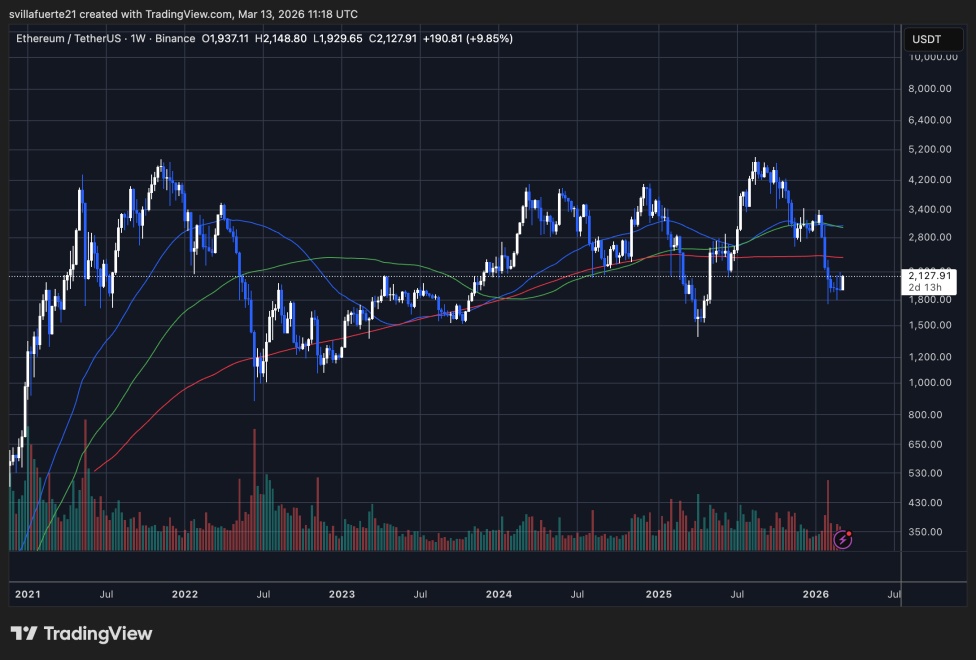
Celofoti has recently pushed ETH sharply below the $2,400-$2,600 zone, which previously acted as an important support zone during the earlier stages of the consolidation. This breakdown led to a rapid decline to the $1,800 area, where buyers eventually stepped in and triggered a short-term pullback.
Currently, Ethereum is trading around $2,100, a price zone that appears to be acting as a temporary balance between buyers and sellers. From a technical perspective, this area now acts as an important cyclical level. Sustained price action above this area could allow ETH to recover to the $2,600 resistance area, where the 100-week moving average is currently trending.
However, the broader structure remains unstable. The 200-week moving average sits just below the current price and could serve as a key long-term support level if selling pressure reverses.
The volume data also shows high activity during the recent decline, suggesting that the market has experienced a significant reversal phase. Whether this is a capitulation or just a pause in the downtrend depends on Ethereum’s ability to reestablish higher resistance levels in the coming weeks.
Featured image from ChatGPT, chart from TradingView.com
Editing process because bitcoinist is committed to delivering comprehensive, accurate and unbiased content. We adhere to strict supply standards and every page is reviewed by a team of top tech experts and experienced editors. This process ensures the integrity, relevance and value of our content to our readers.