Astronomers have traced a powerful burst of radiation called a gamma-ray burst (GRB) back to its source, finding a collision between extreme stellar remnants called neutron stars in colliding galaxies. This could reveal more about these extraordinary collisions, thought to be the only events in the universe capable of generating heavy elements like the gold and silver we wear on our fingers and around our necks.
The GRB, designated GRB 230906A, was detected on September 23, 2023 by a number of NASA space telescopes, including the Chandra X-ray Observatory, the Fermi Gamma-ray Space Telescope, the Neil Gehrels Swift Observatory and the Hubble Space Telescope. GRB 230906A was traced back to a neutron star merger in a small galaxy that is itself embedded in a river of gas 600,000 light-years long, or about six times the width of our entire galaxy.
The article continues below
“Finding a neutron star collision where we did is a game-changer,” discovered team leader Simone Dichiara of Penn State University said in a statement. “It could be the key to unlocking not one, but two important questions in astrophysics.”
The first puzzle Dichiara refers to, which could be solved by a neutron star merger in a singular location, is the fact that when astronomers trace GRBs back to their points of origin, they often seem to occur away from dense galactic nuclei where collisions should be more common, and sometimes away from galaxies altogether.
The second puzzle relates to the fact that although collisions with neutron stars are thought to generate the only environments violent and turbulent enough to forge elements heavier than iron, such as gold, silver and platinum, these elements are often detected in stars far from galactic centers that should have formed before it was possible to be enriched with such heavy elements.
“A Collision Within a Collision”
This neutron star collision was originally discovered via GRB 230906A by Fermi, with astronomers then pinpointing the location of the merger using Chandra, Swift and Hubble.
“Chandra’s precise X-ray localization made this study possible,” said team member Brendan O’Connor, of Carnegie Mellon University. “Without it, we couldn’t have tied the burst to any specific source. And once Chandra told us exactly where to look, Hubble’s extraordinary sensitivity revealed the small, extremely faint galaxy in that position. We were only able to make this discovery after we put all the pieces together.”
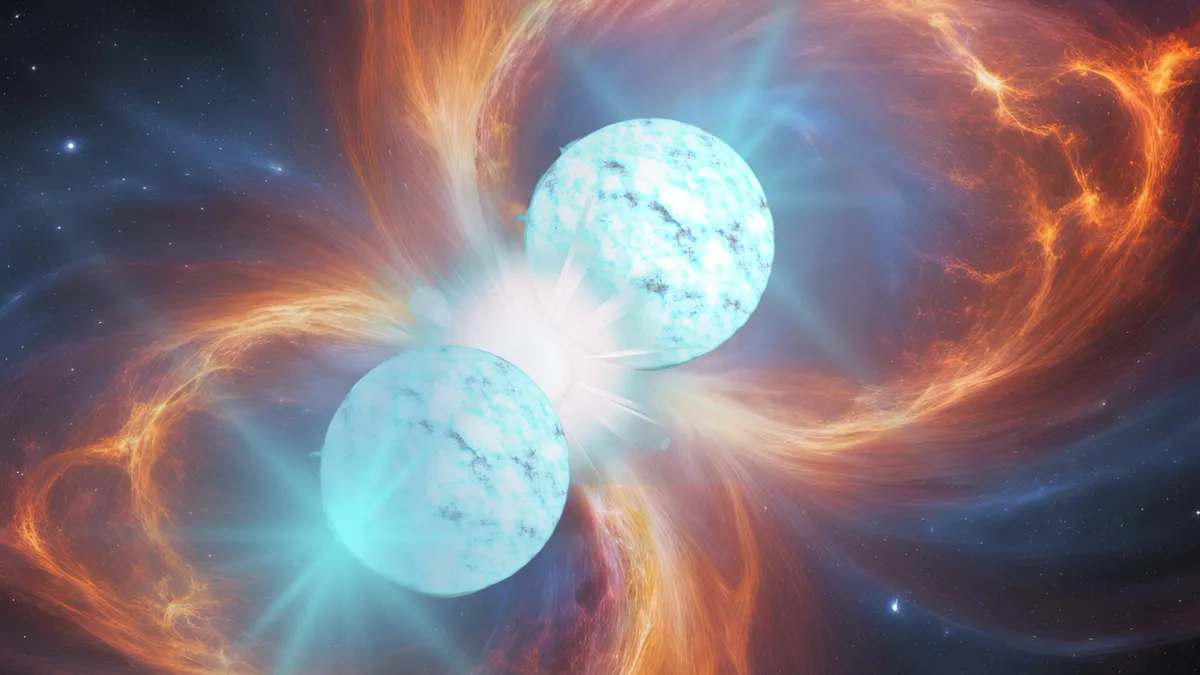
The stream of gas in which the team discovered the home galaxy of this merger is thought to have been created when a group of galaxies collided hundreds of millions of years ago. This event removed gas and dust from these galaxies, forming a gas stream and drifting in intergalactic space.
“We found a collision within a collision,” said team member Eleonora Troja of the University of Rome in Italy. “The galaxy collision triggered a wave of star formation that over hundreds of millions of years led to the birth and eventual collision of these neutron stars.”
The discovery suggests that some GRBs appear to originate outside the boundaries of galaxies because their points of origin are actually small galaxies too faint to be seen.
As for the heavy element enrichment of stars that reside far from the galactic center, the team theorizes highly explosive neutron star mergers like the one that launched GRB 230906A could not only forge such elements, but could also spread them to the outer edges of galaxies.
The team’s research will appear in the Astrophysical Journal Letters.