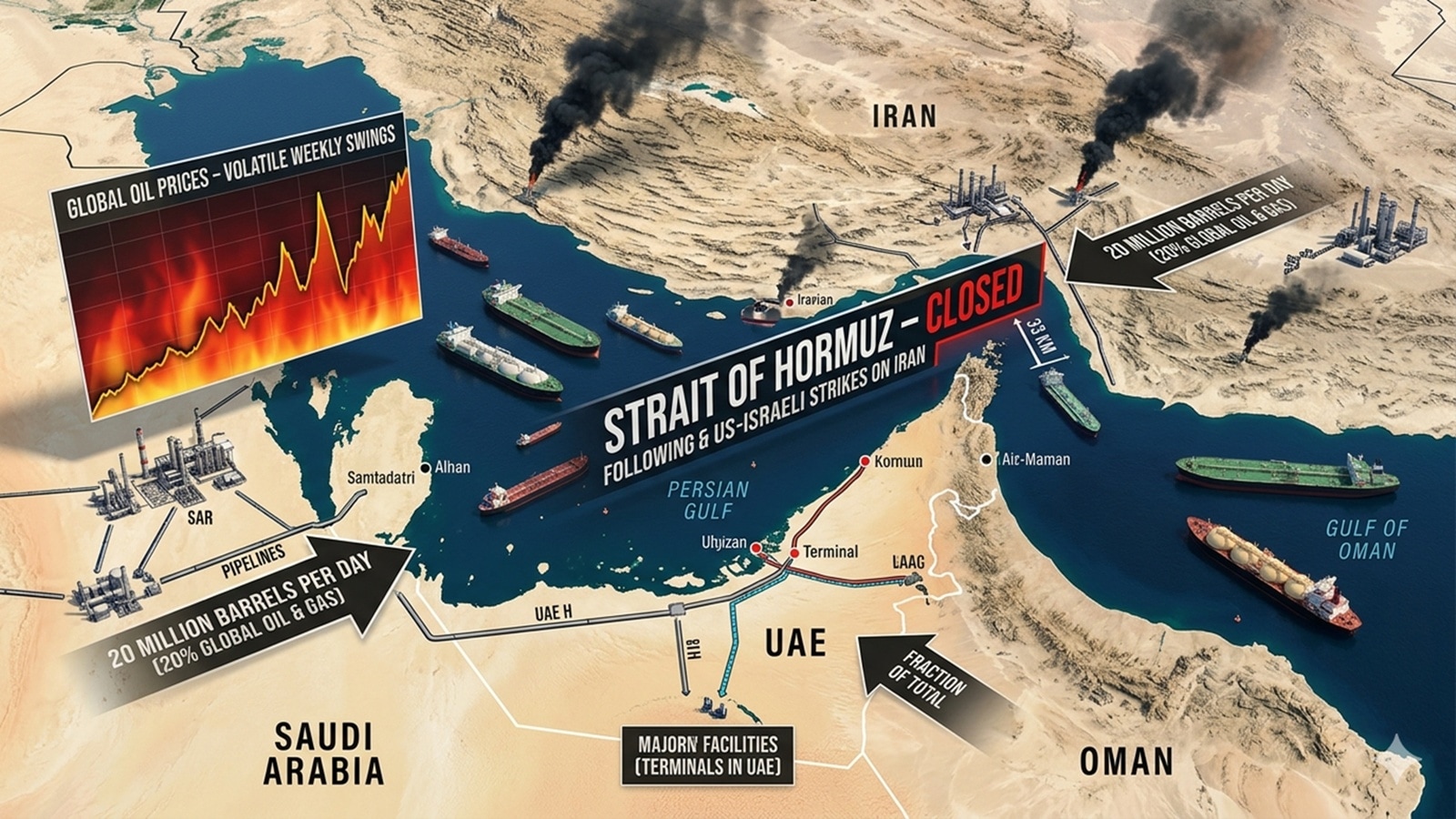
 The Strait of Hormuz supplies one-fifth of the world’s oil and gas produced at Gulf production facilities and refineries to buyers around the world. (AI generated image)
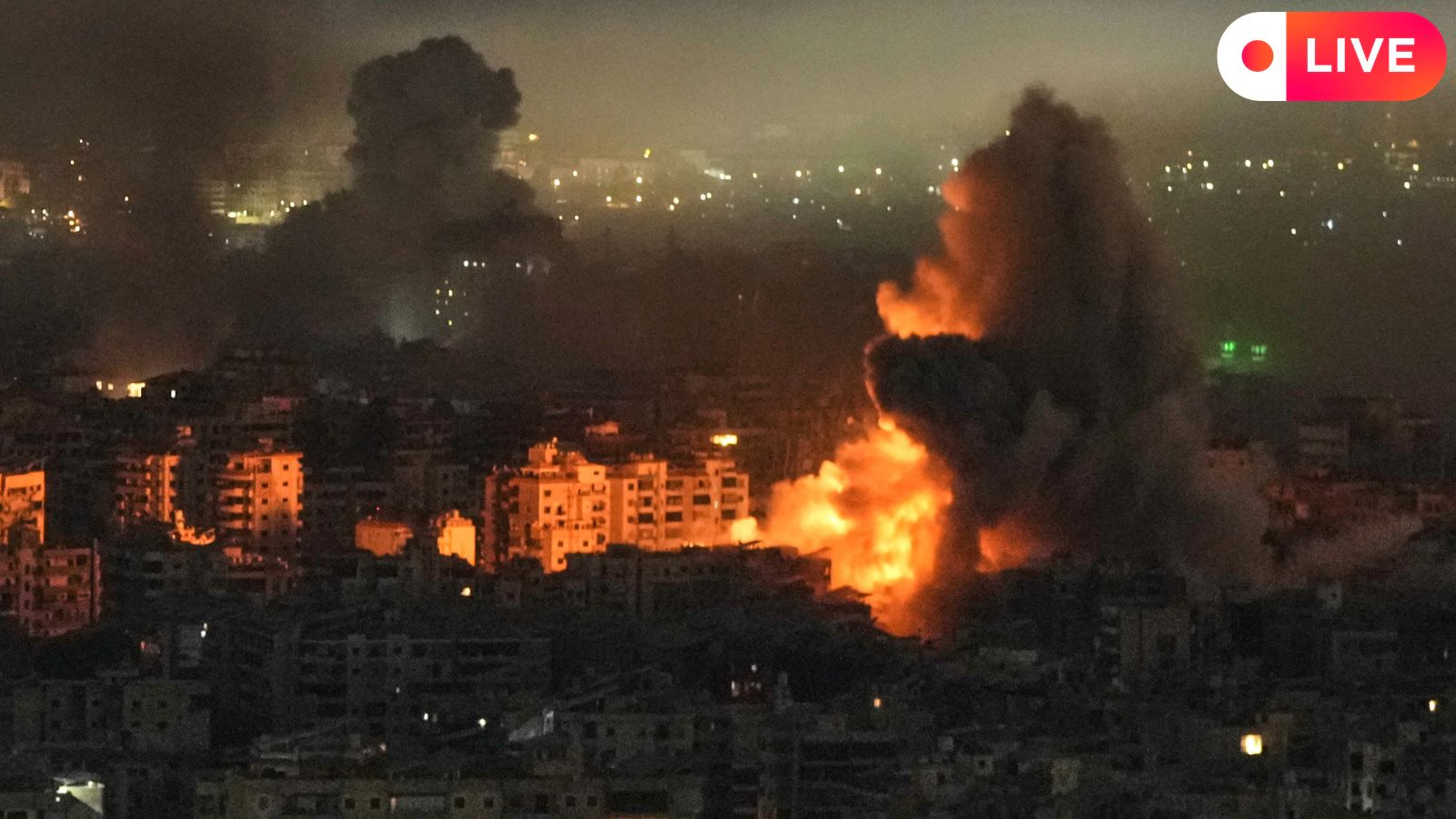
 Global oil markets have been volatile, with prices experiencing some of the biggest swings in history this week after the US-Israel war with Iran choked the flow of crude oil from the key Strait of Hormuz passage.
The Strait of Hormuz transports one-fifth of the world’s oil and gas produced at Gulf facilities and refineries to buyers around the world. The importance of the strait can be judged by the volume of oil transported daily, which is 20 million barrels, making it the world’s busiest oil route after the Malacca Strait between Malaysia and Indonesia.

The Strait of Hormuz is also a major trade route for cargoes of liquefied natural gas (LNG), which are transported in super-refrigerated tankers, The Guardian reported. The Strait has remained effectively closed since the United States and Israel launched attacks on Iran on February 28, and the Islamic nation resorted to attacking US bases in the Gulf region.
Why is the Strait of Hormuz difficult to miss?
Unlike the Strait of Malacca, which transports more than 23 million barrels of oil per day to major buyers such as China, South Korea and Japan, the Strait of Hormuz is difficult to navigate, given its geography, which in turn makes it one of the biggest bottlenecks in the global oil and energy sector.
The Strait of Hormuz connects the Persian Gulf to the west and the Gulf of Oman (and the Arabian Sea) to the east. The Strait connects Iran to the north with Oman and the United Arab Emirates to the south. At its narrowest point, the Strait of Hormuz is only 33 kilometers wide. And it is through this narrow passage that 20% of the world’s crude oil and petroleum products pass to reach the broader global market.
Story continues below this ad.
However, the United Arab Emirates, Saudi Arabia and other Gulf countries, which are major oil and gas producers in the region, have built pipelines that effectively bypass the strait, but they represent only a fraction of the capacity produced daily.
Iran has armed the strait after the US-Israel attack and the IRGC has threatened to “set fire” to any ships passing through the route. the guardian reported.
Strait of Hormuz issue must be resolved through diplomacy: German minister
German Foreign Minister Johann Wadephul said Thursday that a solution to the strategically important Strait of Hormuz can only be achieved through diplomatic channels.
“A reliable and sustainable solution can only be achieved through diplomatic channels, and that is why I believe… that we must bring together our common interests from the Gulf region, but also here in the neighborhood,” Wadephul said during his visit to Turkey.