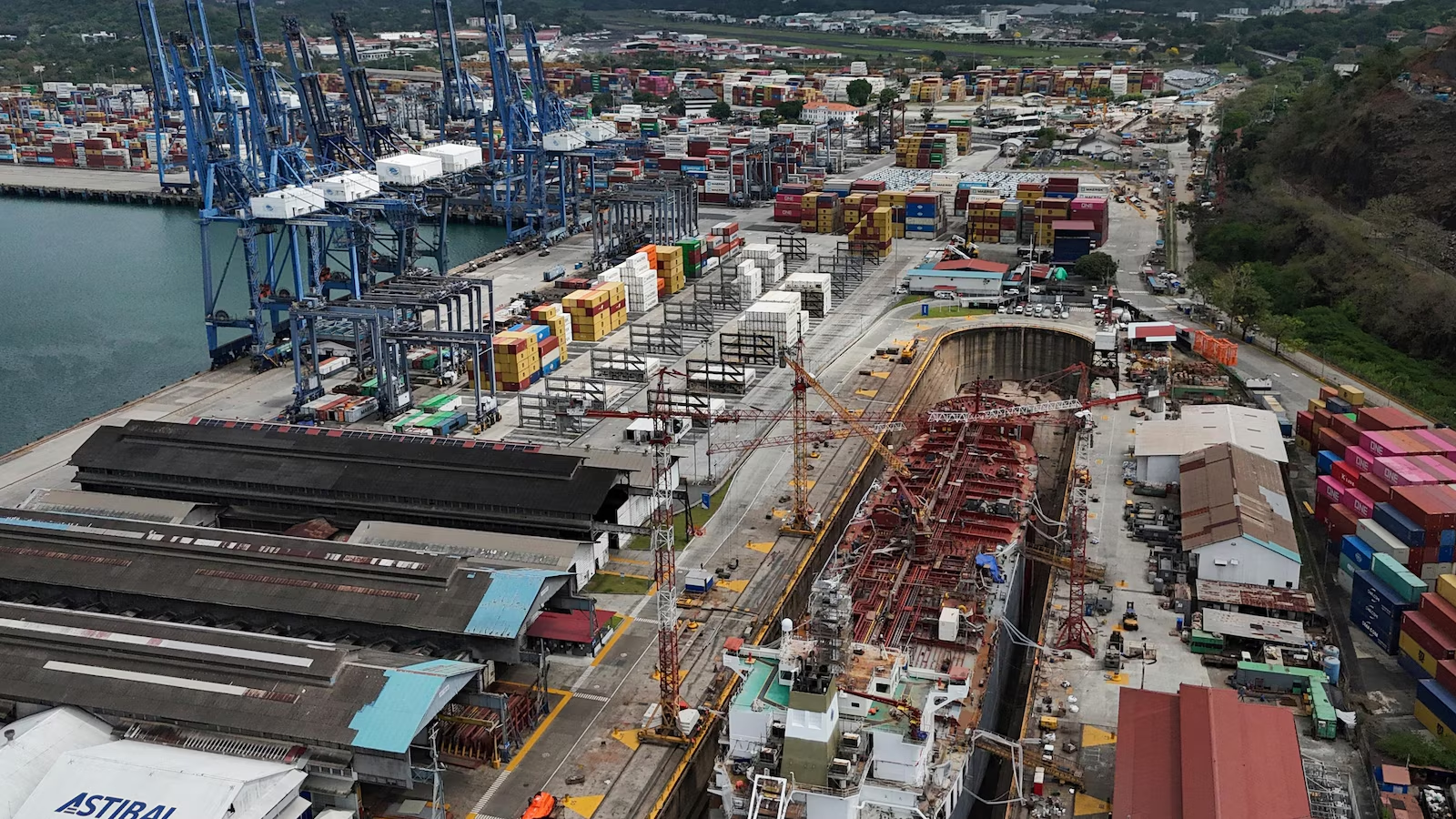
Amid the Iran war, water treatment plants in the Persian Gulf region are at risk, desalination plants in areas such as Bahrain have been damaged by strikes and threats to local water supplies.

Unlike attacks on military bases, personnel and equipment, attacks on energy and especially civilian infrastructure are a new front in warfare that at least one expert says crosses a red line.
“Targeting infrastructure like this is alarming,” says Mohammed Mohammed, head of Middle East climate and water policy at the United Nations University Institute of Water, Environment and Health..
“It’s a red line in a sea of red lines, which, unfortunately, happens in times of war, attacking civilian infrastructure like water infrastructure, because it directly affects the survival of the civilian population, and that concerns me.”
On March 8, Bahrain accused Iran of indiscriminately attacking civilian targets and damaging one of its desalination plants, although it did not say that supplies had gone offline.
The island nation, home to the US Navy’s Fifth Fleet, is one of the countries targeted by Iranian drones and missiles.
Earlier, a US airstrike in Iran had damaged an Iranian desalination plant.
Iranian Foreign Minister Abbas Araghi said the strike on the Iranian plant cut off water supply to 30 villages. By doing so, “the US set this precedent, not Iran,” he warned.
Many Gulf desalination plants are physically integrated with power stations as cogeneration facilities, meaning that an attack on the power infrastructure could disrupt water production.

Desalination involves removing salt from seawater, which is treated as clean drinking water and used as the primary water source in most Persian Gulf countries.
These desalination plants use a process called reverse osmosis.

Get daily national news
Get daily Canada news delivered to your inbox so you never miss the top news of the day.
Jay Warber, an assistant professor in the Department of Chemical Engineering and Applied Chemistry at the University of Toronto, describes the process as a “membrane-based technique” where water is forced through a special polymer material and tiny pores filter out salt and other impurities.
“If you go inside one of these desalination plants, you’ll see rows upon rows of what are called pressure vessels, and these are large plastic tubes that are pressurized to tens of thousands of pressurized atmospheres, and these membranes are rolled up inside of these, and it’s rows upon rows because these are huge water factories,” says Warber.
“They produce a lot of water, often from seawater, but also from other brackish water you can find, groundwater and river water.”
To create the pressure necessary to pump water through these facilities, Warber says, a large amount of energy is required. This means that even a strike on energy infrastructure can indirectly affect a desalination plant.
Why the attack on the desalination plant?
Mahmoud says that beyond drinking, desalination at these facilities means cities have water that can be used for agriculture, industry, sanitation and healthcare.
“The Gulf states, in particular, don’t really have any reliable source of water supply. They don’t have renewable fresh water. I mean, they don’t have a system of rivers and streams that other countries can use and rely on for their water resource needs,” says Mahmoud.
“The impact on those plants has huge, huge, huge detrimental effects because of how much water feeds so many other things. If those plants go offline there are huge, huge cascading effects.”
Striking water treatment plants means that Iran is not only fighting with military force, but also targeting other nations’ civilian infrastructure, putting local populations at grave risk.
This is part of a larger pattern of Iranian responses targeting neighboring infrastructure and regional interests.
Iran has attacked energy infrastructure targets in the Gulf region and blockaded the Strait of Hormuz by threatening any ships trying to pass through the narrow chokepoint.
Limiting cargo and oil transit through the Strait of Hormuz has sent global oil and gas prices skyrocketing and had ramifications for economies beyond the Middle East and even in Canada.
Higher oil prices and shipping volatility could mean pressure to supply chains and accelerate inflation, which means consumers will pay higher prices as a result of the war.
Those attacks on infrastructure range from direct strikes that cause physical damage to desalination plants, but also potential threats to their digital systems.

Are Canada’s water systems safe?
Canada’s Cyber Security Center warned on March 9 of the risk of cyberattacks on infrastructure and other targets in Canada in response to the Iran war, and the U.S. and Israel’s allies are under attack, whether or not they are directly involved.
“Canada’s critical infrastructure operators and other potentially targeted entities should remain vigilant about threats posed by cyber actors aligned with Iranian interests,” the Canadian Cyber Security Center said in a bulletin Monday.
It added: “Iranian state-sponsored cyber threat actors opportunistically target poorly secured critical infrastructure (CI) networks and Internet-connected devices around the world, including those related to the water and energy sectors.”
A separate bulletin from the Cyber Security Center posted in November 2025 also warned that Canadian water systems are at high risk of potential cyber attacks.
“We assess that water systems are an almost strategic target for state-sponsored actors to project power through disruptive or destructive cyber threat activity,” the Cyber Security Center said.
“We judge that state-sponsored actors have developed pre-positioned access to Canadian water systems. However, we judge that these actors only disrupt those water systems during times of crisis or conflict between states.”
Asked for his thoughts on this, Mahmoud says water treatment facilities in the Persian Gulf are “absolutely” vulnerable to cyber attacks.
“A lot of water infrastructure and operations, water distributions, transmissions, are completely automated in terms of how those plants and technologies work. So absolutely, a cyber attack is a way to cause damage in the sense of taking plants offline,” he says, and ultimately adding more direct physical damage.
Mahmoud continued: “The other part that worries me personally with the work I do is that now we’re moving from military targets to civilian infrastructure. That has no military value in my opinion.”
– with files from the Associated Press
(tags to translate)Iran