Iran’s relentless attacks on shipping traffic and energy infrastructure in the Persian Gulf pushed oil back above US$100 a barrel on Thursday as American and Israeli strikes battered the Islamic republic, with no sign of an end to the war.

Iran is trying to cause enough global economic pain to pressure the United States and Israel to stop their bombing campaign, which started the war on February 28. Iran’s president said its attacks would continue until Iran received security guarantees against another attack, suggesting that even a cease-fire or a US declaration of victory would not end the conflict.
US President Donald Trump, meanwhile, has promised to “get the job done” despite saying Iran is “virtually destroyed”.
Iran-backed Hezbollah militants meanwhile fired about 200 rockets from Lebanon into northern Israel as sirens blared and loud booms were heard in other areas as Iranian missiles were intercepted. Israel launched another wave of attacks in Tehran and Lebanon, where 11 people were killed.
The UN refugee agency says about 3.2 million people in Iran have been displaced by the ongoing war. Most have fled Tehran and other major cities to the country’s north or rural areas, it said. It says at least 759,000 people are internally displaced in Lebanon.

Iranian officials dismiss any notion of backing down
Iranian President Masoud Pezheshkian suggested online Thursday that for the war to end, the world needs to recognize Iran’s “legitimate rights,” pay reparations and offer guarantees against future attacks.
In addition to attacking energy infrastructure around the region, Iran has control over the Strait of Hormuz, a waterway that transports one-fifth of the world’s oil from the Persian Gulf to the Indian Ocean.
Amid speculation that the US could target Kharg Island in the Persian Gulf, Iran’s main oil terminal, Iran’s parliamentary speaker, Mohammad Bagher Khalibaf, threatened in a social media post that any attempt to take the islands would “run the Persian Gulf with the blood of aggressors”.

Get breaking national news
Get breaking Canada news delivered to your inbox so you never miss a trending story as it happens.
With traffic in the strait effectively halted, the price of Brent crude oil, the international benchmark, rose by nine percent to more than $100 a barrel, nearly 38% above its price when the war began. Prices have swung back and forth in recent days, rising to around $120 a barrel at one point.
Iran and Hezbollah launched multiple attacks on Israel
It was a sleepless night for many Israelis as Hezbollah fired nearly 200 rockets into the north of the country and deep into Israel, according to the Israeli military.
“The noise was extraordinary, it was really scary,” said Nama Porat, a resident of the rural community of Clil, about 15 kilometers (9 miles) from the Lebanese border. As the sound of explosions and interceptions rang out, she came to the shelter with her son and spent the night.
No serious injuries were reported, but the scale of the fire has shocked northern residents, whose leaders have repeatedly said Hezbollah was dealt a devastating blow in 2024 during its last war with Israel.
“They have a stockpile of weapons and it will never end. We don’t know how much and what to expect,” Porat said.
Israeli Defense Minister Israel Katz warned Lebanon that if its government did not stop Hezbollah attacks, Israel would “take the territory and do it ourselves.”

More than 20 people were killed in the attacks on Lebanon and Iran
Israel, meanwhile, crashed into a car in a beach area of the Lebanese capital where dozens of displaced people have taken refuge, killing eight and injuring 31, the Lebanese health ministry said. The Israeli military said it was “not aware” of a strike at that location.
The Israeli military recently claimed to have struck a nuclear facility in Iran. Israel destroyed the “Taleghan 2” site in an airstrike in October 2024. Satellite photos earlier this year raised concerns that Iran was working to restore the facility.
The US and Israel say one of the central goals of the war is to destroy the remnants of Iran’s nuclear program. They have long suspected Iran of seeking nuclear weapons, but the Islamic Republic says its nuclear program is peaceful.
In Tehran, security force checkpoints came under attack for the first time on Wednesday night, the semi-official Fars news agency reported. At least 10 people were killed in the suspected drone attack.
Israel and the US military behind the attack did not immediately respond to requests for comment.

Iran fires at Gulf Arab countries and hits ship in Persian Gulf
Iran’s latest attacks on its Gulf neighbors violate a United Nations Security Council resolution passed on Wednesday.
Early Thursday morning, a container ship was hit by a projectile off the coast of Dubai and started a small fire, according to the British military’s United Kingdom Maritime Trade Operations Center. It said the crew was safe.
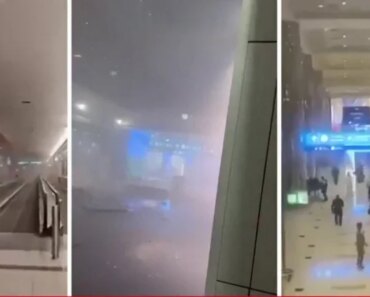
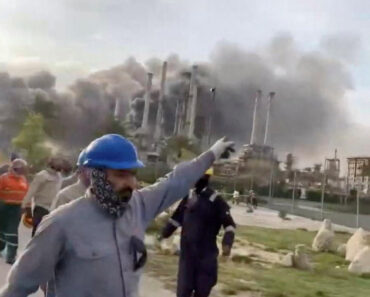
The Iranian attack sparked a huge fire on Muharraq Island, home to Bahrain’s international airport. An Iranian drone crashed into a residential building, injuring two people, and a drone attack on Kuwait’s international airport caused damage but no casualties, Kuwaiti officials said.
The UAE said it activated air defenses twice to protect the futuristic city of Dubai from attack, and firefighters put out a fire at the tower after the drone hit.
Saudi Arabia, meanwhile, shot down a drone targeting the diplomatic quarter in its capital, Riyadh, and shot down other drones in the east, including at least one attempting to target its Shaiba oil field.
Operations at all of the country’s oil terminals have been suspended, officials said Thursday, after an attack on Iraq’s Basra port on Wednesday killed at least one person.
In the UAE, Citibank said it would close all but one of its branches because of an Iranian threat — not yet realized — to target financial institutions in the region.
(tags to translate)Iran