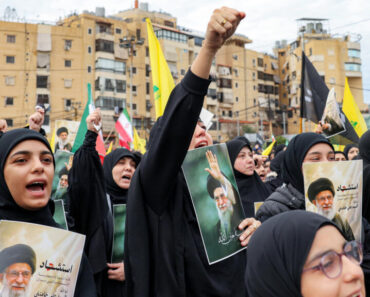
Israeli warplanes bombed the southern suburbs of Beirut and southern Lebanon after Hezbollah launched drones and rockets into northern Israel on Wednesday night in a sharp escalation of the 10-day conflict.
Hezbollah launched successive bursts of rockets and swarms of drones into Israel on Wednesday night, wounding two people, and most of the projectiles were intercepted or fell in open areas.
Iran’s Revolutionary Guard later said they had carried out some attacks with Hezbollah.
In a statement carried by the Fars and Tasnim news agencies, the Guards said the “joint and integrated operation” involved a missile attack by Iran carried out in conjunction with Hezbollah missile and drone fire.
The operation focused on “more than 50 targets” in Israeli territory, the statement added, including Israeli military bases in Haifa, Tel Aviv and Beersheba.
Hezbollah’s attack was the most intense launched by the pro-Iran group since it first fired rockets into Israel 10 days earlier, triggering a retaliatory military campaign by Israel. The rockets were launched alongside Iranian missiles, the first time the two coordinated their attacks on Israel since the war with Iran began.
The Hezbollah operation, dubbed “Operation Chewed Wheat” – a reference to a Quranic verse about reducing enemies to chewed wheat – was a sharp escalation by the group, which is believed to have been hit by nearly two years of daily airstrikes by Israel.
Lebanon was quickly becoming the region’s most intense site of combat as the war in Iran, launched by Israel and the United States two weeks earlier, continued to consume the Middle East and beyond.
Israeli warplanes began bombing Lebanon almost immediately after the Hezbollah attacks. The skies over Beirut lit up red and windows around the capital shook as Israel unleashed its most powerful bombardment on the southern suburbs yet in this round of fighting. Videos showed collapsed buildings in southern Lebanon and smoke-choked streets lit by roaring flames.
Israel also carried out an attack in the early hours of Thursday in the Ramlet al-Baida neighborhood in central Beirut, on the ledge where many displaced families have been sleeping outdoors for the past week. The attack took place in a densely populated area and videos show at least two men dead on the seafront. Lebanon’s Health Ministry said at least seven people were killed in the attack.
Separately, the Health Ministry said at least 17 people were wounded in the attacks in Beirut’s southern suburbs, although more casualties were expected in other attacks across the country.
In southern Lebanon, Israel’s military spokesman said it was attacking Hezbollah missile launchers. They warned residents that it would “soon act with overwhelming force” against Hezbollah and that residents should distance themselves from affected areas immediately, echoing displacement orders issued for vast areas of the country early last week.
Israeli strikes have killed at least 634 people and wounded 1,586 in less than 10 days of fighting. More than 816,700 families have registered as displaced with the Lebanese state, but more are expected to have been displaced by Israeli airstrikes and displacement orders.
Wednesday night’s escalation came as Israeli officials signaled a possible expansion of their campaign against Hezbollah in Lebanon. Israel’s security cabinet met Wednesday night to discuss Lebanon, where officials sought to stop the group’s ability to launch rockets into Israeli territory.
On Wednesday, Israeli army chief Lt. Gen. Eyal Zamir ordered reinforcements to its northern border with Lebanon, redeploying the Golani Brigade from Gaza to the north. The Golani Brigade specializes in offensive ground operations and analysts said the redeployment of the force could signal a broader ground invasion of Lebanon. Hezbollah is reportedly preparing for a full-scale Israeli invasion of southern Lebanon.
Hezbollah fighters have been fighting with Israeli troops in southern Lebanon, particularly around strategic points in the east of the country, such as the hilltops around al-Khiam. Small units of Hezbollah’s elite Radwan force have been acting autonomously to ambush Israeli troops, who have been conducting raids in and out of southern Lebanon.
Hezbollah has reportedly spent the year and a half since its November 2024 ceasefire with Israel rebuilding its capabilities and reconsolidating its organization. Israel had killed most of the group’s senior leaders and killed or incapacitated thousands of its fighters during the 13-month war, although exact numbers were unknown.
As fighting continued in southern Lebanon, Israeli shelling has steadily intensified over the past 10 days. In the early hours of Wednesday morning, Israel attacked an apartment building in central Beirut, wounding four people. It was the second time in a week that Israel struck deep into the capital city, leaving residents shocked and unsure where it was safe.
Lebanon’s government has called on Hezbollah to stop firing at Israel and insisted that the state should have a monopoly on violence in the country. But his army, lacking personnel and equipment, has so far been unable to directly confront the powerful armed group. The government also fears provoking civil conflict in Lebanon, which has a long and painful history of sectarian division and violence.
The Lebanese government, with French assistance, has asked the international community for a ceasefire in Lebanon, calling for negotiations with Israel and promising to curb Hezbollah’s activities in the country. Israel and the United States, however, are skeptical that the Lebanese government can disarm Hezbollah, and the former appears determined to confront the group itself.
Israel’s ambassador to the UN, Danny Danon, on Wednesday cast doubt on the Lebanese government’s efforts to confront Hezbollah.
“If Hezbollah is being dismantled, what is the evidence? What are the operations against the launch sites? Where are the seizures of their weapons? Where is their army?” Danon said.