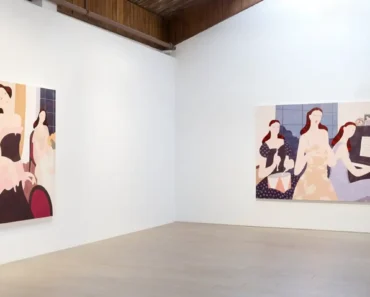
In addition to her unique exploration of imagery and subject matter, Slappe’s technical skills are exceptional, bringing an almost photoreal quality to elements of her work. Her paintings have both a recognizable look and a unique feel. She creates images that are not only visually captivating but also exciting, eliciting an immediate response from the viewer. The combination of how things feel and how they actually are is a concept that Slappe considers in detail. “A lot of times, what it feels like to be in the body is completely different than what it actually, objectively looks like,” she said. “The dichotomy between different painting styles highlights these competing realities.”
Many times, what it feels like to be in a body is completely different from what it actually, objectively looks like.“
In her most recent work, Slappe explores everyday rituals such as shaving, bathing and applying lipstick. These behaviors are second nature to many of us;
But what happens when you view them as part of a larger whole? Her paintings seem to argue that these actions, no matter how small, cannot be divorced from their sociological implications. For example, shaving is “personal, political, sexual, and, if you cut yourself, medical,” she explains. “But it’s so quiet and mundane in our lives that it just becomes integrated into automated feminine rituals.”
Her work awakens the viewer to the rituals we have become accustomed to. Do we mind if we cut our skin while shaving? But what if someone intentionally cuts us with a razor? Eyebrow plucking, pubic hair waxing and fine line injections can all be painful. We reach for scissors, tweezers, and hot wax strips without a second thought, systematically attacking whatever we are told is unfeminine or unattractive. Beyond suffering, all we are left with is a single, homogeneous “woman.” In depicting anatomical elements that seem unrelated to the real body, Slappe reminds us that every attempt to tame nature separates us from our true selves. We are both willing practitioners and unwilling victims of this cultural practice. “Living in the human body is full of tenderness and violence,” Slapey explains. “Cells are being destroyed and regenerated all the time. Your skeletal system is a protective skeleton, but culturally a powerful symbol of death and decay. The body completely embodies this paradox.” The human cost of self-care—in some ways, the cost of sacrificing our own humanity—is high. The old saying “Beauty is Pain” has never been more relevant.
But these works are never just one layer. Their meanings are as intricate as the works themselves, constantly inspiring us to dig deeper. “I spend countless hours on each painting,” Slapey says, “so each piece has more than one or two emotions or concise interpretations.” In addition to the body, traditional female figures also abound. Glittering earrings, knotted bows, painted nails and braided hair are all recurring motifs. More subtle references to feminine ideals come in the form of painted backgrounds featuring plaid prints, daisies and pale pinks. However, every trace of female tenderness is accompanied by corresponding violence. Lipstick turns to blood, earrings pierce skin, nail claws and ribbons bind. Slappe’s images embody the conflict between violence and tenderness that exists within us all. “I think a lot about femininity and violence and how they’re intertwined and maybe even the same thing,” Slappe said. “I find that very fascinating that femininity as a concept can be so insidious and grotesque.”