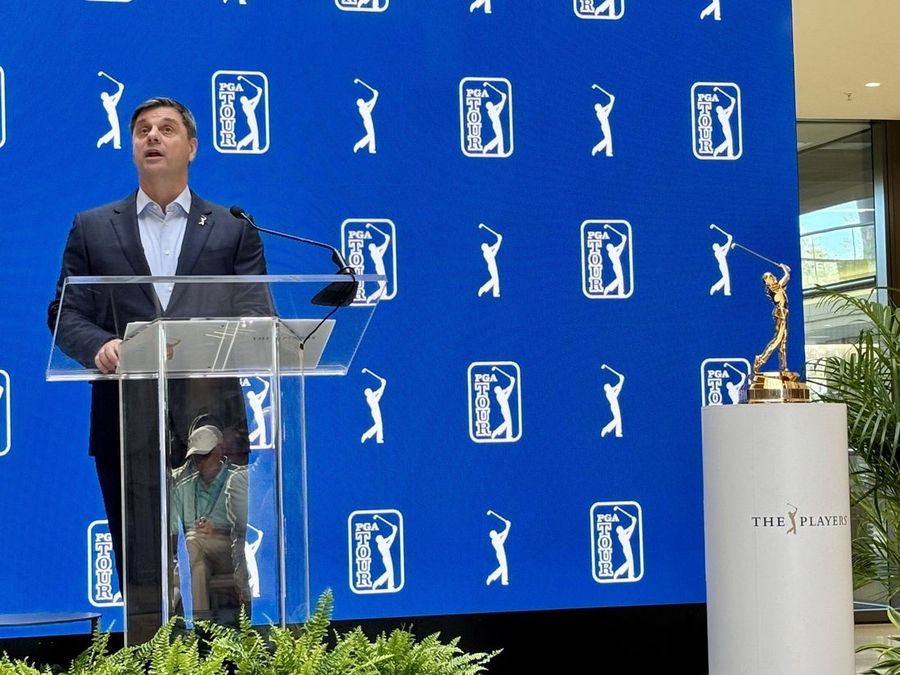
 PGA Tour CEO Brian Rolopp speaks to media, tournament sponsors and Tour employees during a press conference at the PGA Tour’s Global Home in Ponte Vedra Beach, Florida, March 11.
 PONTE VEDRA BEACH, Fla. – No final decisions have been made, but plans are being made to “build the best version of the PGA Tour” possible, with a focus on meritocracy, a 26-event season and the possibility of introducing match play at the end of the year, CEO Brian Rolapp said.
In a well-attended press conference Wednesday at the PGA Tour’s “global home,” Rolapp outlined six pivotal themes shaping the future of the tour.
“This is still a work in progress and by no means a baked cake,” said Rolapp, speaking ahead of the Players Championship. “This is only an area where we are beginning to see meaningful agreement….This is a complex process with many constituencies affected. We will continue to move with urgency, but we are focused on moving in the right direction.
“We went into this project with a very clear goal: to build the best version of the PGA Tour that better serves our fans, players and partners. Along the way, we are putting today’s fans and tomorrow’s fans at the center of our work and ensuring that everything we do and every decision we consider is evaluated through that lens.”
Rolapp is working closely with Tiger Woods and the Future Competition Commission with a shared focus on a competitive model based on meritocracy.
“This is not a closed store,” Rolapp said. “We aim to create a more cohesive schedule with a simple points system where the best players compete against each other more often.
“The fans know who the best players are. They are the best performers on the course. Our competitive model will be built around elevating those who prove they are the best performers inside the ropes.”
Rolapp revealed plans to double the number of signature events to 16, adding the existing four majors and the Players Championship, followed by a second wave of Tier II events.
“If you look at the schedule, we are focused on having a season from late January to early September. We are looking at approximately 21 to 26 tournaments on the first track of top events with the best players competing for higher prize money,” he said. “Then we will have a second track of PGA Tour tournaments to advance to these high-level events.”
As a second theme, Rolapp said there will be a move away from small fields and no-cut events and a more consistent field being built.
“Ideally, we’re aiming for somewhere close to a 120-player field through the cut,” he added. “It continues to be important. It helps fans showcase who they want to see and the most competitive players. It helps our partners know what they are investing in, and it helps players embrace a meritocracy while also better understanding the competitive environment on their schedules.”
According to Rolapp, kicking off the season with a big event at an iconic location on the West Coast was another part of the PGA Tour’s expanded vision.
“That will allow us to end network television in prime time on the East Coast,” he said.
The fourth topic focuses on where the PGA Tour holds tournaments, and plans are in the works to include larger markets such as New York, Chicago, Philadelphia, San Francisco, Washington D.C. and Boston.
“Currently, the PGA Tour competes in only four of the top 10 media markets in the United States,” Rolapp said. “It’s an opportunity. We are evaluating other markets where there is strong fan demand for our sport and opportunities to reach new fans.”
Rolapp dismissed the idea that his definition of “scarcity” in scheduling means a reduction in the number of events each year.
“Ultimately, scarcity is not about the number of events we have; rather, scarcity is about making every event we have important,” he explained. “This is why we are evaluating the role of promotion and relegation between these two tracks within our competitive model… What we envision is what makes professional golf so attractive, a merit-based system that allows players to rise to the top, and every event has greater meaning.”
The sixth and final topic hinged on adding more drama to the PGA Tour schedule, including the potential addition of match play.
“We’re looking at ways we can improve the postseason,” Rolapp said. “We’ve heard from our fans and partners that they want more drama, and we’re considering the possibility of incorporating match play throughout the Tour Championship or postseason to bring those moments that could make the difference between winning and losing at the end of the season.”
Everything Rolapp explained on Wednesday is a work in progress with no decisions made yet, but he planned to provide a further update in late June.
“Nothing has been confirmed,” he said. “We are still doing the work and gathering input from players, partners and other key stakeholders. The player-led board has no recommendations. We look forward to making more meaningful progress on this in the future.
“We plan to host another press conference in the summer and at the Travelers Championship following the board meeting on June 22.”
-Mark Lamport-Stokes, Field Level Media
-Mark Lamport-Stokes, Field Level Media