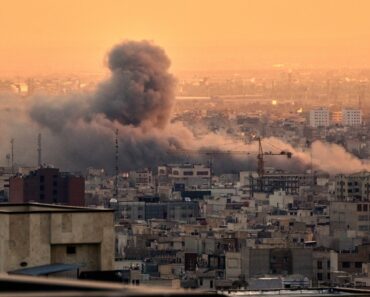
Ukraine has sent drone interceptors and military personnel to Jordan as Middle Eastern countries defend Iranian attacks on US military infrastructure and assets during the US-Israel war against Tehran.
President Volodymyr Zelenskyy confirmed that a Ukrainian team left on Friday for Jordan, which has US military assets at its Muwaffaq Salti air base.
Recommended stories
list of 4 itemsend of list
The move followed a request Thursday from the United States, Zelenskyy said, as Washington seeks cheaper technology to intercept Iranian missiles aimed at Israeli and American defense assets as well as other infrastructure in Qatar, Kuwait, Bahrain, Saudi Arabia and the United Arab Emirates.
At the moment, the United States is using air defense systems such as Patriot missiles, Terminal High Altitude Area Defense (THAAD) batteries and Airborne Warning and Control System (AWACS) aircraft to intercept Iranian drones and missiles targeting its military assets in the region.
However, these types of systems are expensive, costing millions of dollars for each interceptor missile fired, and there are concerns that supplies of US interceptor missiles could run out.
Iran is deploying its cheap, domestically produced Shahed drones across the Gulf and is believed to have thousands in stock. These are the same drones it has supplied to Russia during Moscow’s war against Ukraine. kyiv, which has long sought more advanced American defense systems, has developed technology to mass-produce much cheaper interceptor drones to counter drone swarm attacks from Russia.
“Ukrainians have been fighting against ‘shahed’ drones for years, and everyone recognizes that no other country in the world has this kind of experience. We are ready to help,” Zelenskyy wrote in X on Thursday, adding that Ukraine has asked for advanced defense systems from the United States, such as the Patriot system, in return.
In a Monday post on
Here’s what we know about the Ukrainian drones that the United States and Gulf countries want to deploy:

What do we know about the requested Ukrainian interceptors?
Ukraine has been building thousands of low-cost interceptor drones to counter Iranian Shahed-type drones over the course of the Russia-Ukraine war.
After not receiving enough high-end weaponry from its allies, such as the US Patriot missile defense systems, kyiv was forced to innovate in 2025. It has now become one of the world’s leading manufacturers of “Shahed Killers”.
These cheap but powerful drones are designed to shoot down Russian attack drones before they reach their targets. They are operated by pilots who follow them on a monitor or wear first-person view (FPV) goggles. Each is priced between $1,000 and $2,000, a fraction of the several million dollars it costs to build, transport and fire a high-tech American interceptor.
Ukrainian manufacturers produce thousands of them a month.
Analysts said drones can counter a variety of attacks but cannot intercept ballistic missiles. Until now, they also require trained pilots located close to their area of intervention, although manufacturers are developing automated models.
There are several models that have been developed in Ukraine:
- The bite: This quadcopter is shaped like a bullet and is about the size of a large thermos. It is the fastest of the interceptors, reaching speeds of 315 to 343 kilometers per hour (196 to 213 miles per hour) and can cruise at an altitude of 3,000 meters (10,000 feet). It relies on thermal imaging cameras to hit targets and returns to base if it can’t locate one. Its domed head carries the camera system and an explosive charge. It is manufactured by the Ukrainian startup Wild Hornets.
- Bullet: Developed in late 2025 by Ukrainian weapons manufacturer General Cherry, this high-speed interceptor is powered by a jet engine and four rotors. It can be 3D printed and uses AI-assisted guidance to locate targets. It can reportedly travel at speeds of 130 km/h to 309 km/h (81 mph to 192 mph) and cruise up to 5,500 meters (3.4 miles).
- P1-Sun: The 3D-printed ship produced by weapons company Skyfall can fly at up to 300 km/h (186 mph). He looks like the Sting.
- Octopus 100: This interceptor is designed in Ukraine but is mass produced in the UK. Its technical details are unclear.
- ODIN Win_Hit: Another bullet-shaped drone is built for short-duration, high-intensity missions. It has a top speed of 280 km/h to 300 km/h (174 mph to 186 mph) and can fly up to 5,000 meters (3.1 miles) for seven to 10 minutes at a time. It is developed by the Ukrainian defense company ODIN.
How does the Iranian Shahed operate?
Russia has launched thousands of Iranian-designed Shahed drones into Ukraine, resulting in hundreds, if not thousands, of deaths and severe damage to infrastructure. Ukraine has increasingly countered them.
A New York Times analysis found that Russia sent about 5,000 drones to Ukraine in February and Ukraine shot down 87 percent of them.
Iran, which has long supplied weapons to Moscow, has used the same models in its attacks against its neighbors while facing intense bombing from the United States and Israel. A drone hit Kuwait last week, killing six members of the U.S. military, the Times reported.
Priced between $20,000 and $33,000 each, the GPS-guided drones measure about 3.5 meters (11.5 feet) long. They are loitering munitions and self-destructive vehicles mounted with explosive charges and automated to explode upon hitting programmed targets.
Moscow is believed to have incorporated its own elements into Iranian design and is now mass producing thousands of “kamikaze” models. Zelenskyy claimed in his X post on Monday that there were “Russian components” in the Shaheds crashed remains that Iran has used on its Gulf neighbors.

What have the United States and the Gulf countries been using against Iranian missiles?
The United States has been supporting Gulf countries in intercepting Iranian missiles with expensive defense systems, including:
- Patriot missile systems: Patriot Advanced Capability-2 (PAC-2) and PAC-3 are advanced surface-to-air missile defense systems built by American defense contractor Lockheed Martin that can intercept aircraft, cruise missiles, and short-range ballistic missiles. Ukraine has repeatedly asked the United States for more Patriot batteries, which consist of a truck-mounted launch system with eight launchers that can hold up to four missile interceptors each, a ground-based radar, a control station and a generator. Each Patriot missile costs about $4 million and the launchers cost about $10 million. About 90 people are needed to operate the system. They are in short supply, as Lockheed Martin delivered a record 620 PAC-3 MSE interceptors, the largest number of Patriot missiles, in 2025. Zelenskyy said the United States and its Middle East partners have already burned 800 of them, compared to 600 delivered to Ukraine in four years.

- THAAD missile defense system: Also developed by Lockheed Martin, THAAD uses a combination of radar and interceptors to counter short-, medium- and intermediate-range ballistic missiles and can operate at high altitudes. A THAAD battery consists of six truck-mounted launchers, 48 interceptors (eight for each launcher), a radar system, and a communications and fire control component, and requires 95 personnel. Each battery costs between $1 billion and $1.8 billion to produce.

- AWACS aircraft: These aircraft are part of an early warning radar system designed to detect long-range missiles and projectiles from a distance of up to 400 kilometers (250 miles).