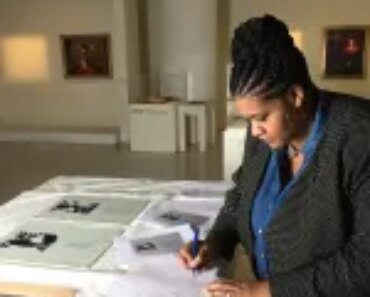
Laura Phipps is the new director of the Gochman Family Collection, a New York-based private collection focused primarily on, but not exclusively on, contemporary Indigenous art. She succeeds Zach Feuer, who co-founded the Forge Project with Becky Gochman in 2021 and currently serves as one of the collection’s five curatorial advisors.
Phipps joins GFC after nearly two decades at the Whitney Museum of American Art. She began an internship there in 2009 and left as associate curator, organizing exhibitions such as “Flatlands” in 2016, which featured the work of five then-upcoming painters, and more recently, “Sixties Surreal” and “Jaune Quick-to-See-Smith: Memory Maps,” which included several loans from the Gochman Collection.
Related articles

“Laura understands that contemporary Native art is at the heart of American art history,” GFC creative director and curator Rachel Martin said in a statement about Phipps’ appointment. “Her artist-first, collaborative practice reflects our belief that collections can function as living, responsive ecosystems.”
Her responsibilities at the GFC will involve more than just overseeing the collection of 750 works (and growing). She will also oversee the collection’s new 10,000-square-foot exhibition space in Katonah, New York, a small Westchester town just a short train ride from New York City. The space, located in two connected buildings off Main Street in downtown Katonah, is scheduled to open this fall.
While the Gochman Family Collection has been open to visitors for years, the Katonah space at the Upper East Side and West Palm Beach homes will be more of a public-facing art space.
“We are essentially creating a white space in Katonah that will provide different curatorial opportunities for the presentation and positioning of the collection,” Phipps said in a phone conversation a few days after starting his new job.
Phipps also expressed excitement about the new ways in which the GFC supports artists in its collection. The Katonah space will have space for readings and performances, as well as two apartments and studio space for artists to use as needed. “It would be great to be able to provide artists with a place that’s close to the city and at some distance from the city if that’s what their practice needs at the time. How we use this space will change as we understand what artists need and want.”
Specific exhibition plans are still pending, but Phipps is looking forward to working with some of the less well-known (at least to the public) contemporary artists in the collection. These include Ishi Glinsky, who “pushes the boundaries of traditional notions of indigenous materials in very interesting, quirky ways”; Saif Azzuz, who “does incredible things in sculpture and painting” and will have an exhibition at Storm King this summer; and artists like Lily Hope and her sister Ursala Hudson Hudson, blanket weavers who “drive the narrative around weaving and storytelling.”
“At Whitney,” Phipps said, “it’s great that I have so many really great colleagues to draw from, but it can also be a crutch for your own decision-making. I’m looking forward to pushing myself and the small team here and learning to really trust my instincts.”