ERBIL, Iraq — Abdullah Mahmoud Tahir phoned his son Saturday night, worried about drone attacks targeting this northern Iraqi city.
“He said, ‘Don’t worry, Dad, I’ll be fine,'” he recalled.
But 90 minutes later a drone killed his son Walat, who was guarding the shuttered Erbil airport. A pro-Iranian militia group claimed responsibility for the attack.
Erbil, the capital of Iraq’s northern Kurdistan region, is not officially involved in the war waged by the United States and Israel in neighboring Iran.
However it is under siege.
Missiles and drones are pounding the city and the surrounding area as Iran uses armed proxy groups based inside Iraq to push back wherever possible.
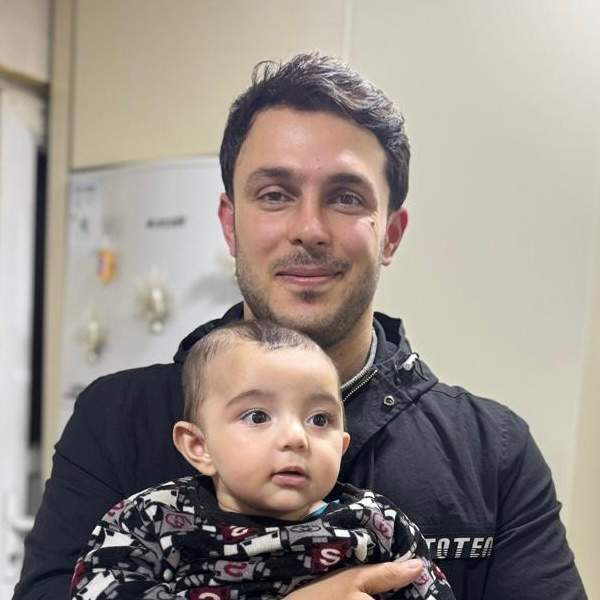
Walat Tahir was killed holding his son in a drone strike on Saturday, March 9, 2026, in Erbil, Iraq.
Family brochure
In Erbil, an ethnic Kurdish city of more than a million, explosions and the sound of anti-missile systems are more routine.
While Iran claims its “harsh retaliatory strikes” targeted US military assets and Israel, civilian residential buildings and a mosque were also damaged.
On Tuesday, the United Arab Emirates condemned the “provocative terrorist drone attack” on its Erbil consulate overnight.
“It’s against human principles,” said Jamil Bassam, who was working at an Erbil church when the drone hit the building on the evening of March 4.
At the time thirty-six families lived in the adjacent Pope Francis residential complex. Most have gone left and are too scared to return, Bassam said.
‘Strike every day by drones’
Walat Tahir’s father and son were killed in a drone strike in Erbil, Iraq on March 9, 2026.
Stewart Bell/Global News
The church is located near an international airport, which houses a US air base. The Islamic Resistance in Iraq claimed responsibility for the attack on the facility.
It said it was doing so to avenge the killing of Iran’s Supreme Leader Ali Khamenei and Hassan Nasrallah, leader of the Lebanese terror group Hezbollah.
Following the deadly airport drone attack, Kurdistan Regional Government President Masoud Barzani warned that his patience was running out.
He accused pro-Iranian groups of attacking Kurdistan’s “civilian areas and economic infrastructure” and the bases of Kurdish Peshmerga fighters.
“We’re hit every day by these drones from Mosul and Kirkuk,” said Omar Salimomar, an Ottawa resident stuck in Iraq. “It’s not easy.”
The Canadian was born in Erbil and flew in for a holiday two weeks ago but was unable to leave when the war broke out and the airport was closed.
He said it would be wise to heed the president’s warning that the Shiite militias firing on Erbil should stop their attacks.
“Hopefully, they got the message but the problem is these militias, they don’t care,” he said. “I’m nervous, my family in Canada, my wife, my son, they’re scared.”
‘Big loss’ to economy
A security guard is injured outside a church by a drone on March 9, 2026, in Erbil, Iraq.
Stewart Bell/Global News
The local economy is also suffering as a result of the Iran war, which has forced the airport to close, a regional cabinet minister said in an interview.
“It’s a great loss,” said Ano Jawhar Abdoka, the Kurdistan Regional Government’s minister of transport and communications.
“It’s very important for the economy of the Kurdistan Region. It’s the main way we get our electronics, medicine, and closing the airport is affecting a lot of businesses.”
Things could be much worse.
Iraq’s semi-autonomous north is controlled by ethnic Kurds, who despise Iran and accuse the Sunni-majority south of supporting Tehran and its proxy militias.
The minister called the drone attack on the airport a “terrorist act” and said the Iraqi government needed to rein in the militia groups responsible.
“They are tools to spread fear and terror among our people,” he said. “We cannot remain Iraqis at the mercy of proxy, arbitrary, quasi-terrorist militias.”
At the same time, he said, the U.S. is bombing nearby pro-Iranian militias, putting Kurdistan in the unique position of being attacked by both sides in the Iran war.
“Now Iraq is very weak, probably one of the most weak countries because of this conflict,” said the minister who represents Christians in the government.
Nazim Hamad Qanabi was injured in a drone strike on Saturday, March 9, 2026, in Erbil, Iraq.
Stewart Bell/Global News
The death toll is small, but growing.
On Monday, Nazim Hamad Qanabi lay in a hospital bed in Erbil, recovering from surgery to repair injuries sustained in a weekend drone barrage.
“Suddenly I felt something falling from the sky. I woke up and I was inside the hospital,” he said as he stood guard at the airport.
The drone landed three to four meters away, spraying him with shrapnel, he said. Both his legs were bandaged, along with his right arm, shoulder and chest.
Across town, Abdullah Mahmood Tahir, dressed in black, greeted family and friends who had arrived to mourn his son’s death.
They said Walat was 31 years old, involved in bodybuilding and had two sons aged five years and six months. He doesn’t know the details of what happened.
“The only thing we know is that he was on duty and the drone was close to his position,” his eldest grandson said as he played on a patch of lawn behind him.
He called the Iranian regime “fascist” and accused it of lashing out at its neighbors because it was too weak to confront the US and Israel directly.
“My son, he was a very kind and good person, and he always wanted peace. But unfortunately, because of the black regime in Iran, he was killed,” Tahir said.
“This is not our war, but it is laid upon our shoulders.”
Stewart.Bell@globalnews.ca
(tags to translate)Erbil(T)Iran War(T)Iraq(T)World