When Israel and the United States first dropped bombs on Tehran, his hometown, Aryan was elated. He was convinced he was witnessing the end of nearly five decades of brutal theocracy.
A week after the attack, he watched the midnight sky light up under fierce bombardment and watched the dawn darken as toxic black smoke choked the Iranian capital and burned his skin.
The shock of those scenes left him wondering if his hopes for the American-Israeli campaign were “just my own wishful thinking.”
“They have attacked everywhere. Night turned into morning and morning turned into night,” said Aryan, 33, who like everyone interviewed by The New York Times, asked not to be identified by his full name, for fear of reprisals. “People are getting more and more discouraged, like me.”
Across Iran, more than 90 million people are caught between two terrifying realities. American and Israeli leaders, whose bombs are leveling more and more of their infrastructure, have called on the Iranians to use this as an opportunity for liberation. And its rulers, determined to cling to power, have threatened more bloodshed against anyone who dares to respond to that call.
“A society worn down by authoritarianism suddenly finds itself in the middle of a fire that has broken out from outside,” Mohammad Maljoo, a well-known economist in Iran, wrote on social media, adding: “War does not open a door to reform or a horizon of liberation.”
Story continues below this ad.
For Iranians, the apocalyptic scenes of bombing – street sewers burning in Tehran, mothers huddled with children in shaking bathrooms and a school destroyed in the first hours of the war – are the most terrifying episodes in a series of devastations that have hit their country over the past nine months.
A deepening economic crisis was already exhausting an Iranian population still recovering from last June’s 12-day war with Israel, which was briefly joined by American warplanes.
In January, security forces crushed a nationwide protest movement with lethal force, leaving thousands dead and an entire country polarized and traumatized by the repression.
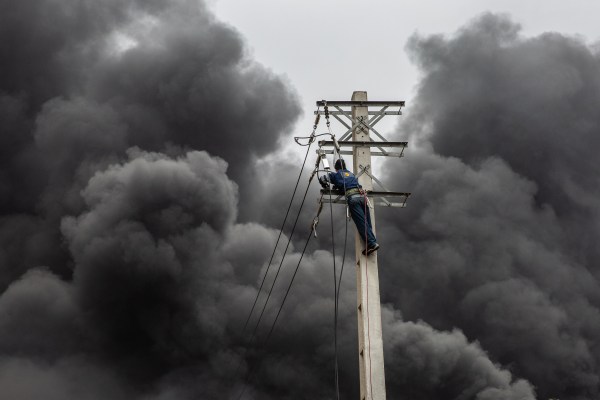 A worker stands on an electrical pole as plumes of smoke rise from an oil storage facility following overnight attacks by U.S. and Israeli forces in Tehran, Iran, Sunday, March 8, 2026. Most ordinary Iranians are cut off from the Internet, and for some it has been infuriating to have so little information about what is happening. (Credits: Arash Khamooshi)
As US and Israeli forces began attacking the capital on February 28, President Donald Trump called on Iranians to overthrow their government, promising that “freedom is within reach.”
Story continues below this ad.
A week after the US-Israeli strikes that killed Iran’s supreme leader, Ayatollah Ali Khamenei, Trump expressed his desire to play a role in selecting the country’s new leader, perhaps from the same authoritarian system he has urged Iranians to rise up against. Authorities responded by naming the dead leader’s son, Mojtaba Khamenei, a hardline cleric, as his successor.
At the same time, Iranian security officials have taken to the airwaves to warn their opponents. On state television Thursday, a Revolutionary Guard official publicly used harsh language rarely used by authorities, threatening that protesters would be seen as agents of Israel.
“The shoot-to-kill order has been issued,” he said. “No one has spoken to you directly about this.”
After the war began, Asoo, a Persian-language publishing house, invited Tehran residents to publish anonymous notes about their feelings. Often it was a mix of lingering hopes that chaos could still overthrow the current system and despair at the destruction being wrought.
Story continues below this ad.
“We live in a space full of fear and hope, but my fears are greater than my hopes,” said one respondent.
For days, US and Israeli bombings have pulverized Iranian military, intelligence and police facilities across the country. And yet, there are no clear signs of a collapse of the government’s deeply entrenched and ideologically motivated security forces.
Many residents describe seeing large crowds of Basij, the plainclothes militia linked to the Revolutionary Guard, roaming the streets on motorcycles and shouting religious slogans as they pass.
Intelligence and security services still appear to be monitoring for signs of dissent.
Story continues below this ad.
Farzad, a resident of a wealthy skyscraper in Tehran, said that in the hours after Ali Khamenei’s death was announced, his neighbors celebrated loudly on their balconies, shouting joyfully in the streets.
Days later, the building management informed them that the security services had warned them that their apartments would be raided in case of new explosions.
Checkpoints have proliferated across the city and the phones of many Iranians have been inundated with state messages urging them to join pro-government protests and report anyone who takes photographs.
Other texts come with unspoken threats of violence. “Any move that disrupts security will be considered direct cooperation with the enemy and will receive a firm response from its children in the IRGC Intelligence Organization,” said a text message shared with The Times, referring to the Islamic Revolutionary Guard Corps.
Story continues below this ad.
While surrounded by these dangers, most ordinary Iranians are cut off from the Internet, and several residents interviewed said it was infuriating to have almost no way of understanding what was happening in their own country.
Amir Hossein Bagheri, an engineer in Iran, wrote on his Facebook page that he distrusted both state media and foreign news outlets, saying they rarely covered how deadly and terrifying the war has been for Iranian civilians. “None of them are trustworthy,” he wrote.
The recent attacks – and the responses that US military officials have offered – appear to have deepened distrust.
In the past two days, attacks have blown up fuel storage facilities, sending oily smoke and black rain over Tehran. The attacks also blew up a desalination plant as Iran grapples with a looming water crisis.
Story continues below this ad.
A statement from US Central Command on Sunday urged residents to stay home for their safety, even as it accused Iranian forces of using civilian areas to protect military operations and indicated it would attack them.
The state of uncertainty has left Iranians helpless and confused.
Kazem, a shopkeeper in Tehran’s bazaar, said he had witnessed a road full of cars suddenly turning around and driving in the wrong direction when they noticed a traffic jam. The blockade was caused by a new checkpoint, not an attack, he said, but “people were terrified, they thought bombs were about to fall.”
Mahsa, a 39-year-old woman with a startup in Tehran, said she and her friends felt such a lack of control that they didn’t even bother to make personal plans, let alone imagine how to try to overthrow their government.
Story continues below this ad.
“We have largely accepted that we live in a situation where many factors affecting our destiny are beyond our control,” he said.
Some Iranians still express hopes that the war could eventually lead to the end of the Islamic Republic, particularly in areas such as Iran’s marginalized Kurdistan region, where ethnic Kurds have long suffered severe discrimination and where some militant groups have expressed ambitions to launch an insurgency.
Omid, 28, an artist from the Kurdish region, said he and his neighbors were still “quietly happy” when government sites were attacked, as long as civilians were not hurt. “Freedom has a price,” he said, “and it is a price that must be paid.”
But Peyman, a digital entrepreneur in Tehran, worries that the price has risen too much.
Like many Iranians interviewed, he said he spent his days at home, unable to work, watching the destruction with growing fear and unease.
He wondered how locals could prevent even petty crime with bombed police stations, let alone how a government could resume running the country after so much had been destroyed.
“We need police. We need intelligence services. We need military universities,” he said. “If we are going to live in Iran in the future, no matter what government we have, we still need institutions.”
When the war began, Peyman envisioned an indirect collaboration between the American and Israeli militaries and the Iranian protesters on the ground, envisioning an uneasy partnership similar to that of Moscow and Washington’s fight against Nazi Germany in World War II.
“The current situation is not like that,” he said. “The United States and Israel are not really cooperating with us.”
Instead, he said, “Iran is gradually turning into ruins.”
This article originally appeared in The New York Times.