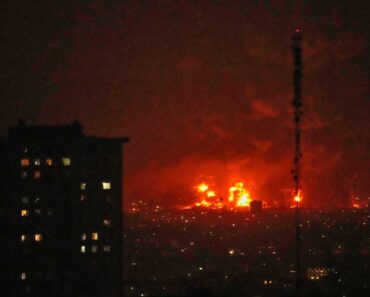
Thick black smoke filled the sky, making day seem like night. Oil-laced toxic rain fell from the air, while the central boulevard was covered in a wall of flames.
This is the scene in Tehran on Sunday after a night of Israeli airstrikes on the city’s oil facilities. It could also capture the mood of international markets as the escalating war in the Middle East sends energy prices skyrocketing and threatens a period of global economic uncertainty.
In the Iranian capital, Israeli strikes hit several oil and gas facilities in and around the city, officials said. In a video geolocated by NBC News, orange flames and belching smoke can be seen rising from the Agdasih fuel depot in the city’s northern Tajrish district.
A cloud of smoke enveloped the Iranian capital to such an extent that residents said it looked like 10 p.m. They reported that the smoke could not leave their homes and could not breathe inside.
“I’m sitting at home with a headache and a bitter taste in my mouth,” Armita, 42, told NBC News on Sunday from the inner city. “It was terrible,” said Mina, 70, who reported that even after the rain had dispersed the worst of it, “you could still smell the smoke.” NBC News is using only their first names given the tense security situation inside the country.

The Israel Defense Forces confirmed in a statement that it had bombed fuel storage facilities in Tehran on Saturday night.
Iran’s environmental protection agency warned people to stay indoors as the explosions released large amounts of toxic hydrocarbons and sulfur and nitrogen oxides.
The latter rain is “highly acidic and dangerous, causing chemical burns to the skin and severe lung damage,” it said. “If the rain contacts the skin, do not rub it, wash immediately with cold running water.”
Along with the rain, oil spewed into the air by the explosions fell on cars and people. On at least one street, oil flowed into a gutter on Kuhser Boulevard in the city’s Shahran neighborhood, according to videos geolocated by NBC News.

Iranian Foreign Ministry spokesman Esmail Bakai said the attacks were nothing short of deliberate chemical warfare.
“Invaders are releasing hazardous materials and toxic materials into the air, poisoning civilians, ravaging the environment and endangering lives on a massive scale,” Bakai wrote in X.
Tehran has been the epicenter of the war, with strikes by the United States and Israel shaking windows and giving residents sleepless nights. Some stand on the roof to watch the incoming attacks.
As the sky filled with black smoke on Sunday, security forces directed traffic wearing special coats and masks to protect themselves.
The attacks, carried out by the Israeli military, may show “the risk appetite is different in the US and Israel in terms of mission,” according to Michael Stephens, senior fellow at the Royal United Services Institute, a London-based think tank.
It’s been a recurring theme throughout the conflict, he said: “different U.S. and Israeli timelines, mission goals and objectives, and a lack of alignment” about the risks they’re prepared to take.
The White House did not immediately respond to NBC News’ request for comment.
But Agnes Callamard, secretary-general of Amnesty International, questioned whether the refineries were legitimate military targets and whether the Israeli military had taken “all feasible precautions to prevent collateral damage to civilians”.
“Incidental harm to civilians, including the release of toxic material, indicates that too few precautions were taken, and that the incidental harm to civilians is disproportionate,” he said in a text message on Monday.
The hellish scenes in Tehran are symbolic of the direct link between this war, energy infrastructure and global markets.

Iran has the third largest proven oil reserves in the world and the conflict has already had serious consequences. Iran is blocking the vital Strait of Hormuz and attacking oil facilities across the Middle East in a campaign of deadly retaliation that will hit global supplies of oil and gas.
Arab officials told NBC News that Iran’s tactic is to raise oil prices in hopes of creating pressure for a ceasefire.
On Sunday, oil prices crossed $100 for the first time since July 2022, a spike from Russia’s invasion of Ukraine months ago.
US crude oil futures rose more than 25%, at one point reaching around $115 per barrel, while Brent, the international benchmark, jumped more than 20% to $110 per barrel.
In early trading on Monday morning, both indices fell slightly.
But Mohammad Khalibaf, the speaker of Iran’s parliament, warned that prices could rise above $100 in the coming days.

“The economic consequences of this war will spill over into infrastructure in the region and around the world,” he was quoted as saying by the semi-official ISNA news agency.
According to Greg Brew, senior analyst at the Eurasia Group think tank, oil markets have managed for months to absorb the pressure built up by the Trump administration’s foreign policy actions. That ranged from allowing Russia to strike against Ukraine by bombing terminals and tankers to the US blockade of Venezuela.
“For months, these managers have pushed the envelope on what oil markets can absorb,” he wrote in X. “Every time he managed to land a blow without causing a shock, he became braver.” That “increased the chances that they would overreach and make a real disaster. Lo and behold,” he said.