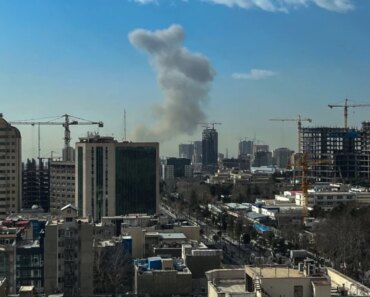
The Iran war has already driven up energy prices globally, with crude prices crossing US$100 a barrel, but some experts are warning that the pain could soon be felt in the grocery aisle.

While a relatively small portion of Canada’s food imports move through the Strait of Hormuz, where traffic has virtually ground to a halt amid the war, University of Toronto professor and supply chain expert Andre Cyr says soaring oil prices are affecting food prices in Canada.
“Energy is in everything. You have to transport food from one place to another, you have to put fuel in those ships. We’re going to start seeing some increase in food prices, because transportation costs are going to go up,” he said.
Continued pressure on oil prices means Canadians will pay 10-15 per cent more at the grocery store by the end of this month, Cyr added.
“It affects freight costs,” he said.
The longer the crisis continues, the harder it will be to ship anything anywhere, says University of Guelph food economist Mike Von Masso.
“If it takes more days to ship goods, we may see an increase in freight or at least a delay in freight. That supply chain disruption could have some ripple effects beyond products moving through the Strait of Hormuz,” he said.
In the short term, Canadians may start paying more for certain types of rice at the grocery store.
“There are certain individual products — such as Indian basmati rice — that could be slowed down or redirected and that would increase the price (for Canadians),” von Masso said.
The more immediate impact will be on food prices in Europe and the Middle East, which receive a significant amount of food shipments through the Strait of Hormuz, he said.

Get breaking national news
For news that impacts Canada and around the world, sign up to get breaking news alerts delivered directly to you as they happen.
Reuters reported that as of last week, nearly 400,000 metric tons of Indian basmati rice were backed up at ports and in transit, and trade officials said export deals had dried up as freight rates doubled after the US and Israel attacked Iran on February 28.
India is the world’s largest exporter of fragrant, premium basmati rice, with buyers in the Middle East, including Saudi Arabia, Iran and the United Arab Emirates, accounting for more than half of its shipments.

“Around 200,000 tonnes of basmati rice is stuck in transit and an equal amount is stuck in Indian ports as the war disrupts shipping routes across the Middle East,” Satish Goel, president of the All India Rice Exporters Association, told Reuters.
Exporters have already moved stocks to ports, but cannot ship to the Middle East due to rising container freight costs and no alternative market can absorb the volume, Goel said.
In 2023, when India limited rice shipments to control domestic prices, it affected food prices globally.
According to the 2022 report, two-thirds of the world’s calories will come from four major foods: wheat, rice, corn and soybeans. At least 72 percent of these crops are grown in just five countries: China, the United States, India, Brazil, and Argentina.
This raises fears of global food insecurity when a critical channel like the Strait of Hormuz is choked.
Fear of long term inflation
US President Donald Trump has said the war will last four to five weeks, possibly longer. Cyr said a protracted conflict that could see oil prices rise further would be “devastating” for food prices.
High oil prices are already causing inflationary pressures around the world.
“Everything is under pressure right now,” he said.
“I would say it’s devastating in the long term because in the short term, yes, we’ll see some increase in oil prices and so on. In the long term, everything is going to go up,” he said.
Regardless of how long the crisis continues, the uncertainty is bad for pocketbooks, von Masso said.
“Even if the fight stops overnight, I think there will still be significant uncertainty regarding oil movement and oil prices,” he said.
– with files from Reuters
© 2026 Global News, a division of Corus Entertainment Inc.
(tags to translate)Iran