As a teenager, I loved reading my horoscope in gossip magazines. But even then my friends and I knew it was nonsense. For us, this was a fun pastime for bored teenagers. So I was surprised when my hairdresser recently asked me about my zodiac sign. When I shared my opinion on astrology and horoscopes, she simply replied, “Typical Taurus.”
Astrology is currently experiencing a remarkable renaissance – especially on social media, where posts about “Gemini”, “Leos” and “Virgo Rising” are everywhere. The trend may partly reflect how deeply people want to identify with personality types and in the process gain some insight into an uncertain future. And perhaps surprisingly, many astrology posts come from people who consider themselves scientifically minded.
How can that be? Today, modern science and astrology stand in stark contrast to each other. There is no evidence that your sign actually affects your daily life. Nevertheless, the origin of horoscopes is not entirely unscientific. It is actually a story that begins with careful observation of the cosmos and the creation of a calendar system thousands of years ago in the Middle East.
On supporting science journalism
If you like this article, please consider supporting our award-winning journalism by subscribes. By purchasing a subscription, you help secure the future of impactful stories about the discoveries and ideas that shape our world today.
What exactly are zodiac signs?
Considered the basis of modern astrology by many people, the zodiac signs are based on 12 constellations: Aries, Taurus, Gemini, Cancer, Leo, Virgo, Libra, Scorpio, Sagittarius, Capricorn, Aquarius and Pisces. These are by no means the only constellations visible in the night sky. In 1922, the International Astronomical Union (IAU) officially recognized 88 constellations, including those associated with the zodiac and other famous examples such as the Big Dipper.
Thousands of years before the IAU’s founding, people in ancient Mesopotamia pondered the constellations. They assigned particular importance to those that lay in the apparent path of the sun, also known as the ecliptic.
Thanks to Mesopotamia’s geographical location, it has historically had very consistent weather patterns. There is a rainy season and a dry season. The wind direction can also be predicted depending on the season. And because certain constellations are visible in the night sky at different times of the year, people may have believed there was a connection between the stars and these seasons.
This idea is not such a stretch: after all, scientists today recognize that the sun and moon actually influence earthly events such as the weather and the tides. But distant stars, which we will discuss later, are another story.
Towards the end of the fifth century BCE, Babylonian astronomers divided the ecliptic into 12 equal parts of 30 degrees each, analogous to their calendar’s 12 months of 30 days each. In doing so, they developed the first known astronomical coordinate system. They assigned each section a constellation located in the night sky along the ecliptic at that time of year.
Then astrology began. The zodiac signs and their associated superstitions spread from Mesopotamia to Greece and Rome and eventually became part of European tradition.
Times change – and so do zodiac signs
In retrospect, it doesn’t seem so far-fetched that people in antiquity or the Middle Ages believed that constellations affected us. What I don’t understand is how this belief has persisted to this day.
We now know much more about astronomy, physics and celestial mechanics. For example, scientists have long understood that constellations are composed of objects that are sometimes very far apart and have no connection to each other except that they appear close together from our vantage point here on Earth.
Furthermore, their distance from Earth is so great that – unlike the Moon or the Sun – they cannot actually affect us or our planet. Stars are giant fusion reactors light years away that do not shape our personalities or life events.
If you’re reading this article, I’m assuming you don’t believe in astrology. But if you find yourself talking to someone hooked on horoscopes, here are three science-based points to bring up:
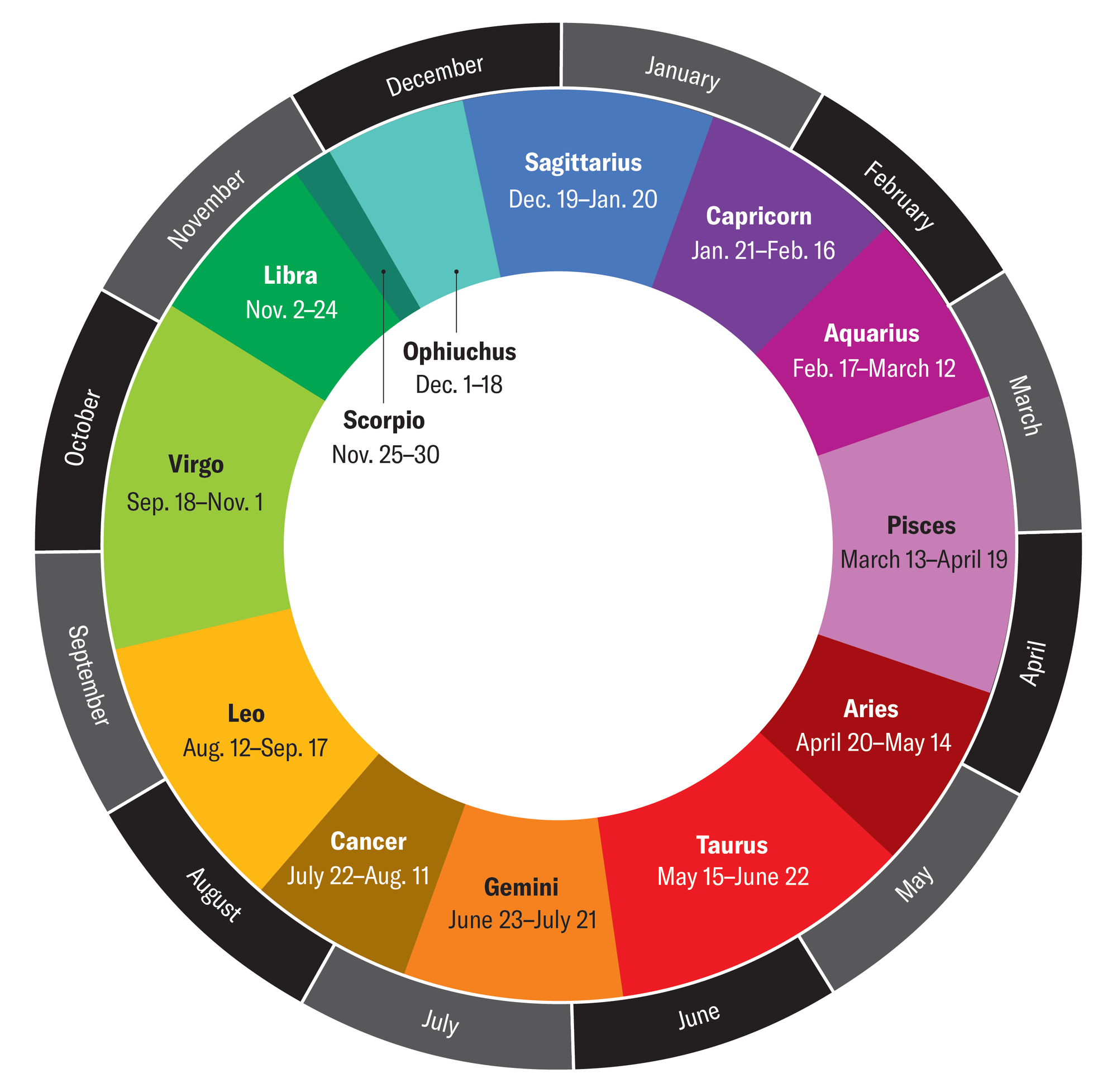
There are actually 13 zodiac signs. If you look at the constellations along the ecliptic, you will find not 12, but 13 of them in a year. Ophiuchus, the serpent bearer, was forgotten. Or rather, it was probably intentionally left out of the list because it did not fit into the Babylonian system of 12 months.
Not every zodiac sign corresponds to a month. The Sun passes through the boundaries of the zodiac signs for different lengths of time as it moves along the ecliptic. For example, the Sun only passes through the boundaries of the constellation Scorpius for six to seven days, while it takes 44 to 45 days to travel through the boundaries of the much larger constellation Virgo.
The zodiac signs change over time. More precisely, the Earth’s axis of rotation performs a wobbly motion like a spinning top, a phenomenon known as precession. This movement shifts which constellations appear in the ecliptic at which time of year. While the constellation Aries was visible in the ecliptic from March 21, according to Babylonian time, today the constellation Pisces appears on that day instead.
Still determined to find your star sign?
A scientifically correct zodiac system exists. In it, each constellation is placed in the ecliptic in modern times.
Amanda Montañez; Source: “The Signs and Constellations of the Zodiac,” by Jeremy B. Tatum, i Journal of the Royal Society of CanadaVol. 103, No. 3; June 2010 (data)
This is quite different from the system still used for astrology today. But don’t worry, Scientific American will not print horoscopes based on the corrected zodiac sign – except perhaps as a joke.
This article originally appeared in Spectrum der Wissenschaft and was reproduced with permission. It was translated from the original German version with the help of artificial intelligence and reviewed by our editors.