President Donald Trump said Saturday that the United States and Latin American countries are uniting to combat violent cartels as his administration seeks to demonstrate that it remains committed to sharpening the focus of American foreign policy in the Western Hemisphere, even as it faces five-alarm crises around the world.
Trump encouraged regional leaders gathered at his Miami-area golf club to take military action against drug cartels and transnational gangs that he said represent an “unacceptable threat” to the hemisphere’s national security.
“The only way to defeat these enemies is to unleash the power of our armies,” Trump said. “We have to use our army. You have to use your army.” Citing the U.S.-led coalition that confronted the Islamic State group in the Middle East, the Republican president said, “Now we must do the same to root out the cartels at home.”
The meeting, which the White House called the “Shield of the Americas” summit, came just two months after Trump ordered a bold U.S. military operation to capture then-Venezuelan President Nicolás Maduro and bring him and his wife to the United States to face drug conspiracy charges.
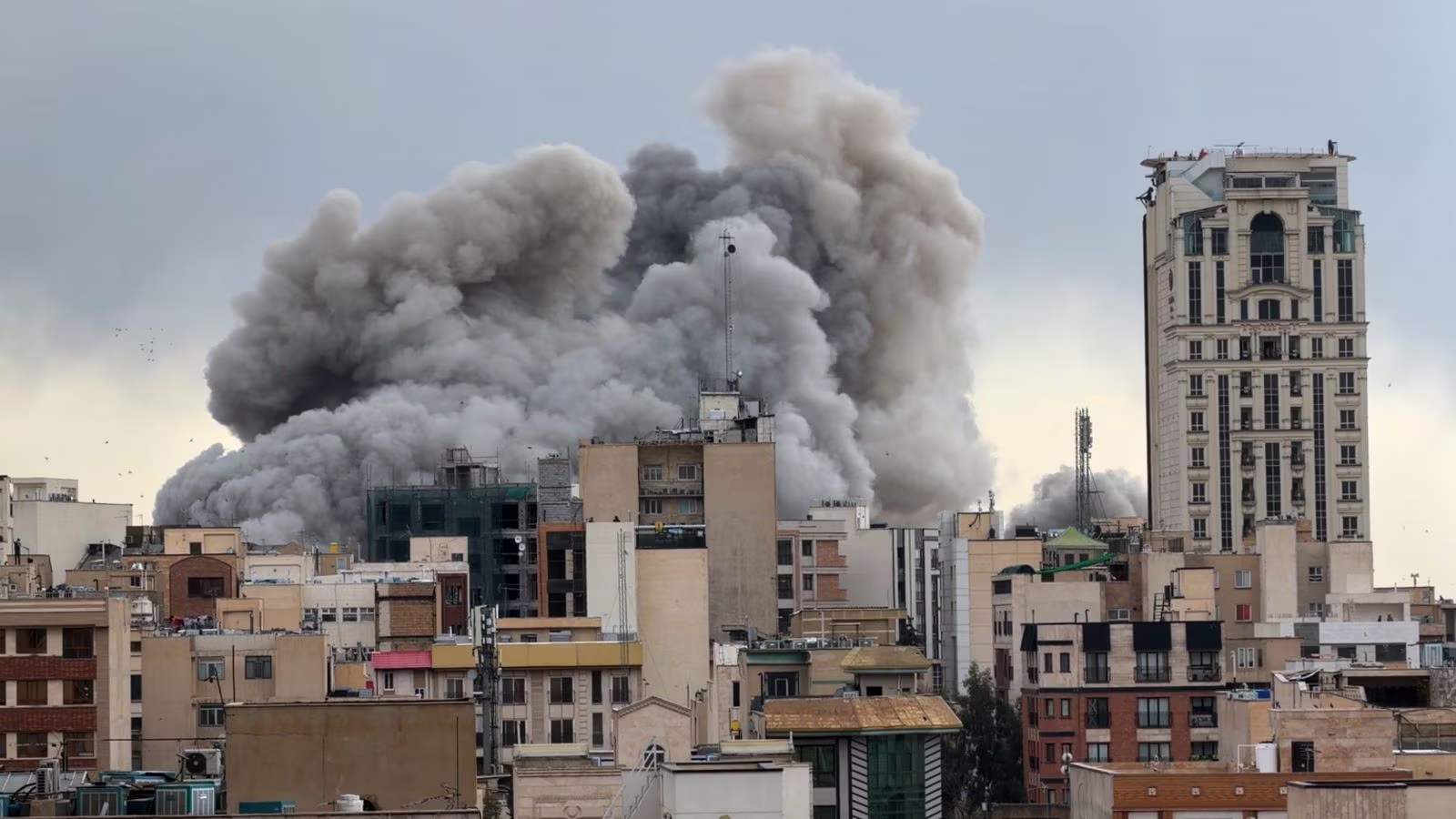
Even more serious is Trump’s decision to launch a war against Iran with Israel a week ago, a conflict that has left hundreds dead, convulsed global markets and disrupted the entire Middle East.
Trump’s time with Latin American leaders was limited: he then left for Dover Air Force Base, Delaware, to be present for the dignified transfer of the six American soldiers killed in a drone attack on a command center in Kuwait, a day after the United States and Israel launched their military campaign against Iran.
Trump called the American deaths a “very sad situation” and praised the fallen troops as “great heroes.”
With the summit, Trump intended to focus attention on the Western Hemisphere, at least for a moment. He has pledged to reassert American dominance in the region and roll back what he sees as years of Chinese economic encroachment on America’s backyard.
Trump also said the United States would focus its attention on Cuba after the war with Iran and suggested his administration would reach a deal with Havana, underscoring Washington’s increasingly aggressive stance against the island’s communist leadership. “Big changes will soon take place in Cuba,” he said, adding that “they are at the end of the road.”
Cuban officials have said on several occasions that they were open to dialogue with the United States as long as it was based on respect for Cuban sovereignty, but they have never confirmed that such talks were taking place.
who was there
Leaders from Argentina, Bolivia, Chile, Costa Rica, the Dominican Republic, Ecuador, El Salvador, Guyana, Honduras, Panama, Paraguay and Trinidad and Tobago joined the Republican president at Trump National Doral Miami, a golf resort where he will also host the Group of 20 summit later this year.
The idea of a summit of like-minded conservatives from across the hemisphere arose from the ashes of what was to be the 10th edition of the Summit of the Americas, which was scrapped during the U.S. military buildup off the coast of Venezuela last year.
The host Dominican Republic, under pressure from the White House, had prohibited Cuba, Nicaragua and Venezuela from attending the regional meeting. But after leftist leaders in Colombia and Mexico threatened to walk out in protest (and without Trump committing to attend), Dominican Republic President Luis Abinader decided at the last minute to postpone the event, citing “deep differences” in the region.
The Shield of the Americas moniker was intended to speak to Trump’s vision of an “America First” foreign policy toward the region that leverages U.S. military and intelligence assets not seen in the area since the end of the Cold War.
To that end, Ecuador and the United States carried out military operations this week against organized crime groups in the South American country. Ecuadorian and US security forces attacked a shelter belonging to the illegal Colombian armed group Comandos de la Frontera in the Ecuadorian Amazon this Friday, authorities reported.
This joint fight against drug traffickers “is just the beginning,” said the president of Ecuador, Daniel Noboa.
It should be noted that the two dominant powers of the region – Brazil and Mexico – were absent from the summit, as well as Colombia, for a long time the axis of the United States’ anti-narcotics strategy in the region.
Trump complained that Mexico is the “epicenter of cartel violence” and that drug lords “orchestrate much of the bloodshed and chaos in this hemisphere.”
“Cartels are ruling Mexico,” Trump said. “We can’t allow that. Too close to us. Too close to you.”
China’s challenge
Trump did not mention his administration’s insistence that countering Chinese influence in the hemisphere is a top priority of his second term.
His national security strategy promotes the “Trump Corollary” of the 19th century Monroe Doctrine, which had sought to prohibit European incursions into the Americas, targeting infrastructure projects, military cooperation and Chinese investments in the region’s resource industries.
The first demonstration of a more forceful approach was Trump’s pressure on Panama to withdraw from China’s Belt and Road Initiative and review long-term port contracts held by a Hong Kong-based company amid US threats to retake the Panama Canal.
More recently, the US capture of Maduro and Trump’s promise to “govern” Venezuela threaten to disrupt oil shipments to China – the largest buyer of Venezuelan crude before the attack – and bring one of Beijing’s closest allies in the region into Washington’s orbit. Trump is scheduled to travel to Beijing later this month to meet with Chinese President Xi Jinping.
For many countries, Chinese trade-focused diplomacy fills a critical financial gap in a region with major development challenges ranging from poverty reduction to infrastructure bottlenecks. In contrast, Trump has been cutting foreign assistance to the region while rewarding countries that lined up behind his crackdown on immigration, a policy widely unpopular across the hemisphere.
Secretary of State Marco Rubio hosted the leaders for a working lunch after Trump left for the event in Delaware. The lunch gave Kristi Noem, whom Trump fired as Homeland Security secretary on Thursday, a chance to debut her new role as special envoy for the “Americas Shield.”
“We want our hemisphere to be more secure, more sovereign and more prosperous,” Noem told the leaders.
Durkin Richer reported from Washington. Associated Press writer Gabriela Molina in Quito, Ecuador, contributed to this report.