DUBAI, United Arab Emirates (AP) — Iran’s president apologized Saturday for attacks on regional nations even as his missiles and drones flew toward Gulf Arab states, suggesting Tehran’s political leadership cannot exercise full command over Iran’s armed forces. He rejected US President Donald Trump’s repeated demands for surrender.

President Masoud Pezheshkian, whose Feb. 28 airstrike killed Supreme Leader Ayatollah Ali Khamenei, a member of the tripartite leadership council that oversees Iran, delivered a defiant message exactly one week into the conflict, which has spread across the region, crippled global markets and aviation, and Iran’s own leadership.
The message, hastily filmed without professional broadcasting equipment, again underscores the limited power the theocracy’s leaders wield over its paramilitary Revolutionary Guard, which controls ballistic missiles aimed at Israel and others. It answered only to Khamenei and is now picking its own targets as the conflict widens.
Shortly after Pezheshkian’s message, Trump warned in a social media post on Saturday that more Iranian officials would be targeted in war: “Iran is going to get hit hard today!” In his comments on his Truth Social website, Trump noted an apology from Pezheshkian.
“Ultimate destruction and certain death due to Iran’s bad behavior is under serious consideration, areas and people groups not considered targets until this moment,” Trump wrote without elaborating.
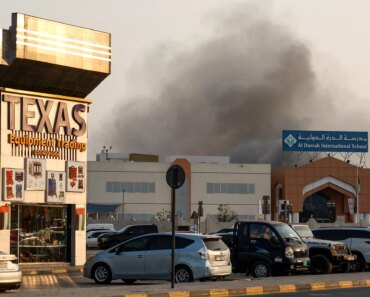
As Iran’s president sought to calm growing Gulf Arab anger over the attack, just hours earlier a wave of missiles and drones disrupted flights at Dubai International Airport, targeted a key Saudi oil facility and sent people fleeing for cover multiple times in Bahrain.
Pezheshkian continued to criticize Trump’s call for Iran’s unconditional surrender to the United States.
“A dream he should take to his grave,” he said.
A statement from Pezheshkian said on Saturday that Iran’s three-member leadership council was in contact with the armed forces about the attack.
“I must apologize to the neighboring countries that were attacked by Iran on my behalf,” the president said. “Henceforth, they should not attack neighboring countries or launch missiles unless those countries attack us. I think we should resolve this through diplomacy.”
General Abolfazal Shekarchi, a spokesman for Iran’s armed forces, added to the confusion by saying after Pezheshkian that Tehran “did not strike countries that did not give America space to invade our country.”
Related videos

American strikes are not coming from the Gulf Arab states now under attack.

Get daily national news
Get the day’s top news, political, economic and current affairs headlines delivered to your inbox once a day.
In response to the ongoing political turmoil, on Saturday, Iran’s top cleric, Ayatollah Nasser Makarem Shirazi, urged the country’s assembly of experts to act quickly to name a new supreme leader. 88-Buildings belonging to the cleric panel were hit by airstrikes in the war, likely slowing down any meeting of the group.
“Timely realization of this important issue will lead to national empowerment and better organization of affairs,” Shirazi said in a statement.
The US says more intense bombing will follow.
There is no foreseeable end to the struggle. The Trump administration approved a new $151 million arms sale to Israel after Trump said there would be no talks without Iran’s “unconditional surrender” and US officials warned of an impending bombing campaign.
Iran’s UN ambassador said the country would “take all necessary measures” to defend itself.
Associated Press video showed explosions flashing and smoke rising in western Tehran, as Israel said it launched a wide range of strikes.
The US and Israel have been battered by attacks targeting Iran’s military capabilities, leadership and nuclear program. The stated goals and timelines of the war have changed repeatedly as the US has sometimes indicated that it is trying to topple Iran’s government or install a new leadership from within.
The fighting has killed at least 1,230 people in Iran, more than 200 in Lebanon and 11 in Israel, according to officials in those countries. Six US soldiers were killed.
Also, early Saturday morning, incoming missiles from Iran sent people into bomb shelters across Israel and loud booms sounded in Jerusalem. There were no immediate reports of casualties from Israel’s emergency services.
As the fighting spreads, Iran has hit out at Gulf nations
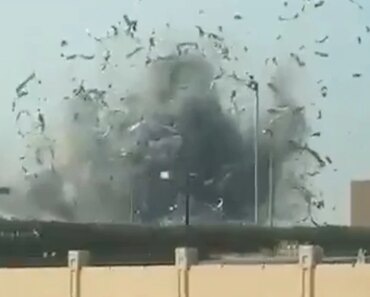
In a sign of the broader nature of the conflict, sirens blared early Saturday in Bahrain as Iranian strikes targeted the island kingdom. And Saudi Arabia said it had destroyed drones aimed at its vast Shaiba oil field and shot down a ballistic missile fired at Prince Sultan Air Base, which hosts US troops.
In Dubai, several explosions were heard on Saturday morning and the government said it had activated air defenses. Passengers waiting for flights at Dubai International Airport descended into train tunnels at the sprawling airfield after an alarm sounded.
That morning, long-haul carrier Emirates said “all flights to and from Dubai have been suspended until further notice”. Shortly after, the decision was reversed and Emirates said the airline would resume operations.


An Iranian Navy ship has landed in India
An Iranian naval vessel landed in India on Saturday, the Indian foreign minister said.
Subrahmanyam Jaishankar said the IRIS Lavan was anchored in the southern city of Kochi after India gave permission when the vessel reported “having problems” on Sunday. News agency Press Trust of India, citing unnamed “government sources”, had earlier reported that the ship had been in Kochi since Wednesday.
“I think this is humanitarian work,” Jaishankar said.
A US submarine sank the Iranian warship IRIS Dena off the coast of Sri Lanka on Wednesday. Another Iranian ship, the IRIS Bushehr, sought help from Sri Lanka, where more than 200 sailors were being brought ashore.
Jaishankar said the ships had previously participated in naval exercises organized by India, but after the war broke out they were “caught on the wrong side of events”.
Qatar warns war could collapse economy
Qatar’s energy minister, Saad al-Kaabi, warned in an interview with the Financial Times that the war could “bring the world economy down,” predicting a widespread shutdown that would send Gulf energy exports to $150 a barrel.
Benchmark US crude rose above $90 a barrel on Friday for the first time in two years.
Writing for the Qatar-funded satellite news network Al Jazeera, one regional analyst warned that Iran was making a “strategic miscalculation of historic proportions”.
Sultan al-Khulaifi, a senior researcher at the Center for Conflict and Humanitarian Studies, wrote: “By spreading the conflict to the Gulf, Tehran is doing exactly what Israel cannot do alone: diverting the war from the Israeli-Iranian axis and turning it into a confrontation between Iran and its Arabian counterpart.”
Al Jazeera, a pan-Arab satellite news network owned and funded by the Qatari government, has previously been used to indicate Doha’s views on regional issues.
Fighting with Israeli forces reported in East Lebanon
The Iran-backed militant group Hezbollah clashed with Israeli forces after its fighters landed in the mountains of eastern Lebanon late on Friday.
Lebanon’s health ministry said 41 people were killed and 40 wounded in Israeli airstrikes on the eastern town of Nabi Chit and nearby areas. The Lebanese army said three of its soldiers were among the dead. The area witnessed intense clashes and airstrikes till Saturday night after Israeli forces landed there and clashed with local gunmen.
Israel did not acknowledge the fighting and its military did not immediately respond to requests for comment.
Israel has carried out waves of airstrikes on Beirut’s southern suburbs, where Hezbollah has a large presence but is home to hundreds of thousands of civilians.
Lebanon’s health ministry said more than 200 people had been killed and more than 800 wounded by Israeli strikes since Monday.
Hezbollah on Saturday warned residents of the northern Israeli towns of Kiryat Shmona and Nahari to evacuate immediately. Shortly after, warning sirens sounded near Nahariya, Kiryat Shmona and Tiberias.
Israel’s army has said it will not evacuate Israelis, instead protecting them by stationing soldiers between villages and Hezbollah and building up its presence in southern Lebanon, where its forces operate.
——
Mednik reported from Tel Aviv, Israel, and Magdi from Cairo, Egypt. Associated Press journalists Bassem Mrou in Beirut, Natalie Meltzer in Nahariya, Israel and Amar Madhani in Doral, Florida contributed reporting.
(tags to translate)Iran