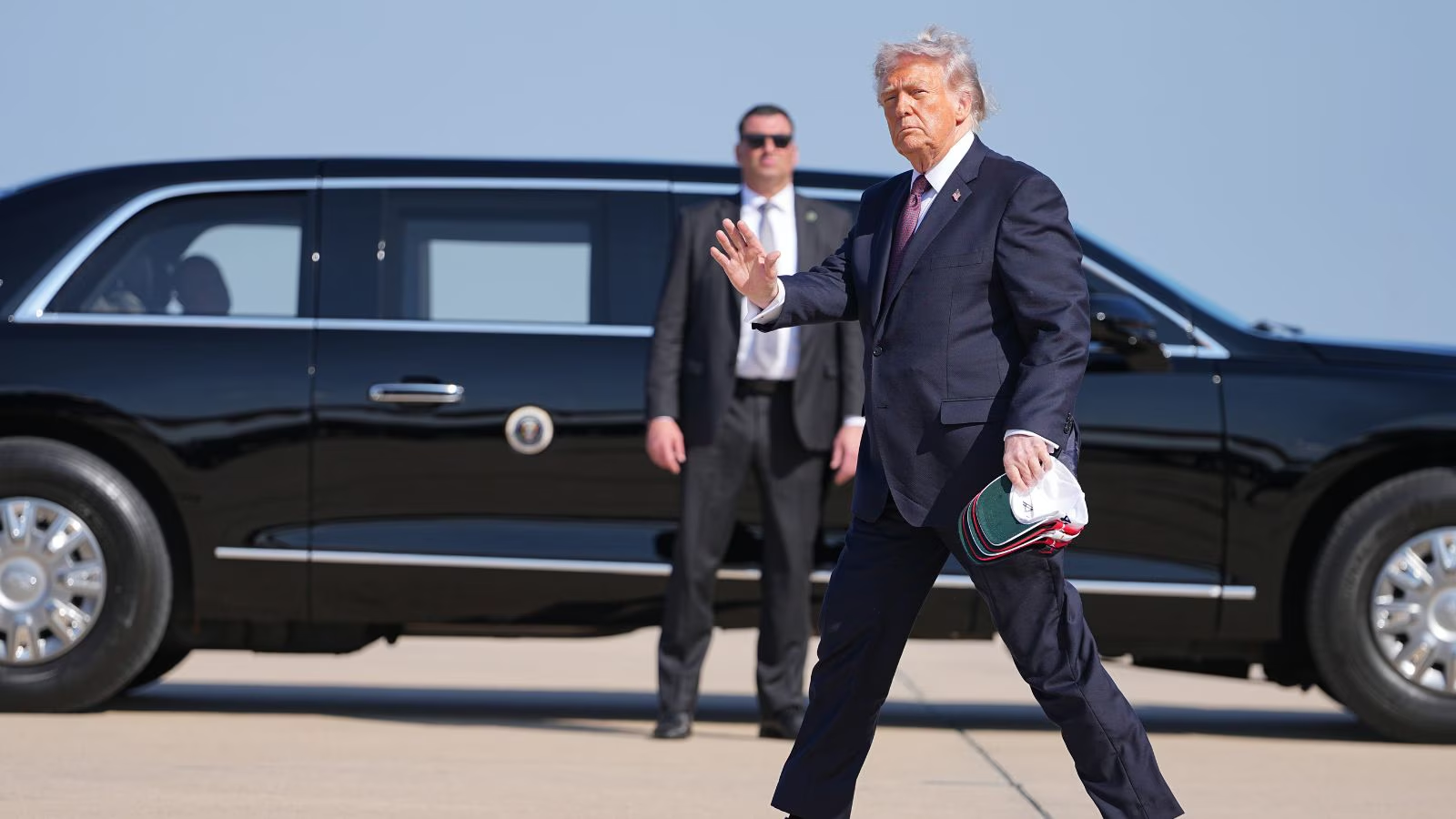
From its attacks on Iran to its global tariffs, the United States has used military force and economic threats to impose its will. China’s top leader, Xi Jinping, is preparing for this era of dangerous rivalry by investing resources in artificial intelligence, quantum computing and other strategic technologies, while expanding the country’s military.
Details of Xi’s ambitious plan for the next five years of China’s technological rise were released Thursday at a meeting of the national legislature in Beijing. The approach reflects Xi’s view that competition with the United States will ultimately be decided by technological innovation that drives economic, military and cultural strength.
The plan calls for fostering new drivers of economic growth in emerging industries such as quantum computing, biomanufacturing, hydrogen and fusion energy, brain-computer interfaces, embodied intelligence and 6G mobile networks. “In the midst of fierce international competition, we must win the strategic initiative,” the plan said.
As China’s relationship with the United States has deteriorated, threatening Beijing’s access to American technology, Beijing’s leaders see achieving self-sufficiency as increasingly urgent. Xi himself said in October that China should “seize this window of opportunity to consolidate and expand our advantages.”
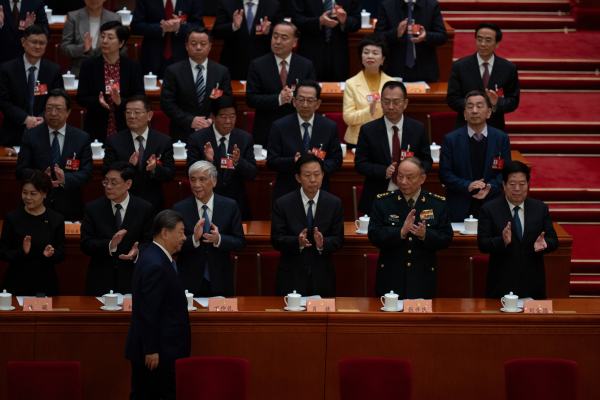 Chinese President Xi Jinping arrives at the opening of the Chinese People’s Political Consultative Conference (CPPCC) at the Great Hall of the People in Beijing, China, Wednesday, March 4, 2026. (AP Photo/Ng Han Guan)
Even as Xi prepares to host President Donald Trump in early April to try to extend a trade truce, he is doubling down on his strategy to ensure China’s economy and military are not vulnerable to being deprived of advanced semiconductors and other critical technologies from the West.
“Chinese leaders believe Washington will continue to try to limit China’s technological development,” said Gerard DiPippo, associate director of the China Research Center at Rand, a research organization. “That belief underpins the urgency behind self-sufficiency efforts.”
Story continues below this ad.
The plan said China would “continuously improve” the country’s competitive advantage in rare earths, whose exports Beijing had restricted in response to the US tariffs, before both sides agreed to suspend retaliatory measures. Furthermore, the plan also called for strengthening China’s ability to counter sanctions and foreign interference.
The ongoing U.S. and Israeli attacks on Iran and the U.S. attack on Venezuela in January, which led to the capture of President Nicolás Maduro and the takeover of that country’s oil industry, may have deepened Chinese leaders’ wariness toward Trump, said Daniel R. Russel, former undersecretary of state for East Asian and Pacific affairs.
“Donald Trump may think he is demonstrating military force that will intimidate Beijing,” said Russel, a distinguished fellow at the Asia Society Policy Institute. “But its actions in Venezuela and Iran are more likely to boost Beijing’s determination to strengthen its ability to resist the United States and reinforce its alignment with Russia.”
To strengthen China against perceived threats, Xi is also committed to continuing to strengthen the People’s Liberation Army forces, even after gutting its high command with purges that have removed its top generals and left key leadership positions vacant.
Story continues below this ad.
The government said Thursday it would increase its military spending by 7% this year relative to last year, bringing its outlay to about $277 billion, about a third of the Trump administration’s proposed military spending for fiscal 2026.
But Xi has indicated that long-term victory depends less on raw spending and more on the country’s ability to dominate the industries of the future. The new plan calls for technological advances, including in drug development, as well as deep-sea mining and fusion energy research. The term “artificial intelligence” is cited more than 50 times.
In areas such as artificial intelligence, robotics, quantum computing and 6G, “I think there is a strong sense among Chinese policymakers that they can get a lead on the United States,” said Kyle Chan, a fellow at the Brookings Institution who focuses on China’s industrial policies.
The goals laid out in the plan are like “huge flashing lights guiding central bureaucrats, local officials, national companies and multinationals on the country’s priorities for the next five years,” said Scott Kennedy, a researcher at the Center for Strategic and International Studies in Washington and author of a new study on China’s push toward technological advances.
Story continues below this ad.
“Policymakers will need to develop more specific policies to achieve these goals, and companies will need to align their strategies, at least in name, toward these goals,” Kennedy wrote in emailed comments.
The plan calls for investment to also flow into upgrading China’s advanced industries, such as industrial robots and pharmaceuticals. And while Xi sets the national vision, execution often falls to local officials across the country, leading to a surge in production that is likely to spill over China’s borders, further straining relations with trading partners.
“As long as industrial policies are implemented with little coordination between local levels, overcapacity will remain a feature,” said Zongyuan Zoe Liu, a fellow at the Council on Foreign Relations who studies Chinese economic strategy. “This means that Chinese producers will continue to find buyers around the world. The tactics are a combination of exporting and moving production capacity abroad.”