His government is benefiting from higher oil and gas prices that could ease Russia’s economic woes. It is taking advantage of the country’s geopolitical weight as an alternative energy provider. And it may win on its own battlefield if the Middle East conflict strains the supply of U.S.-made air defenses to Ukraine.
But Putin is also grappling with the arrival of a new world of unbridled American power under President Donald Trump, who is reining in Russia’s global influence and ripping up Moscow’s playbook for foreign partnerships.
For years, Putin supported anti-American authoritarian governments in Iran, Venezuela and Cuba, unconcerned that Washington would use its overwhelming military power to kill, capture or oust their leaders. That has now changed, as Trump has demonstrated his willingness to ignore international norms and pursue foreign adventures by fully exploiting Washington’s power.
Although Iran came to Russia’s aid with critical drones at the beginning of Putin’s invasion of Ukraine four years ago, Russia has stood by as the United States and Israel battered Iran’s leadership and military. Moscow has issued little more than damning statements that largely avoid naming Trump.
“It shows the limits of ‘What does it mean to be a partner with Russia?’” said Angela Stent, a Russia expert and professor emeritus at Georgetown University. He said Iran’s case was particularly serious given Tehran’s key role in helping Moscow in Ukraine.
Story continues below this ad.
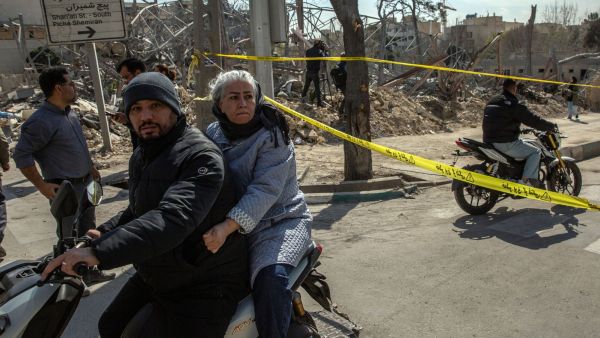 A photograph taken during a government-led press tour shows passersby in Tehran on Wednesday, March 4, 2026, inspecting the remains of a police station that was destroyed by a US-Israeli airstrike. The conflict in Iran may give Moscow a short-term economic boost and in Ukraine, but it has also demonstrated the limits of Russia’s partnerships. (Credit: Arash Khamooshi/The New York Times)
Kremlin spokesman Dmitry Peskov on Friday declined to say how Moscow was helping Iran in its time of need. A day earlier he said: “The war that is happening is not our war.”
Washington’s actions against leaders friendly to Russia have occurred at a dizzying pace.
In the last two months there was the assassination by the United States and Israel of Iran’s supreme leader, Ayatollah Ali Khamenei; the United States’ capture of President Nicolás Maduro of Venezuela; and a US economic blockade aimed at overthrowing Cuban President Miguel Díaz-Canel. In all cases, Russia has offered little visible help.
An American president who pursues foreign heads of state in their homes and offices, without congressional control, has also flipped the script on Putin, who has made his appetite for risk, his willingness to use force and unpredictability central elements of his coercive power in the world.
Story continues below this ad.
“Now he’s not the baddest guy in town,” said Bobo Lo, a Russia analyst and former Australian diplomat in Moscow.
“He is no longer able to instill fear in the way he hoped. That mantle has been passed to Trump,” Lo said. “And that’s why Putin seems, in some ways, a little pathetic.”
The reality is that there is not much Russia, already tied up in Ukraine, could have done to protect Iran except declare war on the United States or Israel, said Alexander Gabuev, director of the Carnegie Russia Eurasia Center, a research institute in Berlin.
Iran was already weakened by an economic and political crisis, the backdrop for the failures that allowed the United States and Israel to kill Khamenei in the early hours of the conflict.
Story continues below this ad.
“Given the intelligence penetration into Iran that was revealed, there was very little Russia, even in conjunction with China, could have done to undo this,” Gabuev said.
But while Putin may be holding back now, he can play a longer game. Trump has made clear that he does not necessarily intend to overthrow Russia-friendly elites in countries where he has intervened and participate in “democracy building.” That leaves open the possibility that Putin maintains ties with them.
Russia has also seen that Trump’s foreign affairs pushes during his second term can cut both ways.
Trump has asserted U.S. power in nations Putin considers his own backyard, including by hosting leaders from Central Asia and negotiating a compromise peace between Azerbaijan and Armenia. But in other cases Trump’s actions have benefited the Kremlin beyond its dreams.
Story continues below this ad.
Trump’s public confrontation in the Oval Office with Ukrainian President Volodymyr Zelenskyy last year excited Moscow. The same was true of Trump’s dismantling of USAID, which the Kremlin long viewed as a U.S. tool for foreign meddling, and the U.S. president’s attacks on Radio Free Europe/Radio Liberty.
And Trump’s threats this year to seize Greenland from Denmark threatened to break up NATO from within, furthering Putin’s long-standing goal of destroying the Western military alliance.
Putin has been hiding any public criticism of Trump as the Russian leader tries to secure what is most important to him: the desired outcome in Ukraine.
In an interview with Politico on Thursday, Trump once again targeted Zelenskyy, not Putin, as the obstacle to peace. Although Ukrainian forces took more territory than they lost in the last two weeks of February — the first such gain since 2023, according to the Institute for the Study of War — Trump repeated what he had told Zelenskyy a year ago in the Oval Office: “You don’t hold the cards.”
This article originally appeared in The New York Times.