Markets were hit by both sides on Thursday. Geopolitical tensions pushed oil to $88 a barrel, and then a bleak jobs report drove up risk assets while they were already down.
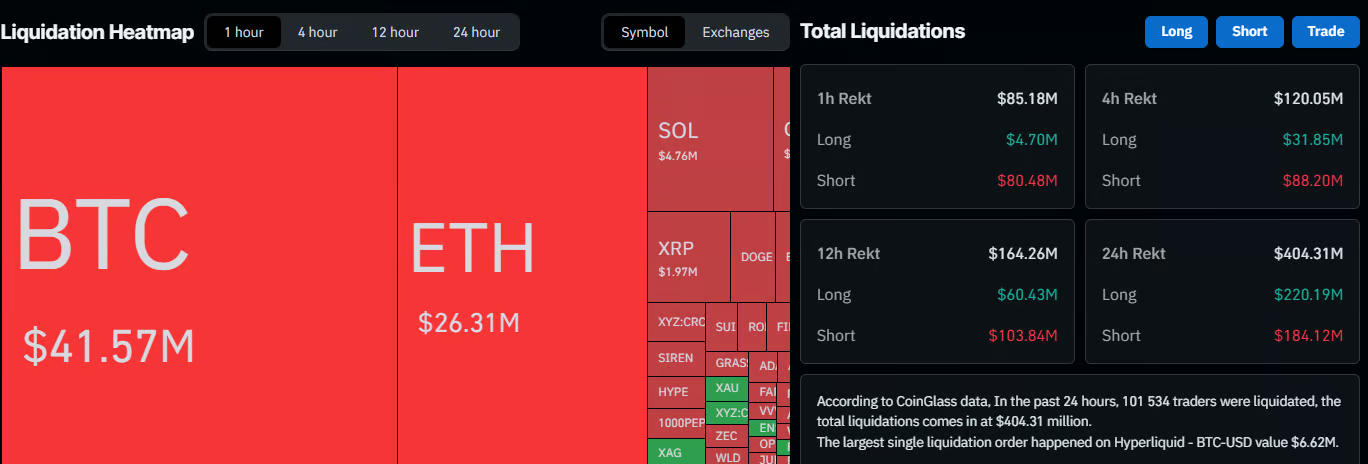
Bitcoin fell by 3.7% in 24 hours to about $69,000. Ethereum fared worse, slipping 4.2% below the psychologically important $2K level. Solana was the hardest hit among the majors, falling 5% to $85. The Fear & Greed crypto index is now at 18 – deep in “Extreme Fear” territory, barely improving from last week’s 13.
Geopolitical trigger
Former President Trump wrote on Social Truth that Iran should accept “unconditional surrender”. These two words angered oil traders.
West Texas Intermediate crude rose to $88 a barrel as the market grappled with potential disruptions to the Strait of Hormuz, the narrow waterway through which about 20% of the world’s oil supply passes daily. Think of it as the jugular vein of the global economy, and someone just took a stab at it.
The oil price of 88 dollars is not catastrophic by historical standards. The price of crude oil in June 2022 reached 120 dollars after the Russian attack on Ukraine. But the direction is more important than the absolute level. When oil suddenly becomes a geopolitical threat rather than a demand force, it acts simultaneously as a tax on consumers and a windfall for corporate margins.
Higher energy costs feed directly into inflation expectations. And inflation expectations are one thing the Federal Reserve absolutely does not want to move in the wrong direction right now.
The job report no one wanted
If the oil shock was a left hook, employment data was a right cross.
The US economy lost 92,000 jobs last month. Wall Street had expected a gain of 59,000. It’s not just a miss—it’s 151,000 moves in the wrong direction. In English: economists predicted modest hiring, instead of significant layoffs.
To put this gap in context, it is relatively rare to lose this amount outside of recessionary periods. The last time payrolls came in was more than 150,000 below consensus during the initial shock of COVID in early 2020. This is not the case, but the comparison is not comforting either.
The combination is particularly toxic for markets. Rising oil prices indicate rising inflationary pressures, arguing against a rate cut. A decline in employment indicates that the economy is weakening, leading to lower rates. The Fed cannot solve both problems at once. This is the textbook definition of a stagflation signal, and it’s a macro scenario that gives portfolio managers nightmares.
Crypto correlation problem
Bitcoin should be a non-compliant asset. Digital gold. Hedge against this kind of macro chaos.
Instead, BTC fell behind the stock. Again. The correlation between Bitcoin and the S&P 500 remains stubbornly flat through 2024 and into 2025. When institutional money dominates the crypto cycle—through spot ETFs, treasury allocations, and brokerage desks—the asset class behaves like a high-beta tech stock rather than a tech safe haven.
The damage was widespread in the crypto market. XRP was around $1.36, showing even the broader altcoin landscape in deep red. One notable exception: U.S. Treasury-backed stablecoins, which have gained 28.9% over the past seven days, as capital has aggressively become the chain’s safest parking spot. When stablecoins are your top category, the market is basically telling you where it wants to sit.
However, there is a silver lining buried in the weekly data. Despite Thursday’s selloff, Bitcoin is still up 4% over the past seven days. This suggests that the broader trend has not fully reversed – at least not yet. Whether this will last another weekly profit or two risky trading sessions is the main question.
What this means for investors
The immediate danger is a feedback loop. Rising oil prices reduce consumer spending power, which further weakens employment and reduces spending again. Expect further downside in risk assets if Friday brings more dovish commentary as Fed officials respond to the inflation signal while ignoring weak jobs.
Especially for crypto, the $69K level for Bitcoin is worth watching closely. It is near the high of the previous period from November 2021, which many technical analysts see as a key support area. A sustained break above $67K would likely trigger a cascade of compression liquidations and could send BTC into the mid-$60K range.
Ethereum below $2k is similarly risky. This level has repeatedly been a battleground in 2025, and each test weakens the confidence of buyers. At $85, Solana is well below its 2024 high and is nearing a level that could wipe out remaining momentum traders.
The fear and greed index at 18 offers a contrarian signal. Historically, readings below 20 have preceded meaningful rallies — not immediately, but for weeks. Extreme fear tends to point to areas of surrender, where weak hands get out and sick capital accumulates. The caveat is that this only works if the macro background is stable. An 18 reading of Fear and Greed could easily turn into a 10 during a real episode of stagflation.
Investors should monitor three things in the coming days: whether oil continues to rise to $90 and above, whether the next round of economic data confirms or contradicts weak jobs, and whether Bitcoin can maintain its weekly gains. Two out of three going the wrong way significantly increases the likelihood of a wider correction.
Bottom line: The geopolitical risk and economic weakness that come together is the macro cocktail that markets hate the most. Crypto has proven once again that it trades as a risk asset during stressful events, not a hedge against them. A fear and greed index that screams “Excessive Fear” could be a buy signal or a warning signal – and which one it is depends entirely on whether the next few data points indicate this is a bad week or the start of something worse.